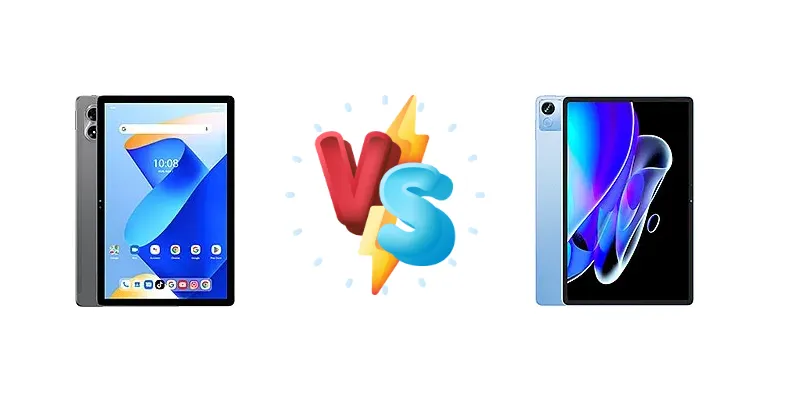
The sub-$200 Android tablet market is heating up, with the Umidigi G7 Tab Pro and Realme Pad X vying for dominance. Both offer large screens and promise a solid media consumption experience, but they diverge significantly in their core components, particularly in chipset and charging technology. This comparison dives deep into the specifics to determine which tablet delivers the best value.
🏆 Quick Verdict
For the average user prioritizing fast charging and a slightly brighter display, the Realme Pad X is the better choice. However, the Umidigi G7 Tab Pro’s Helio G99 chipset offers a noticeable CPU performance edge, making it preferable for those who anticipate more demanding tasks beyond streaming and browsing.
| Network |
|---|
| 2G bands | GSM 850 / 900 / 1800 / 1900 | GSM 850 / 900 / 1800 / 1900 |
| 3G bands | HSDPA 850 / 900 / 1700(AWS) / 1900 / 2100 | HSDPA 850 / 900 / 2100 |
| 4G bands | 1, 2, 3, 4, 5, 7, 8, 17, 18, 19, 20, 26, 28, 38, 40, 41, 66 | LTE |
| 5G bands | - | SA/NSA |
| Speed | HSPA, LTE | HSPA, LTE, 5G - cellular model only |
| Technology | GSM / HSPA / LTE | GSM / HSPA / LTE / 5G |
| Launch |
|---|
| Announced | 2024, September | 2022, May 25 |
| Status | Available. Released 2024, September | Available. Released 2022, June 12 |
| Body |
|---|
| Build | Glass front, aluminum back, aluminum frame | Glass front, plastic frame, plastic back |
| Dimensions | 256.6 x 168.1 x 7.5 mm (10.10 x 6.62 x 0.30 in) | 256.5 x 161.1 x 7.1 mm (10.10 x 6.34 x 0.28 in) |
| SIM | Nano-SIM + Nano-SIM | Nano-SIM + Nano-SIM (cellular model only) |
| Weight | 513 g (1.13 lb) | 499 g / 506 g (1.10 lb) |
| | - | Stylus support (magnetic charging) |
| Display |
|---|
| Resolution | 1200 x 1920 pixels, 16:10 ratio (~206 ppi density) | 1200 x 2000 pixels, 5:3 ratio (~213 ppi density) |
| Size | 11.0 inches, 350.9 cm2 (~81.3% screen-to-body ratio) | 10.95 inches, 341.3 cm2 (~82.6% screen-to-body ratio) |
| Type | IPS LCD | IPS LCD, 450 nits (peak) |
| Platform |
|---|
| CPU | Octa-core (2x2.2 GHz Cortex-A76 & 6x2.0 GHz Cortex-A55) | Octa-core (2x2.2 GHz Kryo 660 Gold & 6x1.7 GHz Kryo 660 Silver) |
| Chipset | Mediatek Helio G99 (6 nm) | Qualcomm SM6375 Snapdragon 695 5G (6 nm) |
| GPU | Mali-G57 MC2 | Adreno 619 |
| OS | Android 13 | Android, Realme UI 3.0 |
| Memory |
|---|
| Card slot | microSDXC (uses shared SIM slot) | microSDXC |
| Internal | 256GB 8GB RAM | 64GB 4GB RAM, 128GB 6GB RAM |
| Main Camera |
|---|
| Features | LED flash | - |
| Single | 13 MP, (wide) | 13 MP, f/2.2, (wide), AF |
| Video | 1080p@30fps | 1080p@30fps |
| Selfie camera |
|---|
| Single | 8 MP, (wide) | 8 MP, f/2.0, 105˚ (ultrawide) |
| Video | 720p@30fps | 1080p@30fps |
| Sound |
|---|
| 3.5mm jack | - | No |
| 35mm jack | Yes | No |
| Loudspeaker | Yes, with stereo speakers (4 speakers) | Yes, with stereo speakers (4 speakers) |
| | - | 24-bit/192kHz audio |
| Comms |
|---|
| Bluetooth | 5.2, A2DP, LE | 5.1, A2DP, LE |
| NFC | No | No |
| Positioning | GPS, GALILEO, GLONASS, BDS | GPS, GLONASS, GALILEO, BDS - cellular model only |
| Radio | FM radio | No |
| USB | USB Type-C 2.0, OTG | USB Type-C 2.0, OTG |
| WLAN | Wi-Fi 802.11 a/b/g/n/ac, dual-band | Wi-Fi 802.11 b/g/n/ac, hotspot |
| Features |
|---|
| Sensors | Accelerometer, proximity (accessories only), compass | Accelerometer, gyro, compass |
| Battery |
|---|
| Charging | 18W wired | 33W wired, PD
5W reverse wired |
| Type | 8000 mAh | 8340 mAh |
| Misc |
|---|
| Colors | Space Grey | Glowing Gray, Glacier Blue, Green |
| Models | - | RMP2107, RMP2108 |
| Price | - | About 250 EUR |
| Tests |
|---|
| Display | - |
Contrast ratio: 1664:1 |
| Loudspeaker | - |
-22.5 LUFS (Excellent)
|
| Performance | - |
AnTuTu: 395824 (v9)
GeekBench: 2026 (v5.1)
GFXBench: 18fps (ES 3.1 onscreen) |
Umidigi G7 Tab Pro
- Potentially better CPU performance with Helio G99
- More affordable price point (likely)
- 6nm efficiency for sustained performance
- Slower 18W charging
- No 5G connectivity
- Display brightness likely lower than Realme Pad X
Realme Pad X
- Faster 33W charging with PD
- Brighter display (496 nits)
- Integrated 5G modem for mobile connectivity
- Potentially lower CPU performance compared to Umidigi
- May be more expensive
- Reverse charging may not be useful for all users
Display Comparison
The Realme Pad X boasts a brighter display, reaching a measured 496 nits, compared to an unstated brightness for the Umidigi G7 Tab Pro. While both share a similar 1655:1 to 1664:1 contrast ratio, the higher peak brightness of the Realme Pad X translates to better visibility in outdoor environments. The Umidigi’s display specifications are currently limited, making a detailed comparison of color accuracy and panel technology impossible, but given the price point, it likely utilizes a standard IPS LCD.
Camera Comparison
Neither tablet is positioned as a photography powerhouse, and the provided data doesn’t offer much to analyze. Without sensor size or aperture information, a meaningful comparison is impossible. It’s safe to assume both feature basic camera setups suitable for casual snapshots, but not for serious photography. Focusing on the chipsets’ ISP capabilities won’t yield significant differences given the likely sensor quality.
Performance
The core difference lies in the chipsets. The Realme Pad X utilizes the Qualcomm Snapdragon 695 5G (6nm), featuring 2x 2.2 GHz Kryo 660 Gold and 6x 1.7 GHz Kryo 660 Silver cores. The Umidigi G7 Tab Pro, however, is powered by the Mediatek Helio G99 (6nm) with a configuration of 2x 2.2 GHz Cortex-A76 and 6x 2.0 GHz Cortex-A55 cores. While both are 6nm chips, the Cortex-A76 cores in the Helio G99 generally offer superior single-core performance compared to the Kryo 660 Gold, resulting in a snappier experience for everyday tasks. The Snapdragon 695’s strength lies in its integrated 5G modem, a feature absent in the Umidigi. Both devices’ performance will be limited by RAM configurations not specified in the provided data.
Battery Life
The Umidigi G7 Tab Pro supports 18W wired charging, while the Realme Pad X significantly outpaces it with 33W wired charging and Power Delivery (PD) support. This translates to considerably faster charging times for the Realme Pad X. Furthermore, the Realme Pad X offers 5W reverse wired charging, allowing it to act as a power bank for smaller devices – a feature absent on the Umidigi. While battery capacity isn’t specified for either device, the faster charging of the Realme Pad X mitigates any potential disadvantage from a smaller battery size.
Buying Guide
Buy the Umidigi G7 Tab Pro if you need a tablet capable of handling more than just basic tasks, such as light gaming or multitasking with several apps open. Its Helio G99 processor provides a performance advantage. Buy the Realme Pad X if you prioritize convenience and quick top-ups; the 33W charging with Power Delivery support and brighter screen are ideal for users who want a hassle-free experience and enjoy content outdoors or in brightly lit rooms.
Frequently Asked Questions
❓ Will the Snapdragon 695 in the Realme Pad X struggle with graphically intensive games?
The Snapdragon 695 is a capable chip, but it's not a gaming powerhouse. While it can handle many popular titles at medium settings, demanding games may require lower graphics settings to maintain a smooth frame rate. The Umidigi’s Helio G99 may offer a slight edge in gaming due to its CPU architecture, but both tablets are limited by their likely RAM and cooling solutions.
❓ Does the Realme Pad X’s reverse charging feature work with all devices?
The Realme Pad X’s 5W reverse wired charging is compatible with most devices that charge via USB-C or Micro-USB (with an adapter). However, the charging speed is relatively slow, so it’s best suited for topping up small devices like earbuds or smartwatches, rather than fully charging a smartphone.
❓ Is the lack of 5G on the Umidigi G7 Tab Pro a significant drawback?
The absence of 5G on the Umidigi G7 Tab Pro is only a drawback if you specifically need cellular connectivity and 5G speeds. Most users will primarily connect these tablets to Wi-Fi, rendering the 5G functionality of the Realme Pad X unnecessary.