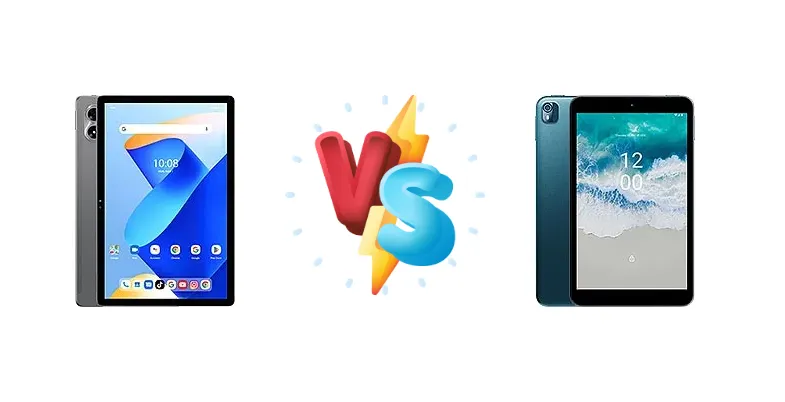
The budget tablet market is fiercely competitive, with options like the Umidigi G7 Tab Pro and Nokia T10 vying for attention. While both aim to deliver an affordable Android experience, they take distinctly different approaches to performance and features. This comparison dives deep into the core specifications to determine which tablet best suits your needs.
🏆 Quick Verdict
For most users, the Umidigi G7 Tab Pro emerges as the superior choice. Its Mediatek Helio G99 chipset provides a substantial performance boost over the Nokia T10’s Unisoc T606, making it better suited for gaming, multitasking, and demanding applications. While the Nokia T10 offers a more established brand reputation, the G7 Tab Pro delivers more bang for your buck.
| Network |
|---|
| 2G bands | GSM 850 / 900 / 1800 / 1900 | GSM 850 / 900 / 1800 / 1900 |
| 3G bands | HSDPA 850 / 900 / 1700(AWS) / 1900 / 2100 | HSDPA 850 / 900 / 2100 |
| 4G bands | 1, 2, 3, 4, 5, 7, 8, 17, 18, 19, 20, 26, 28, 38, 40, 41, 66 | 1, 3, 5, 7, 8, 20, 28, 38, 40, 41 |
| Speed | HSPA, LTE | HSPA 42.2/5.76 Mbps, LTE Cat4 150/50 Mbps |
| Technology | GSM / HSPA / LTE | GSM / HSPA / LTE |
| Launch |
|---|
| Announced | 2024, September | 2022, July 12 |
| Status | Available. Released 2024, September | Available. Released 2022, August 20 |
| Body |
|---|
| Build | Glass front, aluminum back, aluminum frame | Glass front, plastic back, plastic frame |
| Dimensions | 256.6 x 168.1 x 7.5 mm (10.10 x 6.62 x 0.30 in) | 208 x 123.2 x 9 mm (8.19 x 4.85 x 0.35 in) |
| SIM | Nano-SIM + Nano-SIM | Nano-SIM |
| Weight | 513 g (1.13 lb) | 375 g (13.23 oz) |
| | - | Splash resistant |
| Display |
|---|
| Resolution | 1200 x 1920 pixels, 16:10 ratio (~206 ppi density) | 800 x 1280 pixels, 16:10 ratio (~189 ppi density) |
| Size | 11.0 inches, 350.9 cm2 (~81.3% screen-to-body ratio) | 8.0 inches, 185.6 cm2 (~72.4% screen-to-body ratio) |
| Type | IPS LCD | IPS LCD, 360 nits (typ), 450 nits (peak) |
| Platform |
|---|
| CPU | Octa-core (2x2.2 GHz Cortex-A76 & 6x2.0 GHz Cortex-A55) | Octa-core (2x1.6 GHz Cortex-A75 & 6x1.6 GHz Cortex-A55) |
| Chipset | Mediatek Helio G99 (6 nm) | Unisoc T606 (12 nm) |
| GPU | Mali-G57 MC2 | Mali-G57 MP1 |
| OS | Android 13 | Android 12, upgradable to Android 13 |
| Memory |
|---|
| Card slot | microSDXC (uses shared SIM slot) | microSDXC |
| Internal | 256GB 8GB RAM | 32GB 3GB RAM, 64GB 4GB RAM |
| Main Camera |
|---|
| Features | LED flash | LED flash |
| Single | 13 MP, (wide) | 8 MP, 1/4.0", 1.12µm, AF |
| Video | 1080p@30fps | 1080p |
| Selfie camera |
|---|
| Single | 8 MP, (wide) | 2 MP, 1/5.0", 1.65µm |
| Video | 720p@30fps | 720p |
| Sound |
|---|
| 3.5mm jack | - | Yes |
| 35mm jack | Yes | Yes |
| Loudspeaker | Yes, with stereo speakers (4 speakers) | Yes, with stereo speakers |
| Comms |
|---|
| Bluetooth | 5.2, A2DP, LE | 5.0, A2DP, LE |
| NFC | No | No |
| Positioning | GPS, GALILEO, GLONASS, BDS | GPS, GLONASS, GALILEO |
| Radio | FM radio | No |
| USB | USB Type-C 2.0, OTG | USB Type-C 2.0, OTG |
| WLAN | Wi-Fi 802.11 a/b/g/n/ac, dual-band | Wi-Fi 802.11 a/b/g/n/ac, dual-band |
| Features |
|---|
| Sensors | Accelerometer, proximity (accessories only), compass | Accelerometer, proximity |
| Battery |
|---|
| Charging | 18W wired | 10W wired |
| Type | 8000 mAh | Li-Po 5250 mAh |
| Misc |
|---|
| Colors | Space Grey | Ocean Blue |
| Models | - | TA-1503, TA-1472, TA-1462, TA-1457 |
| Price | - | About 160 EUR |
| SAR | - | 1.19 W/kg (body) |
| SAR EU | - | 0.27 W/kg (head) 1.57 W/kg (body) |
Umidigi G7 Tab Pro
- Significantly faster processor for gaming and multitasking
- Faster 18W charging for quicker top-ups
- Potentially higher resolution display
- Less established brand reputation
- Potential for more aggressive image processing
Nokia T10
- Established brand reliability and software support
- Potentially more accurate color reproduction
- Simpler, streamlined software experience
- Slower processor struggles with demanding tasks
- Slow 10W charging
- Less responsive user experience
Display Comparison
Neither device's display specifications are provided, so a direct comparison is limited. However, given the G7 Tab Pro's focus on performance, it's reasonable to expect a higher resolution or refresh rate panel than the Nokia T10. The Nokia T10, benefiting from Nokia's brand reputation, likely prioritizes color accuracy for media consumption. Bezels are likely similar on both, targeting the budget segment. Without specific data, it's difficult to determine which offers a superior viewing experience.
Camera Comparison
Without detailed camera specifications, a direct comparison is challenging. However, given the price points, both tablets likely feature modest camera setups. It’s probable that the Umidigi G7 Tab Pro, aiming for a more feature-rich experience, might include a slightly higher resolution main sensor. Image processing will likely be more aggressive on the G7 Tab Pro, potentially resulting in more vibrant, but less natural-looking photos. The Nokia T10 will likely prioritize a more balanced and realistic image profile, consistent with Nokia’s brand image. The presence of any OIS is unlikely on either device.
Performance
The core difference lies in the chipsets. The Umidigi G7 Tab Pro’s Mediatek Helio G99 (6nm) significantly outperforms the Nokia T10’s Unisoc T606 (12nm). The 6nm process node of the G99 translates to greater power efficiency and reduced thermal throttling, allowing for sustained performance during demanding tasks. The G99’s CPU configuration – 2x2.2 GHz Cortex-A76 & 6x2.0 GHz Cortex-A55 – is notably faster than the T606’s 2x1.6 GHz Cortex-A75 & 6x1.6 GHz Cortex-A55. This means the G7 Tab Pro will handle multitasking, gaming, and app loading times with greater ease. The Unisoc T606 in the Nokia T10 is adequate for basic tasks, but will struggle with more intensive applications.
Battery Life
Battery capacity isn't specified, but the charging speeds reveal a key difference. The Umidigi G7 Tab Pro’s 18W wired charging is significantly faster than the Nokia T10’s 10W charging. This means the G7 Tab Pro will reach a full charge much quicker, minimizing downtime. While a larger battery capacity on the Nokia T10 could offset the slower charging, the G7 Tab Pro’s faster charging is a significant convenience factor for users who need to quickly top up their device.
Buying Guide
Buy the Umidigi G7 Tab Pro if you prioritize performance for gaming, streaming, or productivity tasks and need faster charging. This tablet is ideal for students, casual gamers, and anyone who wants a responsive tablet experience. Buy the Nokia T10 if you value brand reliability and a simpler, more streamlined software experience, and your usage is primarily limited to basic tasks like web browsing and video playback. It’s a good option for those who prioritize a familiar interface and long-term software support.
Frequently Asked Questions
❓ Will the Unisoc T606 in the Nokia T10 struggle with graphically intensive games like PUBG Mobile?
Yes, the Unisoc T606 is a relatively low-powered chipset. While it can run PUBG Mobile, you'll likely need to lower the graphics settings significantly to achieve a playable frame rate. Expect stuttering and lag, especially in busy scenes. The Umidigi G7 Tab Pro’s Helio G99 will provide a much smoother gaming experience.
❓ How long will it take to fully charge the Nokia T10 with its 10W charging?
With 10W charging, a full charge from 0% will likely take between 3-4 hours, depending on battery capacity. This is considerably slower than the Umidigi G7 Tab Pro’s 18W charging, which can potentially reach a full charge in around 2-2.5 hours.
❓ Is the Mediatek Helio G99 in the Umidigi G7 Tab Pro prone to overheating during extended gaming sessions?
The Helio G99’s 6nm process node helps mitigate overheating. While some heat generation is inevitable during prolonged gaming, the G99 is designed to manage thermal throttling effectively, maintaining a reasonable level of performance over extended periods. It's less likely to overheat compared to older, less efficient chipsets.