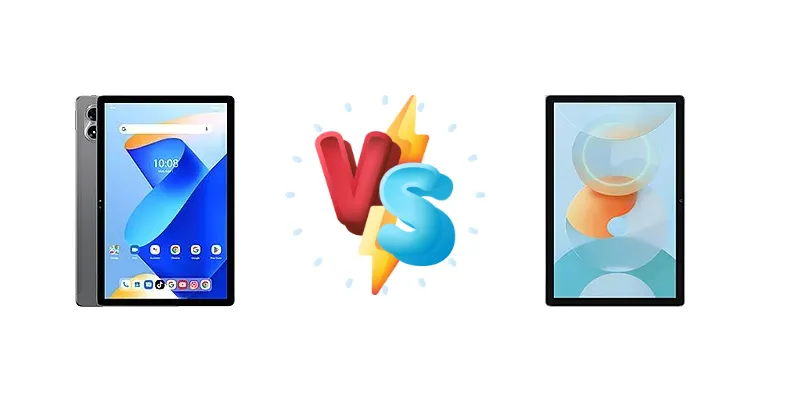
The Umidigi G7 Tab Pro and Blackview Tab 13 represent compelling options in the increasingly competitive budget tablet space. Both aim to deliver a full Android experience without breaking the bank, but they take different approaches to achieving this. The key differentiator lies in their chipsets: the Umidigi leverages the newer, more efficient MediaTek Helio G99, while the Blackview opts for the Helio G85. This comparison will dissect these differences and determine which tablet offers the best overall experience.
🏆 Quick Verdict
For the average user prioritizing performance and future-proofing, the Umidigi G7 Tab Pro emerges as the winner. Its Helio G99 chipset, built on a 6nm process, provides a noticeable performance advantage and improved efficiency over the Blackview Tab 13’s 12nm Helio G85, making it better suited for demanding tasks and sustained use.
| Network |
|---|
| 2G bands | GSM 850 / 900 / 1800 / 1900 | GSM 850 / 900 / 1800 / 1900 |
| 3G bands | HSDPA 850 / 900 / 1700(AWS) / 1900 / 2100 | HSDPA 900 / 2100 |
| 4G bands | 1, 2, 3, 4, 5, 7, 8, 17, 18, 19, 20, 26, 28, 38, 40, 41, 66 | 1, 3, 7, 8, 20, 40 |
| Speed | HSPA, LTE | HSPA, LTE |
| Technology | GSM / HSPA / LTE | GSM / HSPA / LTE |
| Launch |
|---|
| Announced | 2024, September | 2022, August 20 |
| Status | Available. Released 2024, September | Available. Released 2022, August 20 |
| Body |
|---|
| Build | Glass front, aluminum back, aluminum frame | - |
| Dimensions | 256.6 x 168.1 x 7.5 mm (10.10 x 6.62 x 0.30 in) | 238.8 x 157.6 x 7.7 mm (9.40 x 6.20 x 0.30 in) |
| SIM | Nano-SIM + Nano-SIM | Nano-SIM + Nano-SIM |
| Weight | 513 g (1.13 lb) | 450 g (0.99 lb) |
| Display |
|---|
| Resolution | 1200 x 1920 pixels, 16:10 ratio (~206 ppi density) | 1200 x 1920 pixels, 16:10 ratio (~224 ppi density) |
| Size | 11.0 inches, 350.9 cm2 (~81.3% screen-to-body ratio) | 10.1 inches, 295.8 cm2 (~78.6% screen-to-body ratio) |
| Type | IPS LCD | IPS LCD |
| Platform |
|---|
| CPU | Octa-core (2x2.2 GHz Cortex-A76 & 6x2.0 GHz Cortex-A55) | Octa-core (2x2.0 GHz Cortex-A75 & 6x1.8 GHz Cortex-A55) |
| Chipset | Mediatek Helio G99 (6 nm) | Mediatek MT6769Z Helio G85 (12 nm) |
| GPU | Mali-G57 MC2 | Mali-G52 MC2 |
| OS | Android 13 | Android 12, Doke OS_P 3.0 |
| Memory |
|---|
| Card slot | microSDXC (uses shared SIM slot) | microSDXC (uses shared SIM slot) |
| Internal | 256GB 8GB RAM | 128GB 6GB RAM |
| | - | eMMC 5.1 |
| Main Camera |
|---|
| Dual | - | 13 MP
2 MP |
| Features | LED flash | - |
| Single | 13 MP, (wide) | 8 MP |
| Video | 1080p@30fps | 1080p@30fps |
| Selfie camera |
|---|
| Single | 8 MP, (wide) | 8 MP |
| Video | 720p@30fps | Yes |
| Sound |
|---|
| 3.5mm jack | - | No |
| 35mm jack | Yes | No |
| Loudspeaker | Yes, with stereo speakers (4 speakers) | Yes, with stereo speakers |
| Comms |
|---|
| Bluetooth | 5.2, A2DP, LE | 5.0, A2DP |
| NFC | No | No |
| Positioning | GPS, GALILEO, GLONASS, BDS | GPS, GLONASS, GALILEO, BDS |
| Radio | FM radio | FM Radio |
| USB | USB Type-C 2.0, OTG | USB Type-C, OTG |
| WLAN | Wi-Fi 802.11 a/b/g/n/ac, dual-band | Wi-Fi 802.11 a/b/g/n/ac, dual-band |
| Features |
|---|
| Sensors | Accelerometer, proximity (accessories only), compass | Accelerometer |
| Battery |
|---|
| Charging | 18W wired | - |
| Type | 8000 mAh | 7280 mAh |
| Misc |
|---|
| Colors | Space Grey | Twilight Blue, Space Gray, Silver |
Umidigi G7 Tab Pro
- More powerful and efficient Helio G99 chipset
- Likely better gaming performance
- Improved power efficiency for longer battery life
- May be slightly more expensive
- Charging speed is relatively slow (18W)
Blackview Tab 13
- Potentially lower price point
- Adequate for basic tasks like browsing and video streaming
- 18W charging is standard for this price range
- Less powerful Helio G85 chipset
- Lower performance in demanding applications
- Less efficient, potentially shorter battery life
Display Comparison
While both tablets likely feature similar LCD panels (data unavailable), the underlying performance of the chipsets will impact the smoothness of scrolling and animations. The G99 in the Umidigi G7 Tab Pro has a more powerful GPU, potentially leading to a more fluid visual experience. The absence of information regarding panel technology (IPS, TFT) or refresh rates makes a direct comparison difficult, but the G99’s processing power could better handle rendering complex UI elements.
Camera Comparison
Without detailed camera specifications, a direct comparison is limited. However, it’s reasonable to assume both tablets utilize similar budget-oriented camera sensors. The chipset’s image signal processor (ISP) plays a crucial role in image quality, and the G99’s more advanced ISP in the Umidigi G7 Tab Pro likely offers better noise reduction and dynamic range. The focus should be on real-world image samples to assess actual performance, as megapixel counts alone are not indicative of quality.
Performance
The core of the difference lies in the chipsets. The Umidigi G7 Tab Pro’s MediaTek Helio G99 (6nm) boasts a more modern architecture than the Blackview Tab 13’s Helio G85 (12nm). The G99’s Cortex-A76 cores, clocked at 2.2 GHz, offer a significant performance uplift over the G85’s Cortex-A75 cores at 2.0 GHz. The 6nm fabrication process also translates to improved power efficiency, meaning the Umidigi is likely to run cooler and experience less throttling under sustained load. This benefits users engaged in gaming or video editing. The G99’s superior GPU will also provide a better gaming experience.
Battery Life
Both tablets feature 18W wired charging. While battery capacity is not specified, the Helio G99’s superior power efficiency in the Umidigi G7 Tab Pro will likely result in longer battery life despite potentially having a similar capacity to the Blackview Tab 13. The 6nm process allows the G99 to accomplish more per watt, extending usage time between charges. The 18W charging speed is relatively slow for both devices, suggesting neither is designed for rapid top-ups.
Buying Guide
Buy the Umidigi G7 Tab Pro if you need a tablet capable of handling multitasking, moderate gaming, and demanding applications with greater efficiency. It’s ideal for students, professionals, or anyone who values responsiveness and longevity. Buy the Blackview Tab 13 if you prioritize a slightly lower upfront cost and your usage is primarily focused on basic tasks like video streaming, web browsing, and light productivity – where the performance difference will be less noticeable.
Frequently Asked Questions
❓ Will the Umidigi G7 Tab Pro handle demanding games like Genshin Impact or Call of Duty Mobile?
While not a dedicated gaming tablet, the Helio G99 in the Umidigi G7 Tab Pro is capable of running these games at medium settings with acceptable frame rates. Expect some compromises in graphical fidelity to maintain smooth gameplay. The G85 in the Blackview Tab 13 will struggle more with these titles.
❓ How much of a real-world performance difference will I notice between the Helio G99 and Helio G85 for everyday tasks?
For basic tasks like web browsing, email, and video playback, the difference will be minimal. However, when multitasking, editing photos/videos, or running multiple apps simultaneously, the Umidigi G7 Tab Pro’s G99 will feel noticeably snappier and more responsive due to its superior processing power and efficiency.
❓ Is the 18W charging speed sufficient for either tablet?
18W charging is relatively slow by modern standards. Expect a full charge to take around 3-4 hours. Neither tablet prioritizes fast charging, focusing instead on affordability. Consider a Power Delivery (PD) charger for potentially faster charging if supported.