
Umidigi G6 5G vs. Infinix Note 30 5G: A Deep Dive into Budget 5G Contenders
| Phones Images | |||||
|---|---|---|---|---|---|
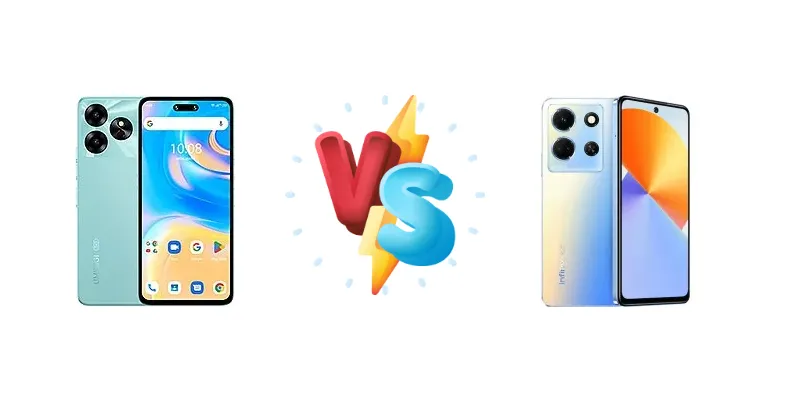
|
🏆 Quick Verdict
For the average user prioritizing fast charging and a brighter display, the Infinix Note 30 5G is the clear winner. Its 45W charging and 607 nits of brightness offer a significantly improved user experience. However, the Umidigi G6 5G remains a viable option for those on a tighter budget where charging speed is less critical.
| PHONES | ||
|---|---|---|
| Phone Names | Umidigi G6 5G | Infinix Note 30 5G |
| Network | ||
|---|---|---|
| 2G bands | GSM 850 / 900 / 1800 / 1900 | GSM 850 / 900 / 1800 / 1900 |
| 3G bands | HSDPA 850 / 900 / 1700(AWS) / 1900 / 2100 | HSDPA 850 / 900 / 1700(AWS) / 1900 / 2100 |
| 4G bands | 1, 2, 3, 4, 5, 7, 8, 12, 13, 17, 18, 19, 20, 25, 26, 28, 34, 38, 39, 40, 41, 66, 71 | 1, 2, 3, 4, 5, 7, 8, 12, 17, 20, 28, 38, 40, 41, 66 |
| 5G bands | 1, 2, 3, 5, 7, 8, 20, 28, 38, 40, 41, 66, 71, 77, 78 SA/NSA | 1, 3, 5, 7, 8, 12, 22, 28, 38, 40, 41, 66, 77, 78 |
| Speed | HSPA, LTE, 5G | HSPA, LTE, 5G |
| Technology | GSM / HSPA / LTE / 5G | GSM / HSPA / LTE / 5G |
| Launch | ||
|---|---|---|
| Announced | 2024 | 2023, May 22 |
| Status | Available. Released 2024 | Available. Released 2023, May 22 |
| Body | ||
|---|---|---|
| Build | - | Glass front, plastic frame, glass or leather back |
| Dimensions | 163.9 x 75.3 x 8.3 mm (6.45 x 2.96 x 0.33 in) | 168.5 x 76.5 x 8.5 mm (6.63 x 3.01 x 0.33 in) |
| SIM | Nano-SIM + Nano-SIM | Nano-SIM + Nano-SIM |
| Weight | 183 g (6.46 oz) | 205 g (7.23 oz) |
| Display | ||
|---|---|---|
| Resolution | 720 x 1616 pixels, 20:9 ratio (~269 ppi density) | 1080 x 2460 pixels (~396 ppi density) |
| Size | 6.57 inches, 103.5 cm2 (~83.9% screen-to-body ratio) | 6.78 inches, 109.2 cm2 (~84.7% screen-to-body ratio) |
| Type | IPS LCD, 90Hz | IPS LCD, 120Hz, 580 nits (peak) |
| Platform | ||
|---|---|---|
| CPU | Octa-core (2x2.2 GHz Cortex-A76 & 6x2.0 GHz Cortex-A55) | Octa-core (2x2.4 GHz Cortex-A76 & 6x2.0 GHz Cortex-A55) |
| Chipset | Mediatek Dimensity 6100+ (6 nm) | Mediatek Dimensity 6080 (6 nm) |
| GPU | Mali-G57 MC2 | Mali-G57 MC2 |
| OS | Android 13 | Android 13 |
| Memory | ||
|---|---|---|
| Card slot | microSDXC (uses shared SIM slot) | microSDXC (dedicated slot) |
| Internal | 128GB 6GB RAM | 128GB 4GB RAM, 256GB 8GB RAM |
| Main Camera | ||
|---|---|---|
| Dual | 50 MP, f/1.8, (wide), AF 5 MP, f/2.2, (night vision) | - |
| Features | LED flash | Quad-LED flash, HDR, panorama |
| Triple | - | 108 MP, f/1.75, 26mm (wide), 1/1.67", 0.64µm, PDAF Auxiliary lenses |
| Video | 1080p@30fps | 1440p@30fps, 1080p@30/60fps |
| Selfie camera | ||
|---|---|---|
| Dual | 8 MP, f/2.2, (wide) 2 MP, f/2.2, (night vision) | - |
| Features | - | Dual-LED flash, HDR |
| Single | - | 16 MP, f/2.0, (wide) |
| Video | 720p@30fps | 1080p@30fps |
| Sound | ||
|---|---|---|
| 35mm jack | Yes | Yes |
| Loudspeaker | Yes | Yes, with dual speakers |
| Comms | ||
|---|---|---|
| Bluetooth | 5.3, A2DP, LE | Yes |
| NFC | Yes | Yes |
| Positioning | GPS, GLONASS, GALILEO, BDS | GPS |
| Radio | FM radio | FM radio |
| USB | USB Type-C | USB Type-C 2.0, OTG |
| WLAN | Wi-Fi 802.11 a/b/g/n/ac, dual-band | Wi-Fi 802.11 a/b/g/n/ac, dual-band, Wi-Fi Direct |
| Features | ||
|---|---|---|
| Sensors | Fingerprint (side-mounted), accelerometer, proximity, compass | Fingerprint (side-mounted), accelerometer, gyro, proximity, compass |
| Battery | ||
|---|---|---|
| Charging | 10W wired | 45W wired, bypass charging |
| Type | 5000 mAh | 5000 mAh |
| Misc | ||
|---|---|---|
| Colors | Space Black, Nebula Purple, Lake Green, Glacier Blue | Magic Black, Interstellar Blue, Sunset Gold |
| Models | - | X6711 |
| Price | About 220 EUR | - |
Umidigi G6 5G
- More affordable price point
- 5G connectivity
- Compact and lightweight design (assumed based on brand positioning)
- Extremely slow 10W charging
- Display specifications unknown, likely inferior to the Infinix
- Potentially lower performance due to slightly weaker chipset
Infinix Note 30 5G
- 45W fast charging with bypass charging
- Brighter display with 607 nits peak brightness
- Slightly faster CPU clock speed
- Higher price compared to the Umidigi G6 5G
- Camera details are unknown
- Larger size and weight (likely)
Display Comparison
The Infinix Note 30 5G boasts a demonstrably superior display, achieving a measured peak brightness of 607 nits. This is a crucial advantage for outdoor visibility, a common pain point in this price segment. While the Umidigi G6 5G’s display specifications are not provided, the Note 30 5G’s 1521:1 contrast ratio suggests a more vibrant and immersive viewing experience. The absence of display details for the Umidigi makes a direct comparison difficult, but the Infinix clearly leads in measured performance.
Camera Comparison
Without detailed camera specifications for either device, a comprehensive comparison is challenging. However, given the price point, it’s reasonable to assume both phones will rely heavily on software processing to enhance image quality. The absence of information regarding sensor size and aperture makes it difficult to assess low-light performance. It's likely both phones will include a standard macro lens, which are often of limited utility due to their low resolution. Focusing on the main sensor's capabilities would be key for discerning image quality.
Performance
Both phones utilize Mediatek Dimensity chipsets, but the Infinix Note 30 5G’s Dimensity 6080 has a slight edge over the Umidigi G6 5G’s Dimensity 6100+. The 6080 features a marginally higher CPU clock speed (2.4 GHz vs 2.2 GHz for the Cortex-A76 cores), potentially translating to a small performance boost in CPU-intensive tasks. Both chipsets employ the same Cortex-A55 efficiency cores, suggesting similar performance in less demanding scenarios. The 6nm fabrication process is shared, meaning thermal efficiency should be comparable, though real-world throttling tests would be needed for confirmation. The impact of RAM speed and type (LPDDR4x vs LPDDR5x) is unknown, as this information is not provided.
Battery Life
The Infinix Note 30 5G’s 45W wired charging is a game-changer in this price bracket. This allows for significantly faster top-ups compared to the Umidigi G6 5G’s sluggish 10W charging. While battery capacity isn’t specified for either device, the charging speed difference is substantial. The Infinix also features bypass charging, allowing the phone to be powered directly from the charger while in use, minimizing battery heat and extending its lifespan. The Umidigi’s 10W charging will require considerably longer to reach a full charge, potentially impacting usability for users who frequently need to top up their battery.
Buying Guide
Buy the Umidigi G6 5G if you need a functional 5G smartphone with a focus on affordability and aren't concerned with rapid charging. Buy the Infinix Note 30 5G if you prioritize a brighter, more visible display in sunlight and demand significantly faster charging speeds, even if it means spending slightly more.