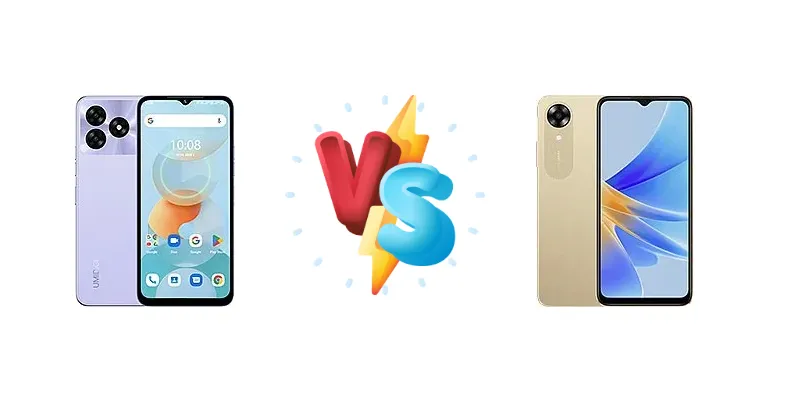
The Umidigi G5A and Oppo A17k represent the fiercely competitive entry-level smartphone market. Both aim to deliver essential smartphone functionality at an incredibly affordable price point, but they achieve this with different hardware choices. This comparison dissects those choices, focusing on how they impact real-world performance and usability for the average consumer.
🏆 Quick Verdict
For most users, the Oppo A17k emerges as the better choice. Its MediaTek Helio G35 chipset, featuring an octa-core CPU, provides a noticeable performance advantage over the Umidigi G5A’s quad-core Helio A22, translating to smoother multitasking and app loading. While both offer basic functionality, the A17k’s processing power makes it the more future-proof option.
| Network |
|---|
| 2G bands | GSM 850 / 900 / 1800 / 1900 | GSM 850 / 900 / 1800 / 1900 |
| 3G bands | HSDPA 850 / 900 / 1700(AWS) / 1900 / 2100 | HSDPA 850 / 900 / 2100 |
| 4G bands | 1, 2, 3, 4, 5, 7, 8, 12, 17, 20, 28, 38, 40, 41, 66 | 1, 3, 5, 8, 38, 40, 41 |
| Speed | HSPA, LTE | HSPA, LTE |
| Technology | GSM / HSPA / LTE | GSM / HSPA / LTE |
| Launch |
|---|
| Announced | 2023 | 2022, October 13 |
| Status | Available. Released 2023 | Available. Released 2022, October 18 |
| Body |
|---|
| Dimensions | 163.9 x 75.7 x 8.8 mm (6.45 x 2.98 x 0.35 in) | 164.2 x 75.6 x 8.3 mm (6.46 x 2.98 x 0.33 in) |
| SIM | Nano-SIM + Nano-SIM | Nano-SIM + Nano-SIM |
| Weight | 195 g (6.88 oz) | 189 g (6.67 oz) |
| | - | IPX4 water resistance |
| Display |
|---|
| Protection | - | Panda Glass |
| Resolution | 720 x 1600 pixels, 20:9 ratio (~269 ppi density) | 720 x 1612 pixels, 20:9 ratio (~269 ppi density) |
| Size | 6.52 inches, 102.6 cm2 (~82.7% screen-to-body ratio) | 6.56 inches, 103.4 cm2 (~83.3% screen-to-body ratio) |
| Type | IPS LCD | IPS LCD, 480 nits (typ), 600 nits (HBM) |
| Platform |
|---|
| CPU | Quad-core 2.0 GHz Cortex-A53 | Octa-core (4x2.3 GHz Cortex-A53 & 4x1.8 GHz Cortex-A53) |
| Chipset | Mediatek Helio A22 (12 nm) | Mediatek MT6765 Helio G35 (12 nm) |
| GPU | PowerVR GE8320 | PowerVR GE8320 |
| OS | Android 13 | Android 12, ColorOS 12.1 |
| Memory |
|---|
| Card slot | microSDXC (uses shared SIM slot) | microSDXC |
| Internal | 64GB 4GB RAM | 64GB 3GB RAM |
| | - | eMMC 5.1 |
| Main Camera |
|---|
| Dual | 13 MP, f/2.2, (wide), AF
Auxiliary lens | - |
| Features | LED flash | LED flash, panorama |
| Single | - | 8 MP, f/2.0, (wide), AF |
| Video | 1080p@30fps | 1080p@30fps |
| Selfie camera |
|---|
| Single | 5 MP, f/2.0, (wide) | 5 MP, f/2.2, (wide) |
| Video | 720p@30fps | 1080p@30fps |
| Sound |
|---|
| 3.5mm jack | - | Yes |
| 35mm jack | Yes | Yes |
| Loudspeaker | Yes | Yes |
| Comms |
|---|
| Bluetooth | 5.0, A2DP, LE | 5.3, A2DP, LE, aptX HD |
| NFC | No | No |
| Positioning | GPS, GLONASS, GALILEO, BDS | GPS, GLONASS, BDS, GALILEO |
| Radio | FM radio | Unspecified |
| USB | USB Type-C | microUSB 2.0, OTG |
| WLAN | Wi-Fi 802.11 a/b/g/n/ac | Wi-Fi 802.11 a/b/g/n/ac, dual-band |
| Features |
|---|
| Sensors | Fingerprint (side-mounted), accelerometer, proximity, compass | Fingerprint (side-mounted), accelerometer, proximity, compass |
| Battery |
|---|
| Charging | 10W wired | - |
| Type | 5000 mAh | Li-Po 5000 mAh |
| Misc |
|---|
| Colors | Graphite Black, Jade Green, Lavender Purple, Pearl White, Space Gray | Navy Blue, Gold |
| Models | - | CPH2471 |
| Price | About 100 EUR | About 130 EUR |
Umidigi G5A
- Lowest possible price point
- Functional for basic communication
- Simple and straightforward software experience
- Slow performance with Helio A22
- Limited multitasking capabilities
- Outdated chipset
Oppo A17k
- Octa-core Helio G35 offers better performance
- Smoother multitasking and app loading
- More responsive user experience
- Still an entry-level chipset
- Camera performance is likely limited
- May be slightly more expensive than the G5A
Display Comparison
Neither device boasts a standout display. Both utilize panels with similar resolutions, and detailed specifications like brightness nits and color accuracy are unavailable. However, the focus here is on performance, and the display is likely a cost-optimized component on both. Bezels are expected to be substantial on both devices, typical of this price bracket. The display is unlikely to be a deciding factor for most buyers.
Camera Comparison
Camera performance is likely to be similar, and largely unimpressive, on both devices. Detailed sensor information is lacking, but both will likely feature a primary camera alongside basic auxiliary lenses (often 2MP macro or depth sensors). Image processing will be minimal, and low-light performance will be poor. Focusing on the primary sensor, the A17k’s slightly more powerful processor *may* allow for marginally faster image processing, but the difference will be minimal. The 2MP macro cameras on both are unlikely to produce usable images.
Performance
The core difference lies in the chipsets. The Umidigi G5A’s MediaTek Helio A22 is a quad-core processor clocked at 2.0 GHz, utilizing Cortex-A53 cores. The Oppo A17k, however, features the MediaTek Helio G35, an octa-core processor with a more complex configuration: four cores at 2.3 GHz and four at 1.8 GHz, also based on the Cortex-A53 architecture. This octa-core setup, and the higher clock speeds, provide a significant advantage in multitasking and app responsiveness. While both are 12nm chips, the G35’s architecture is designed for better sustained performance. The G5A will struggle with more than a few apps open simultaneously, while the A17k will handle a heavier workload more gracefully.
Battery Life
Battery capacity details are missing for both devices. However, both are likely to feature batteries in the 4000-5000 mAh range, typical for this segment. The Umidigi G5A charges at 10W, which is slow. The Oppo A17k’s charging speed is also likely to be 10W, offering similar 0-100% charge times. Battery life will depend heavily on usage, but the A17k’s more efficient processor could translate to slightly longer runtimes under moderate load.
Buying Guide
Buy the Umidigi G5A if you prioritize absolute minimal cost and only need a phone for the most basic tasks – calls, texts, and light app usage. It’s a functional device for those on the tightest of budgets. Buy the Oppo A17k if you value a more responsive user experience, even for simple tasks, and anticipate using your phone for slightly more demanding activities like social media browsing or casual gaming. The A17k offers a better balance of performance and affordability.
Frequently Asked Questions
❓ Will the Oppo A17k handle popular social media apps like Facebook and Instagram smoothly?
Yes, the Helio G35 chipset in the Oppo A17k is significantly more capable than the Helio A22 in the Umidigi G5A. It should handle Facebook, Instagram, and similar apps with acceptable smoothness, even with multiple apps open. The G5A may exhibit noticeable lag when switching between these apps.
❓ Is the Helio G35 in the Oppo A17k capable of playing any mobile games?
The Helio G35 can handle some light mobile gaming, but don't expect high frame rates or demanding graphics settings. Games like PUBG Mobile or Call of Duty Mobile will likely need to be played on the lowest settings to achieve playable frame rates. The Umidigi G5A’s Helio A22 will struggle even with the simplest games.
❓ How much storage does each phone offer, and can it be expanded?
While specific storage configurations aren't provided, both phones likely start with 32GB of internal storage. Both devices almost certainly support microSD card expansion, allowing you to add more storage for photos, videos, and apps. Check the product listing for the maximum supported microSD card size.
❓ Which phone is better for someone who primarily uses their phone for calls and texts?
Both phones are perfectly adequate for basic calls and texts. However, the Oppo A17k’s more responsive processor will make even these simple tasks feel smoother and more enjoyable. If cost is the absolute primary concern, the Umidigi G5A will suffice, but the A17k offers a better overall experience.