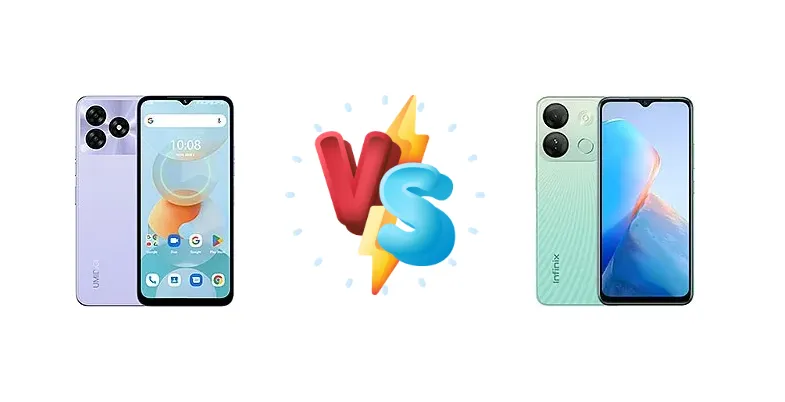
The sub-$150 smartphone market is fiercely competitive. Both the Umidigi G5A and the Infinix Smart 7 HD aim to deliver essential smartphone functionality at an incredibly affordable price point. However, they take different approaches to achieving this, with the G5A prioritizing a newer, albeit still entry-level, chipset while the Smart 7 HD opts for an octa-core CPU configuration. This comparison will dissect the key differences to determine which device offers the best value.
🏆 Quick Verdict
For the average user prioritizing responsiveness and future-proofing, the Umidigi G5A is the better choice. While both phones share the same slow 10W charging, the G5A’s Mediatek Helio A22, despite its lower clock speed, benefits from architectural improvements over the Smart 7 HD’s CPU, resulting in a smoother user experience.
| Network |
|---|
| 2G bands | GSM 850 / 900 / 1800 / 1900 | GSM 850 / 900 / 1800 / 1900 |
| 3G bands | HSDPA 850 / 900 / 1700(AWS) / 1900 / 2100 | HSDPA 850 / 900 / 2100 |
| 4G bands | 1, 2, 3, 4, 5, 7, 8, 12, 17, 20, 28, 38, 40, 41, 66 | 1, 3, 5, 8, 38, 40, 41 |
| Speed | HSPA, LTE | HSPA, LTE |
| Technology | GSM / HSPA / LTE | GSM / HSPA / LTE |
| | - | 1, 2, 3, 4, 5, 7, 8, 20, 28, 38, 40, 41 |
| Launch |
|---|
| Announced | 2023 | 2023, April 14 |
| Status | Available. Released 2023 | Available. Released 2023, April 14 |
| Body |
|---|
| Build | - | Glass front, plastic back, plastic frame |
| Dimensions | 163.9 x 75.7 x 8.8 mm (6.45 x 2.98 x 0.35 in) | 163.9 x 75.5 x 8.7 mm (6.45 x 2.97 x 0.34 in) |
| SIM | Nano-SIM + Nano-SIM | Nano-SIM + Nano-SIM |
| Weight | 195 g (6.88 oz) | 196.5 g (6.95 oz) |
| Display |
|---|
| Resolution | 720 x 1600 pixels, 20:9 ratio (~269 ppi density) | 720 x 1612 pixels, 20:9 ratio (~267 ppi density) |
| Size | 6.52 inches, 102.6 cm2 (~82.7% screen-to-body ratio) | 6.6 inches, 104.6 cm2 (~84.6% screen-to-body ratio) |
| Type | IPS LCD | IPS LCD, 500 nits |
| Platform |
|---|
| CPU | Quad-core 2.0 GHz Cortex-A53 | Octa-core 1.6 GHz |
| Chipset | Mediatek Helio A22 (12 nm) | - |
| GPU | PowerVR GE8320 | - |
| OS | Android 13 | Android 12 (Go edition) |
| Memory |
|---|
| Card slot | microSDXC (uses shared SIM slot) | microSDXC (dedicated slot) |
| Internal | 64GB 4GB RAM | 64GB 2GB RAM |
| | - | UFS 2.1 |
| Main Camera |
|---|
| Dual | 13 MP, f/2.2, (wide), AF
Auxiliary lens | 8 MP, f/2.0
0.08 MP, (depth) |
| Features | LED flash | Dual-LED flash, HDR, panorama |
| Single | - | 8 MP, f/2.0
Auxiliary lens |
| Video | 1080p@30fps | 1080p@30fps |
| Selfie camera |
|---|
| Features | - | LED flash |
| Single | 5 MP, f/2.0, (wide) | 5 MP, f/2.0 |
| Video | 720p@30fps | 720p@30fps |
| Sound |
|---|
| 3.5mm jack | - | Yes |
| 35mm jack | Yes | Yes |
| Loudspeaker | Yes | Yes |
| Comms |
|---|
| Bluetooth | 5.0, A2DP, LE | 5.0, A2DP, LE |
| NFC | No | No |
| Positioning | GPS, GLONASS, GALILEO, BDS | GPS |
| Radio | FM radio | FM radio |
| USB | USB Type-C | microUSB 2.0, OTG |
| WLAN | Wi-Fi 802.11 a/b/g/n/ac | Wi-Fi 802.11 b/g/n |
| Features |
|---|
| Sensors | Fingerprint (side-mounted), accelerometer, proximity, compass | Fingerprint (rear-mounted), accelerometer, proximity |
| Battery |
|---|
| Charging | 10W wired | 10W wired |
| Type | 5000 mAh | 5000 mAh |
| Misc |
|---|
| Colors | Graphite Black, Jade Green, Lavender Purple, Pearl White, Space Gray | Ink Black, Silk Blue, Jade White, Green Apple |
| Models | - | X6516 |
| Price | About 100 EUR | About 110 EUR |
Umidigi G5A
- More modern chipset architecture (Helio A22)
- Potentially better power efficiency
- Smoother responsiveness in everyday tasks
- Limited RAM (likely)
- Slow 10W charging
Infinix Smart 7 HD
- Octa-core CPU for potential multitasking benefits
- Very affordable price point
- Potentially wider app compatibility
- Less efficient CPU architecture
- Slower performance in single-core tasks
- Slow 10W charging
Display Comparison
Neither Umidigi nor Infinix provide display specifications beyond size. Given the price bracket, both likely utilize LCD panels with 720p+ resolution. The absence of details like peak brightness or color gamut suggests neither phone excels in display quality. Bezels are expected to be substantial on both devices, impacting the overall screen-to-body ratio. Color accuracy will likely be standard for this segment, prioritizing power efficiency over fidelity.
Camera Comparison
Camera details are sparse for both devices. It’s safe to assume both feature a primary camera and potentially a secondary depth sensor. Without sensor size or aperture information, a direct comparison is difficult. However, given the price point, image quality will be heavily reliant on software processing. The absence of Optical Image Stabilization (OIS) on either device suggests low-light performance will be limited. Any marketing around megapixel counts should be viewed with skepticism, as sensor size and image processing are far more important than resolution alone.
Performance
The core difference lies in the processors. The Umidigi G5A features a Mediatek Helio A22 (12 nm), a quad-core processor built on a more modern 12nm process. This process node generally translates to better power efficiency compared to the older process likely used in the Infinix Smart 7 HD. The Smart 7 HD boasts an octa-core CPU clocked at 1.6 GHz. While more cores *can* improve multitasking, the Cortex-A53 cores in the G5A are more efficient per core. The Helio A22’s architecture provides a performance advantage in single-core tasks, which are crucial for app launch times and general responsiveness. The Smart 7 HD’s octa-core setup may show marginal gains in heavily multi-threaded applications, but these are unlikely to be common on these devices. RAM configurations are not specified, but both will likely be limited, further emphasizing the importance of efficient CPU architecture.
Battery Life
Both the Umidigi G5A and the Infinix Smart 7 HD are equipped with 10W wired charging. This is a significant limitation, meaning a full charge will take a considerable amount of time – likely exceeding 3 hours. Battery capacity is not specified, but both will likely feature batteries in the 4000-5000 mAh range to provide all-day battery life with moderate usage. The Helio A22’s power efficiency in the G5A may translate to slightly longer battery life, offsetting any potential capacity differences.
Buying Guide
Buy the Umidigi G5A if you need a phone that feels more responsive for everyday tasks like browsing and social media, and if you value a slightly more modern chipset architecture. Buy the Infinix Smart 7 HD if you prioritize a potentially wider app compatibility due to the octa-core CPU, and if you are looking for the absolute lowest possible price point, accepting some performance trade-offs.
Frequently Asked Questions
❓ Will the Infinix Smart 7 HD struggle with popular apps like WhatsApp and Facebook?
While the Smart 7 HD can run these apps, the octa-core CPU’s older architecture may result in slower loading times and occasional lag, especially with multiple apps open. The Umidigi G5A’s Helio A22 is likely to provide a smoother experience for these common tasks.
❓ How long will it take to fully charge either phone from 0%?
With both phones limited to 10W charging, expect a full charge to take approximately 3 to 4 hours. This is a significant drawback for users who need quick top-ups.
❓ Is the camera on either phone good enough for casual social media photos?
Both cameras will be adequate for basic social media sharing in good lighting conditions. However, expect limited detail and dynamic range, especially in low-light environments. Don't expect flagship-level image quality.
❓ Can either phone handle basic mobile games?
Both phones can handle less demanding 2D games. However, graphically intensive 3D games will likely experience significant lag and low frame rates. The Helio A22 in the G5A may offer slightly better performance in some games, but neither phone is designed for serious gaming.