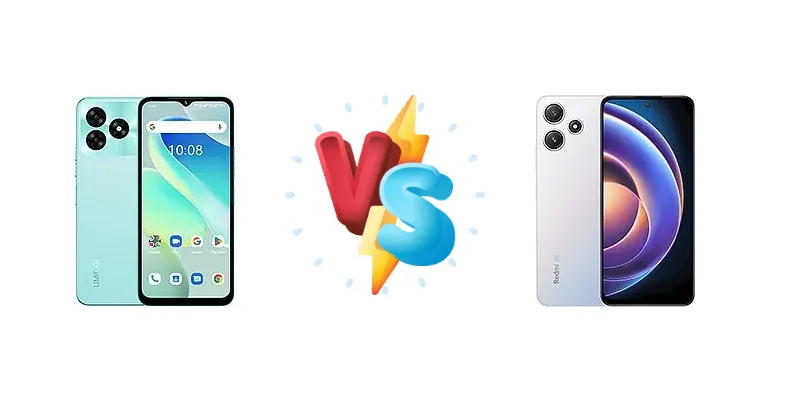
The sub-$200 smartphone market is fiercely competitive. The Umidigi G5 and Xiaomi Redmi Note 12R represent compelling options, but cater to slightly different priorities. The G5 focuses on affordability, while the Redmi Note 12R aims to deliver a more refined experience with a newer chipset and faster charging. This comparison breaks down the key differences to help you choose the right phone.
🏆 Quick Verdict
For most users, the Xiaomi Redmi Note 12R is the superior choice. Its Snapdragon 4 Gen 2 chipset, built on a 4nm process, provides a noticeable performance advantage and improved efficiency over the Umidigi G5’s Unisoc T606. The 18W charging with PD support is also a significant benefit, offering faster and more versatile power replenishment.
| Network |
|---|
| 2G bands | GSM 850 / 900 / 1800 / 1900 | GSM 850 / 900 / 1800 / 1900 |
| 3G bands | HSDPA 850 / 900 / 1700(AWS) / 1900 / 2100 | HSDPA 850 / 900 / 2100 |
| 4G bands | 1, 2, 3, 4, 5, 7, 8, 12, 17, 20, 28, 38, 40, 41, 66 | 1, 3, 5, 8, 34, 38, 39, 40, 41 |
| 5G bands | - | 1, 5, 8, 28, 41, 78 SA/NSA |
| Speed | HSPA, LTE | HSPA, LTE, 5G |
| Technology | GSM / HSPA / LTE | GSM / CDMA / HSPA / EVDO / LTE / 5G |
| Launch |
|---|
| Announced | 2023 | 2023, June 28 |
| Status | Available. Released 2023 | Available. Released 2023, June 28 |
| Body |
|---|
| Build | - | Glass front, plastic frame, glass back |
| Dimensions | 163.9 x 75.7 x 8.8 mm (6.45 x 2.98 x 0.35 in) | 168.6 x 76.3 x 8.2 mm (6.64 x 3.00 x 0.32 in) |
| SIM | Nano-SIM + Nano-SIM | Nano-SIM + Nano-SIM |
| Weight | 195 g (6.88 oz) | 199 g (7.02 oz) |
| Display |
|---|
| Resolution | 720 x 1612 pixels, 20:9 ratio (~267 ppi density) | 1080 x 2460 pixels (~396 ppi density) |
| Size | 6.6 inches, 104.6 cm2 (~84.3% screen-to-body ratio) | 6.79 inches, 109.5 cm2 (~85.1% screen-to-body ratio) |
| Type | IPS LCD, 90Hz, 400 nits (typ) | IPS LCD, 90Hz, 550 nits |
| Platform |
|---|
| CPU | Octa-core (2x1.6 GHz Cortex-A75 & 6x1.6 GHz Cortex-A55) | Octa-core (2x2.2 GHz Cortex-A78 & 6x1.95 GHz Cortex-A55) |
| Chipset | Unisoc T606 (12 nm) | Qualcomm SM4450 Snapdragon 4 Gen 2 (4 nm) |
| GPU | Mali-G57 MP1 | Adreno 613 |
| OS | Android 13 | Android 13, MIUI 14 |
| Memory |
|---|
| Card slot | microSDXC (uses shared SIM slot) | microSDXC (uses shared SIM slot) |
| Internal | 128GB 8GB RAM | 128GB 4GB RAM, 128GB 6GB RAM, 128GB 8GB RAM, 256GB 8GB RAM |
| Main Camera |
|---|
| Dual | 50 MP, f/1.8, (wide), AF
Auxiliary lens | 50 MP, f/1.8, (wide), PDAF
2 MP (macro) |
| Features | LED flash | LED flash, HDR |
| Video | 1080p@30fps | 1080p@30fps |
| Selfie camera |
|---|
| Features | - | HDR |
| Single | 8 MP, f/2.2, (wide) | 5 MP, f/2.2, (wide), 1/5.0", 1.12µm |
| Video | 720p@30fps | 1080p@30fps |
| Sound |
|---|
| 35mm jack | Yes | Yes |
| Loudspeaker | Yes | Yes |
| Comms |
|---|
| Bluetooth | 5.0, A2DP, LE | 5.3, A2DP, LE |
| Infrared port | - | Yes |
| NFC | No | Yes (market/region dependent) |
| Positioning | GPS, GLONASS, GALILEO, BDS | GPS, GLONASS, GALILEO, BDS |
| Radio | FM radio | No |
| USB | USB Type-C | USB Type-C |
| WLAN | Wi-Fi 802.11 a/b/g/n/ac | Wi-Fi 802.11 a/b/g/n/ac, dual-band |
| Features |
|---|
| Sensors | Fingerprint (side-mounted), accelerometer, proximity, compass | Fingerprint (side-mounted), accelerometer, compass |
| Battery |
|---|
| Charging | 10W wired | 18W wired, PD |
| Type | 5000 mAh | Li-Po 5000 mAh |
| Misc |
|---|
| Colors | Graphite Black, Jade Green, Lavender Purple, Pearl White, Space Gray | Black, Blue, Silver |
| Models | - | 23076RA4BC |
| Price | About 160 EUR | About 150 EUR |
Umidigi G5
- Lowest possible price point
- Functional for basic tasks
- Acceptable battery life for light users
- Slow charging (10W)
- Outdated Unisoc T606 chipset
- Subpar performance for demanding apps
Xiaomi Redmi Note 12R
- Faster Snapdragon 4 Gen 2 chipset
- 18W charging with PD support
- Improved performance and efficiency
- Slightly higher price
- May still lack features found in higher-end phones
- Camera performance, while better, is still budget-level
Display Comparison
Neither device boasts a standout display. Both likely utilize LCD panels, common in this price bracket. While specific details like peak brightness and color gamut are unavailable, the Redmi Note 12R’s potential for a higher quality panel, given Xiaomi’s manufacturing capabilities, is plausible. Bezels are expected to be similar on both, prioritizing cost reduction over premium aesthetics. The absence of high refresh rates on either device is standard for this segment.
Camera Comparison
Without detailed sensor information, a direct camera comparison is difficult. However, the Redmi Note 12R likely benefits from Qualcomm’s image signal processor (ISP), which generally delivers superior image processing compared to Unisoc’s offerings. The focus should be on the main sensor performance; the inclusion of 2MP macro lenses on both devices is largely marketing fluff. Expect the Redmi Note 12R to produce more detailed and dynamic photos, particularly in challenging lighting conditions. The Redmi Note 12R's ISP will likely offer better noise reduction and color accuracy.
Performance
The core difference lies in the chipsets. The Xiaomi Redmi Note 12R’s Qualcomm Snapdragon 4 Gen 2 (4nm) is a significant upgrade over the Umidigi G5’s Unisoc T606 (12nm). The 4nm fabrication process translates to better power efficiency and reduced thermal throttling, meaning sustained performance during demanding tasks. The Snapdragon’s CPU, featuring 2x2.2 GHz Cortex-A78 cores, outperforms the G5’s 2x1.6 GHz Cortex-A75 cores in both single-core and multi-core benchmarks. This will be noticeable in app launch times, multitasking, and gaming. While both phones likely feature similar RAM configurations, the chipset is the bottleneck.
Battery Life
Both phones likely feature similar battery capacities (around 5000mAh is typical for this segment). However, the Redmi Note 12R’s 18W wired charging with Power Delivery (PD) support is a clear advantage. 10W charging on the Umidigi G5 will result in significantly longer charging times. While battery life will be comparable under light usage, the Redmi Note 12R’s faster charging allows for quicker top-ups, reducing downtime. A full charge on the G5 could take well over 3 hours, while the Redmi Note 12R should achieve a full charge in around 2 hours.
Buying Guide
Buy the Umidigi G5 if you absolutely need the lowest possible price and are willing to compromise on performance and charging speed. It’s a functional device for basic tasks. Buy the Xiaomi Redmi Note 12R if you prioritize a smoother user experience, faster app loading times, and quicker charging, even if it means spending a little more. It’s the better all-rounder for daily use.
Frequently Asked Questions
❓ Will the Redmi Note 12R handle demanding games like PUBG Mobile smoothly?
The Snapdragon 4 Gen 2 in the Redmi Note 12R is capable of running PUBG Mobile, but likely at medium settings to maintain a stable frame rate. Expect some occasional frame drops during intense action. The Umidigi G5’s Unisoc T606 will struggle with PUBG, requiring significantly lower settings and potentially exhibiting noticeable lag.
❓ Does the Redmi Note 12R support fast charging accessories from other brands?
Yes, the Redmi Note 12R supports Power Delivery (PD) charging, a widely adopted standard. This means you can use PD-compatible chargers from brands like Anker, Aukey, and others to take advantage of the 18W charging speed. However, ensure the charger is PD-certified for optimal compatibility.
❓ Is the Unisoc T606 in the Umidigi G5 sufficient for everyday tasks like browsing and social media?
Yes, the Unisoc T606 is adequate for basic tasks like web browsing, social media, and messaging. However, you may experience slowdowns when multitasking or opening multiple apps. It's not ideal for demanding applications or heavy users.
❓ What type of storage does the Redmi Note 12R use, and is it expandable?
While specific details vary by region, the Redmi Note 12R typically utilizes UFS 2.2 storage, which is faster than the eMMC storage often found in this price range. It also includes a dedicated microSD card slot for expandable storage, allowing you to add up to 1TB of additional space.