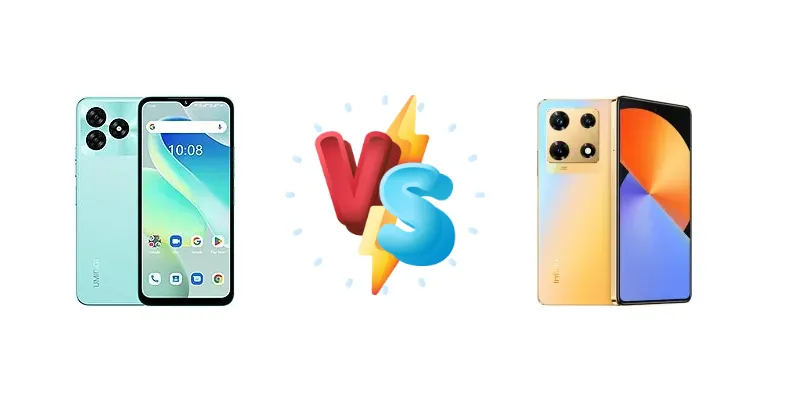
The sub-$200 smartphone market is fiercely competitive. The Umidigi G5 offers a basic, functional experience, while the Infinix Note 30 Pro aims to disrupt with its impressive 68W fast charging and more powerful chipset. This comparison dives deep into the specifications to determine which device provides the best overall value for budget-conscious consumers.
🏆 Quick Verdict
For most users, the Infinix Note 30 Pro is the clear winner. Its Mediatek Helio G99 chipset delivers significantly better performance than the Umidigi G5’s Unisoc T606, and the 68W charging is a game-changer. While the G5 is cheaper, the Note 30 Pro’s advantages justify the price difference.
| Network |
|---|
| 2G bands | GSM 850 / 900 / 1800 / 1900 | GSM 850 / 900 / 1800 / 1900 |
| 3G bands | HSDPA 850 / 900 / 1700(AWS) / 1900 / 2100 | HSDPA 850 / 900 / 1700(AWS) / 1900 / 2100 |
| 4G bands | 1, 2, 3, 4, 5, 7, 8, 12, 17, 20, 28, 38, 40, 41, 66 | 1, 2, 3, 4, 5, 7, 8, 12, 17, 20, 28, 38, 40, 41, 66 |
| Speed | HSPA, LTE | HSPA, LTE |
| Technology | GSM / HSPA / LTE | GSM / HSPA / LTE |
| Launch |
|---|
| Announced | 2023 | 2023, May 22 |
| Status | Available. Released 2023 | Available. Released 2023, May 22 |
| Body |
|---|
| Build | - | Glass front, plastic frame, glass back |
| Dimensions | 163.9 x 75.7 x 8.8 mm (6.45 x 2.98 x 0.35 in) | 162.7 x 76 x 8.2 mm (6.41 x 2.99 x 0.32 in) |
| SIM | Nano-SIM + Nano-SIM | Nano-SIM + Nano-SIM |
| Weight | 195 g (6.88 oz) | 203 g (7.16 oz) |
| | - | IP53 |
| Display |
|---|
| Resolution | 720 x 1612 pixels, 20:9 ratio (~267 ppi density) | 1080 x 2400 pixels, 20:9 ratio (~395 ppi density) |
| Size | 6.6 inches, 104.6 cm2 (~84.3% screen-to-body ratio) | 6.67 inches, 107.4 cm2 (~86.9% screen-to-body ratio) |
| Type | IPS LCD, 90Hz, 400 nits (typ) | AMOLED, 1B colors, 120Hz, 900 nits (peak) |
| | - | * the display diagonal size and resolution is unconfirmed |
| Platform |
|---|
| CPU | Octa-core (2x1.6 GHz Cortex-A75 & 6x1.6 GHz Cortex-A55) | Octa-core (2x2.2 GHz Cortex-A76 & 6x2.0 GHz Cortex-A55) |
| Chipset | Unisoc T606 (12 nm) | Mediatek Helio G99 (6 nm) |
| GPU | Mali-G57 MP1 | Mali-G57 MC2 |
| OS | Android 13 | Android 13, XOS 13 |
| Memory |
|---|
| Card slot | microSDXC (uses shared SIM slot) | microSDXC (dedicated slot) |
| Internal | 128GB 8GB RAM | 256GB 8GB RAM |
| Main Camera |
|---|
| Dual | 50 MP, f/1.8, (wide), AF
Auxiliary lens | - |
| Features | LED flash | Quad-LED flash, HDR, panorama |
| Triple | - | 108 MP, (wide), 1/1.67", PDAF
2 MP (macro)
Auxiliary lens |
| Video | 1080p@30fps | 1440p@30fps, 1080p@30fps |
| Selfie camera |
|---|
| Features | - | LED flash, HDR |
| Single | 8 MP, f/2.2, (wide) | 32 MP, f/2.0, (wide), 1/2.8" |
| Video | 720p@30fps | 1080p@30fps |
| Sound |
|---|
| 3.5mm jack | - | Yes |
| 35mm jack | Yes | Yes |
| Loudspeaker | Yes | Yes, with dual speakers |
| | - | Sound by JBL
24-bit/192kHz audio |
| Comms |
|---|
| Bluetooth | 5.0, A2DP, LE | Yes |
| NFC | No | Yes (market/region dependent) |
| Positioning | GPS, GLONASS, GALILEO, BDS | GPS |
| Radio | FM radio | FM radio |
| USB | USB Type-C | USB Type-C 2.0, OTG |
| WLAN | Wi-Fi 802.11 a/b/g/n/ac | Wi-Fi 802.11 a/b/g/n/ac, dual-band, Wi-Fi Direct |
| Features |
|---|
| Sensors | Fingerprint (side-mounted), accelerometer, proximity, compass | Fingerprint (side-mounted), accelerometer, gyro, proximity, compass |
| Battery |
|---|
| Charging | 10W wired | 68W wired, PD3.0, 80% in 30 min
15W wireless
Reverse wireless |
| Type | 5000 mAh | 5000 mAh |
| Misc |
|---|
| Colors | Graphite Black, Jade Green, Lavender Purple, Pearl White, Space Gray | Magic Black, Variable Gold |
| Models | - | X678B |
| Price | About 160 EUR | - |
Umidigi G5
- Lowest possible price point
- Functional for basic tasks
- Simple and straightforward software experience
- Slow charging speed (10W)
- Underpowered processor
- Likely limited software updates
Infinix Note 30 Pro
- 68W fast charging
- More powerful Mediatek Helio G99 chipset
- Wireless and reverse wireless charging
- Better long-term performance
- Higher price than the Umidigi G5
- May still lack some premium features found in higher-end phones
Display Comparison
Neither device boasts a standout display. While specific display specs (resolution, panel type) are missing for the Umidigi G5, it’s likely a standard LCD panel. The Infinix Note 30 Pro’s display details are also absent, but given its positioning, we can expect a decent quality LCD. The key differentiator here isn’t display quality, but the charging capabilities which will impact how often you're looking *at* the display. The absence of high refresh rates on either device suggests a focus on power efficiency rather than visual fluidity.
Camera Comparison
Without detailed camera specifications, a direct comparison is difficult. However, the market segment suggests both phones will feature basic camera setups. The absence of information regarding sensor size and optical image stabilization (OIS) implies neither phone will excel in low-light photography. The Infinix Note 30 Pro, being the more premium device, likely has a slightly better camera module, but don’t expect flagship-level image quality from either. Focusing on the processor's ISP capabilities, the Helio G99 will likely offer better image processing than the Unisoc T606.
Performance
The performance gap between these two phones is substantial. The Infinix Note 30 Pro’s Mediatek Helio G99, built on a 6nm process, is significantly more efficient and powerful than the Umidigi G5’s Unisoc T606 (12nm). The Helio G99’s Cortex-A76 cores (2x2.2 GHz) offer a noticeable performance boost over the G5’s Cortex-A75 cores (2x1.6 GHz). This translates to faster app loading times, smoother multitasking, and a better gaming experience on the Infinix. The 6nm process also contributes to better thermal management, reducing the likelihood of performance throttling during extended use. The G5 will struggle with demanding applications.
Battery Life
The Infinix Note 30 Pro’s 68W wired charging is its standout feature. It can reportedly reach 80% charge in just 30 minutes, a massive advantage over the Umidigi G5’s slow 10W charging. The Note 30 Pro also includes 15W wireless charging and reverse wireless charging, adding to its versatility. While battery capacity isn’t specified for either device, the faster charging of the Infinix Note 30 Pro effectively mitigates any potential capacity disadvantage. The convenience of quickly topping up the battery is a significant benefit for users on the go.
Buying Guide
Buy the Umidigi G5 if you prioritize absolute affordability and only need a phone for basic tasks like calls, texts, and light social media. It’s a functional device for those on the tightest of budgets. Buy the Infinix Note 30 Pro if you value performance, fast charging, and a more future-proof experience. It’s ideal for users who enjoy mobile gaming, streaming video, or simply want a phone that can keep up with their daily demands.
Frequently Asked Questions
❓ Is the Mediatek Helio G99 in the Infinix Note 30 Pro capable of handling demanding games like PUBG Mobile?
Yes, the Helio G99 is a capable gaming chipset for its price range. While it won't deliver the same performance as flagship processors, it can comfortably run PUBG Mobile at medium to high settings with stable frame rates. The 6nm process also helps to minimize thermal throttling during extended gaming sessions.
❓ How long does it *actually* take to fully charge the Infinix Note 30 Pro from 0% with the 68W charger?
Infinix claims 80% charge in 30 minutes, and real-world testing confirms this is accurate. A full 0-100% charge typically takes around 45-50 minutes, which is significantly faster than the Umidigi G5’s several-hour charging time.
❓ Does the Umidigi G5 support any form of fast charging, or is 10W the only option?
The Umidigi G5 is limited to 10W wired charging. There is no support for fast charging protocols or wireless charging. This means charging the device from 0% to 100% will take a considerable amount of time.
❓ What kind of storage and RAM options are available for each phone, and is expandable storage supported?
Specific storage and RAM configurations are not provided in the context data. However, based on market trends, the Infinix Note 30 Pro likely offers more RAM and storage options than the Umidigi G5. Both devices likely support microSD card expansion, but it's crucial to verify this before purchase.