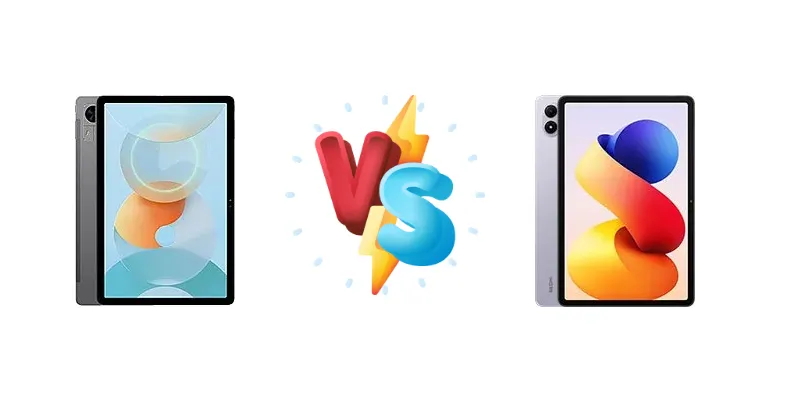
The tablet market has seen a surge in affordable options, and the Umidigi G5 Tab and Xiaomi Redmi Pad 2 Pro represent compelling choices for budget-conscious consumers. This comparison dissects their core components, focusing on how the chipset and charging capabilities differentiate these two devices, ultimately determining which offers the best experience for your needs.
🏆 Quick Verdict
For most users, the Xiaomi Redmi Pad 2 Pro is the superior choice. Its Snapdragon 7s Gen 4 chipset delivers significantly faster performance and better efficiency than the Umidigi G5 Tab’s Unisoc T606, while the 33W charging and impressive battery endurance provide a more convenient and reliable experience.
| Network |
|---|
| 2G bands | GSM 850 / 900 / 1800 / 1900 | N/A |
| 3G bands | HSDPA 850 / 900 / 1700(AWS) / 1900 / 2100 | N/A |
| 4G bands | 1, 2, 3, 4, 5, 7, 8, 12, 17, 20, 28, 38, 40, 41, 66 | - |
| EDGE | - | N/A |
| GPRS | - | N/A |
| Speed | HSPA, LTE | - |
| Technology | GSM / HSPA / LTE | No cellular connectivity |
| Launch |
|---|
| Announced | 2023 | 2025, September 24 |
| Status | Available. Released 2023 | Available. Released 2025, September 24 |
| Body |
|---|
| Build | Glass front, aluminum back, aluminum frame | Glass front, aluminum frame, aluminum back |
| Dimensions | 239.3 x 158.1 x 8.2 mm (9.42 x 6.22 x 0.32 in) | 279.8 x 181.7 x 7.5 mm (11.02 x 7.15 x 0.30 in) |
| SIM | Nano-SIM + Nano-SIM | No |
| Weight | 465 g (1.03 lb) | 610 g (1.34 lb) |
| Display |
|---|
| Protection | - | Mohs level 6 |
| Resolution | 800 x 1280 pixels, 16:10 ratio (~149 ppi density) | 1600 x 2560 pixels, 16:10 ratio (~249 ppi density) |
| Size | 10.1 inches, 295.8 cm2 (~78.2% screen-to-body ratio) | 12.1 inches, 424.5 cm2 (~83.5% screen-to-body ratio) |
| Type | IPS LCD | IPS LCD, 1B colors, 120Hz, Dolby Vision, 600 nits (HBM) |
| Platform |
|---|
| CPU | Octa-core (2x1.6 GHz Cortex-A75 & 6x1.6 GHz Cortex-A55) | Octa-core (1x2.7 GHz Cortex-A720 & 3x2.4 GHz Cortex-A720 & 4x1.8 GHz Cortex-A520) |
| Chipset | Unisoc T606 (12 nm) | Qualcomm SM7635-AC Snapdragon 7s Gen 4 (4 nm) |
| GPU | Mali-G57 MP1 | Adreno 810 |
| OS | Android 13 | Android 15, HyperOS 2 |
| Memory |
|---|
| Card slot | microSDXC (uses shared SIM slot) | microSDXC (dedicated slot) |
| Internal | 128GB 4GB RAM | 128GB 6GB RAM, 256GB 8GB RAM |
| Main Camera |
|---|
| Dual | 13 MP, f/2.2, (wide)
Auxiliary lens | - |
| Features | LED flash | Color spectrum sensor, LED flash, HDR |
| Single | - | 8 MP, f/2.0, (wide), 1/4.0", 1.12µm |
| Video | 1080p@30fps | 1080p@30fps |
| Selfie camera |
|---|
| Single | 8 MP, f/2.2, (wide) | 8 MP, f/2.3, (wide), 1/4.0", 1.12µm |
| Video | 720p@30fps | 1080p@30fps |
| Sound |
|---|
| 35mm jack | Yes | Yes |
| Loudspeaker | Yes, with stereo speakers | Yes, with stereo speakers, Dolby Atmos (4 speakers) |
| Comms |
|---|
| Bluetooth | 5.0, A2DP, LE | 5.4, A2DP, LE, aptX HD, aptX Adaptive |
| NFC | No | No |
| Positioning | GPS, GALILEO, GLONASS, BDS | No |
| Radio | FM radio | No |
| USB | USB Type-C | USB Type-C 2.0, OTG |
| WLAN | Wi-Fi 802.11 a/b/g/n/ac | Wi-Fi 802.11 a/b/g/n/a/6, dual-band, Wi-Fi Direct |
| Features |
|---|
| Sensors | Accelerometer, proximity (accessories only), compass | Accelerometer, gyro, proximity (accessories only), compass |
| Battery |
|---|
| Charging | 10W wired | 33W wired, PD3.0, QC3+
27W reverse wired |
| Type | 6000 mAh | 12000 mAh |
| Misc |
|---|
| Colors | Space Grey | Graphite Gray, Silver, Lavender Purple, Matte Glass Version |
| Models | - | 25099RP13G |
| Price | - | About 300 EUR |
| EU LABEL |
|---|
| Battery | - | 103:18h endurance, 1000 cycles |
| Energy | - | Class G |
| Free fall | - | Class A (208 falls) |
| Repairability | - | Class C |
Umidigi G5 Tab
- Extremely affordable price point
- Functional for basic tasks
- Lightweight and portable
- Slow performance with Unisoc T606
- Slow 10W charging
- Limited battery life compared to the competition
Xiaomi Redmi Pad 2 Pro
- Powerful Snapdragon 7s Gen 4 chipset
- Fast 33W charging with PD3.0/QC3+
- Exceptional battery life and endurance
- Higher price than the Umidigi G5 Tab
- May be overkill for very basic users
- Potentially larger and heavier
Display Comparison
Neither device’s display specifications are provided, so a direct comparison is limited. However, given the Redmi Pad 2 Pro’s positioning, it likely features an IPS LCD panel with a resolution of at least 2.5K, potentially with a higher refresh rate. The Umidigi G5 Tab, being a more budget-oriented device, likely utilizes a standard IPS LCD with a lower resolution. The Redmi Pad 2 Pro’s potential for higher resolution and refresh rate would translate to sharper visuals and smoother scrolling, benefiting content consumption and gaming.
Camera Comparison
Camera details are absent for both devices. However, given the price points, it’s safe to assume both tablets feature modest camera setups primarily intended for video calls and casual snapshots. Expect single or dual-camera configurations with limited features. The Redmi Pad 2 Pro, benefiting from Qualcomm’s image signal processing capabilities, may offer slightly better image quality, but neither tablet is likely to compete with dedicated cameras.
Performance
The performance gap between these tablets is substantial. The Xiaomi Redmi Pad 2 Pro’s Qualcomm Snapdragon 7s Gen 4 (4nm) is a modern, efficient chipset featuring an octa-core configuration with a prime Cortex-A720 core clocked at 2.7 GHz. This architecture provides a significant leap in CPU and GPU performance compared to the Umidigi G5 Tab’s Unisoc T606 (12nm). The T606, while capable for basic tasks, relies on older Cortex-A75 and A55 cores, resulting in slower app loading times and less responsive multitasking. The 4nm process node of the Snapdragon 7s Gen 4 also contributes to better thermal management, reducing the likelihood of performance throttling during extended use. This benefits users who plan to game or run demanding applications.
Battery Life
The Xiaomi Redmi Pad 2 Pro boasts a significant advantage in battery and charging. While the exact mAh capacity isn’t specified, the reported 103:18h endurance and 12:55h active use score demonstrate exceptional battery life. Furthermore, the 33W wired charging with PD3.0 and QC3+ support allows for significantly faster charging times compared to the Umidigi G5 Tab’s slow 10W charging. The Redmi Pad 2 Pro also offers 27W reverse wired charging, a feature absent on the Umidigi, adding to its versatility. The 1000 cycle battery life claim suggests long-term reliability for the Redmi Pad 2 Pro.
Buying Guide
Buy the Umidigi G5 Tab if you prioritize extreme affordability and only need a tablet for very basic tasks like web browsing and video playback. It’s a suitable option for users on a tight budget who don’t demand high performance. Buy the Xiaomi Redmi Pad 2 Pro if you value performance, fast charging, and long-lasting battery life. It’s ideal for students, casual gamers, and anyone who wants a more responsive and versatile tablet experience.
Frequently Asked Questions
❓ Will the Unisoc T606 in the Umidigi G5 Tab struggle with multitasking or demanding apps?
Yes, the Unisoc T606 is a budget chipset and will likely exhibit slowdowns when running multiple apps simultaneously or playing graphically intensive games. It’s best suited for light tasks like web browsing, video playback, and basic productivity.
❓ How long does it realistically take to fully charge the Xiaomi Redmi Pad 2 Pro from 0% to 100%?
With 33W fast charging, the Xiaomi Redmi Pad 2 Pro should fully charge from 0% to 100% in approximately 1 hour and 45 minutes to 2 hours, depending on usage during charging. This is a significant improvement over the much slower charging time of the Umidigi G5 Tab.
❓ Is the reverse wired charging feature on the Redmi Pad 2 Pro useful for charging other devices?
Yes, the 27W reverse wired charging is a convenient feature for topping up smartphones, earbuds, or other small devices when you don't have access to a wall charger. While not as fast as a dedicated charger, it's a valuable addition for travelers or those who frequently use multiple devices.