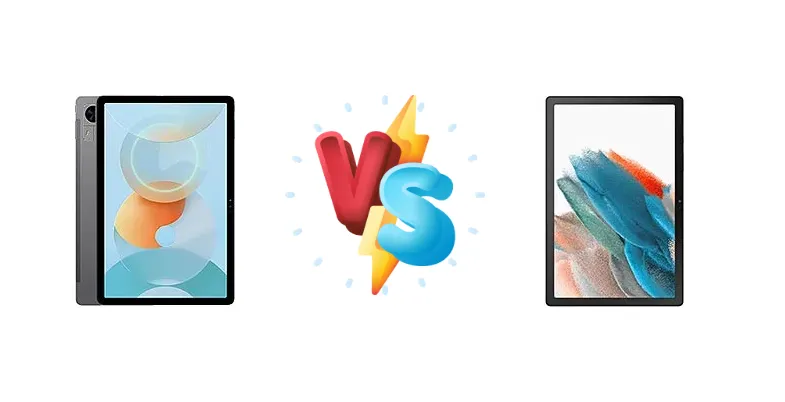
The sub-$200 tablet market is fiercely competitive, and the Umidigi G5 Tab and Samsung Galaxy Tab A8 10.5 (2021) are two strong contenders. Both aim to deliver a functional Android experience without breaking the bank, but they achieve this with slightly different approaches to chipset selection and feature sets. This comparison dives deep into the specifics to determine which tablet offers the best value for your money.
🏆 Quick Verdict
For most users, the Samsung Galaxy Tab A8 10.5 (2021) is the better choice. While the Umidigi G5 Tab offers a compelling price, the Tab A8’s slightly more powerful Unisoc Tiger T618 chipset and faster 15W charging provide a smoother, more responsive experience that justifies the price difference.
| Network |
|---|
| 2G bands | GSM 850 / 900 / 1800 / 1900 | GSM 850 / 900 / 1800 / 1900 |
| 3G bands | HSDPA 850 / 900 / 1700(AWS) / 1900 / 2100 | HSDPA 850 / 900 / 1700(AWS) / 1900 / 2100 |
| 4G bands | 1, 2, 3, 4, 5, 7, 8, 12, 17, 20, 28, 38, 40, 41, 66 | 1, 2, 3, 4, 5, 7, 8, 12, 17, 20, 28, 38, 40, 41, 66 |
| Speed | HSPA, LTE | HSPA, LTE - cellular model only |
| Technology | GSM / HSPA / LTE | GSM / HSPA / LTE |
| Launch |
|---|
| Announced | 2023 | 2021, December 15 |
| Status | Available. Released 2023 | Available. Released 2022, January 17 |
| Body |
|---|
| Build | Glass front, aluminum back, aluminum frame | - |
| Dimensions | 239.3 x 158.1 x 8.2 mm (9.42 x 6.22 x 0.32 in) | 246.8 x 161.9 x 6.9 mm (9.72 x 6.37 x 0.27 in) |
| SIM | Nano-SIM + Nano-SIM | Nano-SIM (cellular model only) |
| Weight | 465 g (1.03 lb) | 508 g (1.12 lb) |
| Display |
|---|
| Resolution | 800 x 1280 pixels, 16:10 ratio (~149 ppi density) | 1200 x 1920 pixels, 16:10 ratio (~216 ppi density) |
| Size | 10.1 inches, 295.8 cm2 (~78.2% screen-to-body ratio) | 10.5 inches, 319.7 cm2 (~80.0% screen-to-body ratio) |
| Type | IPS LCD | TFT LCD |
| Platform |
|---|
| CPU | Octa-core (2x1.6 GHz Cortex-A75 & 6x1.6 GHz Cortex-A55) | Octa-core (2x2.0 GHz Cortex-A75 & 6x2.0 GHz Cortex-A55) |
| Chipset | Unisoc T606 (12 nm) | Unisoc Tiger T618 (12 nm) |
| GPU | Mali-G57 MP1 | Mali G52 MP2 |
| OS | Android 13 | Android 11, upgradable to Android 14, One UI 6 |
| Memory |
|---|
| Card slot | microSDXC (uses shared SIM slot) | microSDXC (dedicated slot) |
| Internal | 128GB 4GB RAM | 32GB 2GB RAM, 32GB 3GB RAM, 64GB 2GB RAM, 64GB 3GB RAM, 64GB 4GB RAM, 128GB 3GB RAM, 128GB 4GB RAM |
| Main Camera |
|---|
| Dual | 13 MP, f/2.2, (wide)
Auxiliary lens | - |
| Features | LED flash | - |
| Single | - | 8 MP, AF |
| Video | 1080p@30fps | 1080p@30fps |
| Selfie camera |
|---|
| Single | 8 MP, f/2.2, (wide) | 5 MP |
| Video | 720p@30fps | 1080p@30fps |
| Sound |
|---|
| 3.5mm jack | - | Yes |
| 35mm jack | Yes | Yes |
| Loudspeaker | Yes, with stereo speakers | Yes, with stereo speakers (4 speakers) |
| Comms |
|---|
| Bluetooth | 5.0, A2DP, LE | 5.0, A2DP, LE |
| NFC | No | No |
| Positioning | GPS, GALILEO, GLONASS, BDS | GPS, GLONASS, BDS, GALILEO, QZSS - cellular model only |
| Radio | FM radio | No |
| USB | USB Type-C | USB Type-C 2.0 |
| WLAN | Wi-Fi 802.11 a/b/g/n/ac | Wi-Fi 802.11 a/b/g/n/ac, dual-band, Wi-Fi Direct |
| Features |
|---|
| Sensors | Accelerometer, proximity (accessories only), compass | Accelerometer, gyro, proximity, compass |
| Battery |
|---|
| Charging | 10W wired | 15W wired |
| Type | 6000 mAh | Li-Po 7040 mAh |
| Misc |
|---|
| Colors | Space Grey | Gray, Silver, Pink Gold |
| Models | - | SM-X200, SM-X205 |
| Price | - | About 230 EUR |
| SAR EU | - | 0.92 W/kg (body) |
Umidigi G5 Tab
- Lower price point makes it highly accessible.
- Unisoc T606 is sufficient for basic tasks.
- Likely lightweight and portable design.
- Slower processor compared to the Tab A8.
- Slower 10W charging.
- Potentially less refined software experience.
Samsung Galaxy Tab A8 10.5 (2021)
- More powerful Unisoc Tiger T618 chipset.
- Faster 15W charging for quicker top-ups.
- Samsung’s established brand and software support.
- Higher price compared to the Umidigi G5 Tab.
- May not offer significant improvements for very basic use cases.
- Still utilizes an IPS LCD panel, lacking advanced display tech.
Display Comparison
Neither tablet boasts a particularly impressive display. Both are likely utilizing IPS LCD panels, common in this price bracket. However, detailed specs like resolution and peak brightness are missing. The focus here is on processing power, not visual fidelity. Bezels are expected to be substantial on both devices, maximizing screen real estate within a budget-friendly design. Color accuracy is likely to be standard for this segment, suitable for casual viewing but not professional color work.
Camera Comparison
Camera performance is unlikely to be a deciding factor for either tablet. Both are expected to feature basic camera setups, likely with a primary sensor and a secondary depth or macro lens. Given the context data, focusing on the main sensor is key. The absence of detailed sensor information suggests both will deliver adequate, but not exceptional, image quality in good lighting conditions. The image processing algorithms will likely prioritize simplicity over advanced features.
Performance
The core difference lies in the chipsets. The Samsung Galaxy Tab A8 utilizes the Unisoc Tiger T618, featuring a CPU clocked at 2.0 GHz, while the Umidigi G5 Tab employs the Unisoc T606 with a 1.6 GHz clock speed. Both are octa-core designs with the same Cortex-A75 and A55 core configuration, but the higher clock speed of the T618 translates to a noticeable performance advantage in app loading times and multitasking. While both are 12nm chips, the T618’s architecture is optimized for slightly better sustained performance. This benefits users who frequently switch between apps or engage in light gaming.
Battery Life
Battery capacity is not specified, but both tablets will likely feature batteries in the 6000-7000 mAh range, typical for 10-inch tablets. However, the Samsung Galaxy Tab A8’s 15W wired charging is a significant advantage over the Umidigi G5 Tab’s 10W charging. This means the Tab A8 will reach a full charge considerably faster, minimizing downtime and maximizing usability. The faster charging is particularly beneficial for users who rely on their tablet throughout the day.
Buying Guide
Buy the Umidigi G5 Tab if you prioritize absolute affordability and are willing to accept slightly slower performance for basic tasks like web browsing and video playback. Buy the Samsung Galaxy Tab A8 10.5 (2021) if you value a more responsive user experience, faster charging, and the established brand reputation of Samsung, even if it means spending a bit more.
Frequently Asked Questions
❓ Will the Unisoc T618 in the Galaxy Tab A8 handle demanding games like PUBG Mobile?
While the Unisoc T618 is a capable chip, demanding games like PUBG Mobile will likely require reduced graphics settings for a smooth experience. It's not a gaming powerhouse, but it can handle casual gaming sessions without significant issues. The T606 in the Umidigi G5 Tab will struggle even more with these titles.
❓ Is the 10W charging on the Umidigi G5 Tab noticeably slow compared to the 15W on the Samsung Tab A8?
Yes, the difference is quite noticeable. 10W charging will take significantly longer to fully charge the Umidigi G5 Tab, potentially adding several hours to the charging time. The 15W charging on the Samsung Tab A8 provides a much faster and more convenient charging experience, especially for users who need to quickly top up their battery.
❓ How does the software experience differ between the two tablets?
The Samsung Galaxy Tab A8 runs Samsung’s One UI, which offers a more polished and feature-rich software experience compared to the likely stock Android or lightly customized version on the Umidigi G5 Tab. Samsung provides longer software support and updates, ensuring your tablet remains secure and functional for a longer period.