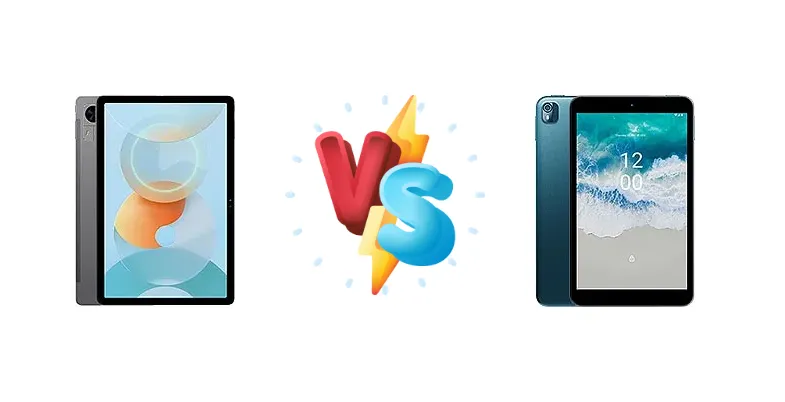
The budget tablet market is fiercely competitive, and the Umidigi G5 Tab and Nokia T10 find themselves in direct contention. Both devices are powered by the same Unisoc T606 chipset, leading to a fascinating comparison focused on how software, build quality, and brand reputation differentiate these nearly identical hardware platforms.
🏆 Quick Verdict
For the average user prioritizing brand trust and potential software updates, the Nokia T10 is the slightly safer bet. However, if price is the absolute deciding factor, the Umidigi G5 Tab offers the same core performance at a potentially lower cost, making it a viable alternative.
| Network |
|---|
| 2G bands | GSM 850 / 900 / 1800 / 1900 | GSM 850 / 900 / 1800 / 1900 |
| 3G bands | HSDPA 850 / 900 / 1700(AWS) / 1900 / 2100 | HSDPA 850 / 900 / 2100 |
| 4G bands | 1, 2, 3, 4, 5, 7, 8, 12, 17, 20, 28, 38, 40, 41, 66 | 1, 3, 5, 7, 8, 20, 28, 38, 40, 41 |
| Speed | HSPA, LTE | HSPA 42.2/5.76 Mbps, LTE Cat4 150/50 Mbps |
| Technology | GSM / HSPA / LTE | GSM / HSPA / LTE |
| Launch |
|---|
| Announced | 2023 | 2022, July 12 |
| Status | Available. Released 2023 | Available. Released 2022, August 20 |
| Body |
|---|
| Build | Glass front, aluminum back, aluminum frame | Glass front, plastic back, plastic frame |
| Dimensions | 239.3 x 158.1 x 8.2 mm (9.42 x 6.22 x 0.32 in) | 208 x 123.2 x 9 mm (8.19 x 4.85 x 0.35 in) |
| SIM | Nano-SIM + Nano-SIM | Nano-SIM |
| Weight | 465 g (1.03 lb) | 375 g (13.23 oz) |
| | - | Splash resistant |
| Display |
|---|
| Resolution | 800 x 1280 pixels, 16:10 ratio (~149 ppi density) | 800 x 1280 pixels, 16:10 ratio (~189 ppi density) |
| Size | 10.1 inches, 295.8 cm2 (~78.2% screen-to-body ratio) | 8.0 inches, 185.6 cm2 (~72.4% screen-to-body ratio) |
| Type | IPS LCD | IPS LCD, 360 nits (typ), 450 nits (peak) |
| Platform |
|---|
| CPU | Octa-core (2x1.6 GHz Cortex-A75 & 6x1.6 GHz Cortex-A55) | Octa-core (2x1.6 GHz Cortex-A75 & 6x1.6 GHz Cortex-A55) |
| Chipset | Unisoc T606 (12 nm) | Unisoc T606 (12 nm) |
| GPU | Mali-G57 MP1 | Mali-G57 MP1 |
| OS | Android 13 | Android 12, upgradable to Android 13 |
| Memory |
|---|
| Card slot | microSDXC (uses shared SIM slot) | microSDXC |
| Internal | 128GB 4GB RAM | 32GB 3GB RAM, 64GB 4GB RAM |
| Main Camera |
|---|
| Dual | 13 MP, f/2.2, (wide)
Auxiliary lens | - |
| Features | LED flash | LED flash |
| Single | - | 8 MP, 1/4.0", 1.12µm, AF |
| Video | 1080p@30fps | 1080p |
| Selfie camera |
|---|
| Single | 8 MP, f/2.2, (wide) | 2 MP, 1/5.0", 1.65µm |
| Video | 720p@30fps | 720p |
| Sound |
|---|
| 3.5mm jack | - | Yes |
| 35mm jack | Yes | Yes |
| Loudspeaker | Yes, with stereo speakers | Yes, with stereo speakers |
| Comms |
|---|
| Bluetooth | 5.0, A2DP, LE | 5.0, A2DP, LE |
| NFC | No | No |
| Positioning | GPS, GALILEO, GLONASS, BDS | GPS, GLONASS, GALILEO |
| Radio | FM radio | No |
| USB | USB Type-C | USB Type-C 2.0, OTG |
| WLAN | Wi-Fi 802.11 a/b/g/n/ac | Wi-Fi 802.11 a/b/g/n/ac, dual-band |
| Features |
|---|
| Sensors | Accelerometer, proximity (accessories only), compass | Accelerometer, proximity |
| Battery |
|---|
| Charging | 10W wired | 10W wired |
| Type | 6000 mAh | Li-Po 5250 mAh |
| Misc |
|---|
| Colors | Space Grey | Ocean Blue |
| Models | - | TA-1503, TA-1472, TA-1462, TA-1457 |
| Price | - | About 160 EUR |
| SAR | - | 1.19 W/kg (body) |
| SAR EU | - | 0.27 W/kg (head) 1.57 W/kg (body) |
Umidigi G5 Tab
- Potentially lower price point
- Identical performance to Nokia T10
- May offer more aggressive discounts
- Less established brand reputation
- Potentially less frequent software updates
- Build quality may be inferior
Nokia T10
- Stronger brand reputation (Nokia)
- Likely better software support
- Potentially more durable build quality
- Potentially higher price
- Identical performance to Umidigi G5 Tab
- May lack unique features
Display Comparison
Both the Umidigi G5 Tab and Nokia T10 are expected to feature 10.1-inch displays, given their market positioning. However, specific details like panel type (IPS vs. VA), resolution, and brightness are not provided. The Unisoc T606’s integrated GPU is capable of driving 1080p content, suggesting both tablets likely target this resolution. Without knowing the peak brightness in nits, it’s difficult to assess outdoor visibility, but given the price point, neither is expected to excel in direct sunlight. Color accuracy will likely be standard for this segment, prioritizing cost over professional-grade color reproduction.
Camera Comparison
Camera performance is unlikely to be a key differentiator. Both tablets will likely feature basic camera setups, potentially with a single rear camera and a front-facing camera for video calls. Given the lack of information, it’s safe to assume image quality will be adequate for casual snapshots but not competitive with smartphones. The absence of details regarding sensor size or aperture suggests a focus on cost reduction rather than photographic capabilities. Any additional cameras (like a 2MP macro) are likely included for marketing purposes and offer limited real-world benefit.
Performance
The core of both tablets is the Unisoc T606, a 12nm octa-core processor featuring two Cortex-A75 cores clocked at 1.6 GHz and six Cortex-A55 cores, also at 1.6 GHz. This configuration provides a balanced approach to performance, suitable for everyday tasks like web browsing, video playback, and light multitasking. The identical CPU and chipset mean performance will be virtually indistinguishable between the two devices. RAM configurations, which are not specified, will significantly impact multitasking capabilities; more RAM (4GB or higher) is recommended for smoother operation. Thermal management will likely be passive, relying on the tablet chassis to dissipate heat, which could lead to some throttling under sustained load.
Battery Life
Both devices utilize 10W wired charging, indicating a similar charging experience. Battery capacity is not specified, but a typical tablet in this price range would likely house a 5000-6000 mAh battery. With the power-efficient Unisoc T606, users can expect all-day battery life with moderate usage, such as web browsing and video streaming. The 10W charging rate will result in a relatively slow charge time, likely taking several hours to reach 100%. The actual battery life will depend heavily on screen brightness, usage patterns, and background app activity.
Buying Guide
Buy the Umidigi G5 Tab if you need a functional tablet for basic tasks like media consumption and light browsing, and are comfortable with a less established brand to maximize value. Buy the Nokia T10 if you prefer a brand with a stronger track record for software support and build quality, and are willing to pay a small premium for that peace of mind.
Frequently Asked Questions
❓ Will the Unisoc T606 struggle with demanding games like PUBG Mobile?
The Unisoc T606 is a capable processor for casual gaming, but demanding titles like PUBG Mobile will likely require reduced graphics settings and frame rates for a playable experience. Expect some frame drops and potential stuttering, especially during intense action sequences. It's best suited for less graphically intensive games.
❓ How long can I expect software updates to be supported on the Nokia T10?
Nokia typically provides a commitment of at least two years of security updates for its tablets. While major Android version updates aren't guaranteed, the T10 is likely to receive regular security patches, enhancing its long-term security and usability. Umidigi's update policy is less predictable.
❓ Is the 10W charging speed a significant drawback?
10W charging is relatively slow compared to modern fast-charging standards. However, given the likely battery capacity (5000-6000 mAh) and the tablet's intended use case (casual consumption), it's unlikely to be a major inconvenience. It's best to charge the tablet overnight or during periods of inactivity.