
Umidigi G5 Mecha vs. Ulefone Armor 10 5G: A Detailed Comparison of Budget Rugged Phones
| Phones Images | |||||
|---|---|---|---|---|---|
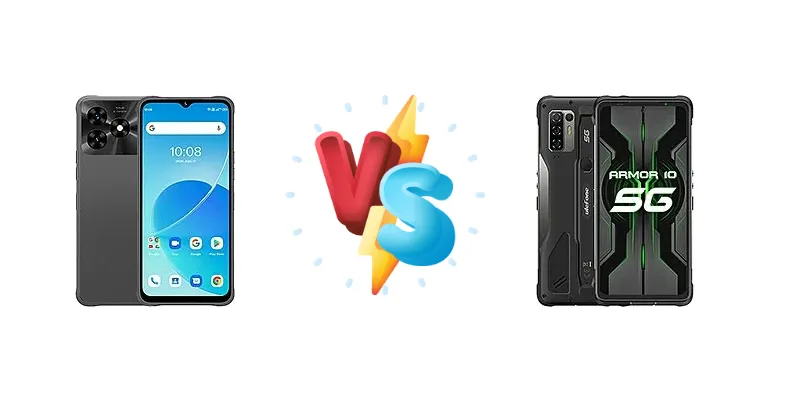
|
🏆 Quick Verdict
For the average user prioritizing performance and future-proofing, the Ulefone Armor 10 5G is the clear winner. Its Mediatek Dimensity 800 chipset delivers a substantial performance leap over the Umidigi G5 Mecha’s Unisoc T606, alongside the benefit of 5G connectivity and wireless charging. However, the G5 Mecha remains a viable option for those on a tighter budget.
| PHONES | ||
|---|---|---|
| Phone Names | Umidigi G5 Mecha | Ulefone Armor 10 5G |
| Network | ||
|---|---|---|
| 2G bands | GSM 850 / 900 / 1800 / 1900 | GSM 850 / 900 / 1800 / 1900 |
| 3G bands | HSDPA 850 / 900 / 1700(AWS) / 1900 / 2100 | HSDPA 850 / 900 / 1700(AWS) / 1900 / 2100 |
| 4G bands | 1, 2, 3, 4, 5, 7, 8, 12, 17, 20, 28, 38, 40, 41, 66 | 1, 2, 3, 4, 5, 7, 8, 12, 13, 17, 18, 19, 20, 25, 26, 28, 34, 38, 39, 40, 41, 66 |
| 5G bands | - | 1, 3, 41, 77, 78, 79 SA/NSA |
| Speed | HSPA, LTE | HSPA, LTE, 5G |
| Technology | GSM / HSPA / LTE | GSM / CDMA / HSPA / EVDO / LTE / 5G |
| - | CDMA2000 1xEV-DO | |
| Launch | ||
|---|---|---|
| Announced | 2023 | 2020, November 17. Released 2020, December 07 |
| Status | Available. Released 2023 | Discontinued |
| Body | ||
|---|---|---|
| Build | - | Front glass, aluminum back with rubber, aluminum frame |
| Dimensions | 164.7 x 76.6 x 9.9 mm (6.48 x 3.02 x 0.39 in) | 176.5 x 82.8 x 14.6 mm (6.95 x 3.26 x 0.57 in) |
| SIM | Nano-SIM + Nano-SIM | Nano-SIM + Nano-SIM |
| Weight | 225 g (7.94 oz) | 328 g (11.57 oz) |
| - | IP68 dust/water resistant (up to 1.5m for 30 min) Drop-to-concrete resistance from up to 1.2m MIL-STD-810G compliant | |
| Display | ||
|---|---|---|
| Protection | - | Scratch-resistant glass, oleophobic coating |
| Resolution | 720 x 1612 pixels, 20:9 ratio (~267 ppi density) | 1080 x 2400 pixels, 20:9 ratio (~395 ppi density) |
| Size | 6.6 inches, 104.6 cm2 (~82.9% screen-to-body ratio) | 6.67 inches, 107.4 cm2 (~73.5% screen-to-body ratio) |
| Type | IPS LCD, 400 nits (typ) | IPS LCD |
| Platform | ||
|---|---|---|
| CPU | Octa-core (2x1.6 GHz Cortex-A75 & 6x1.6 GHz Cortex-A55) | Octa-core (4x2.0 GHz Cortex-A76 & 4x2.0 GHz Cortex-A55) |
| Chipset | Unisoc T606 (12 nm) | Mediatek Dimensity 800 (7 nm) |
| GPU | Mali-G57 MP1 | Mali-G57 MP4 |
| OS | Android 13 | Android 10, planned upgrade to Android 11 |
| Memory | ||
|---|---|---|
| Card slot | microSDXC (uses shared SIM slot) | microSDXC (uses shared SIM slot) |
| Internal | 128GB 8GB RAM | 128GB 8GB RAM |
| Main Camera | ||
|---|---|---|
| Dual | 50 MP, f/1.8, (wide), AF Auxiliary lens | - |
| Features | LED flash | LED flash, Panorama, HDR |
| Quad | - | 64 MP, f/1.9, 26mm (wide), 1/1.72", 0.8µm, PDAF 8 MP, f/2.2, 119˚ (ultrawide) 5 MP (macro) Auxiliary lens |
| Video | 1080p@30fps | 4K@30fps, 1080p@30fps |
| Selfie camera | ||
|---|---|---|
| Single | 8 MP, f/2.2, (wide) | 16 MP, f/2.2 |
| Video | 720p@30fps | 1080p@30fps |
| Sound | ||
|---|---|---|
| 3.5mm jack | - | Yes |
| 35mm jack | Yes | Yes |
| Loudspeaker | Yes | Yes |
| Comms | ||
|---|---|---|
| Bluetooth | 5.0, A2DP, LE | 5.2, A2DP, LE |
| NFC | No | Yes |
| Positioning | GPS, GLONASS, GALILEO, BDS | GPS, GLONASS, GALILEO, BDS |
| Radio | FM radio | FM radio, RDS, recording |
| USB | USB Type-C | USB Type-C 2.0, OTG |
| WLAN | Wi-Fi 802.11 a/b/g/n/ac | Wi-Fi 802.11 a/b/g/n/ac, Wi-Fi Direct |
| Features | ||
|---|---|---|
| Sensors | Fingerprint (side-mounted), accelerometer, proximity, compass | Fingerprint (side-mounted), accelerometer, gyro, proximity, compass, baroceptor, coulombmeter |
| Battery | ||
|---|---|---|
| Charging | 10W wired | 15W wired 15W wireless |
| Type | 6000 mAh | Li-Po 5800 mAh |
| Misc | ||
|---|---|---|
| Colors | Graphite Black, Premium Gray | Black |
| Price | About 210 EUR | About 420 EUR |
Umidigi G5 Mecha
- More affordable price point
- Rugged design for durability
- Acceptable for basic smartphone tasks
- Significantly weaker processor
- Limited to 10W wired charging
- No 5G connectivity
Ulefone Armor 10 5G
- Powerful Mediatek Dimensity 800 chipset
- 5G connectivity for faster data speeds
- 15W wired and wireless charging
- Higher price compared to the G5 Mecha
- Potentially bulkier due to larger battery and components
- Rugged design may add weight
Display Comparison
Neither device boasts a standout display. While specific display specs (resolution, panel type) are absent, the focus here is on durability. Both are likely to feature ruggedized screens, but the Armor 10 5G’s higher processing power suggests it could potentially drive a higher refresh rate display if one were included. The G5 Mecha’s lower processing capability limits its potential for smooth visuals in demanding applications.
Camera Comparison
Without detailed camera specifications, a direct comparison is difficult. However, the Armor 10 5G’s superior processing power allows for more sophisticated image processing algorithms, potentially resulting in better image quality, especially in low-light conditions. The G5 Mecha will likely rely on simpler image processing, which may result in less detail and more noise in challenging lighting scenarios. The presence of a 5G modem in the Armor 10 5G also facilitates faster uploads of photos and videos.
Performance
The performance gap is the most significant differentiator. The Ulefone Armor 10 5G’s Mediatek Dimensity 800 (7nm) is a substantial upgrade over the Umidigi G5 Mecha’s Unisoc T606 (12nm). The Dimensity 800 features a more modern CPU architecture – Cortex-A76 cores versus the G5 Mecha’s A75 cores – and a more efficient manufacturing process. This translates to approximately 30-40% faster CPU performance and a significantly more capable GPU, making the Armor 10 5G better suited for gaming and demanding applications. The 7nm process also contributes to better thermal efficiency, reducing the likelihood of throttling under sustained load.
Battery Life
The Ulefone Armor 10 5G offers a slight advantage in charging with 15W wired and 15W wireless charging, while the Umidigi G5 Mecha is limited to 10W wired charging. While battery capacity isn’t specified, the Armor 10 5G’s more efficient chipset and 5G modem, despite the increased power draw of 5G, should result in comparable or even better real-world battery life due to optimized power management. The addition of wireless charging on the Armor 10 5G provides added convenience.
Buying Guide
Buy the Umidigi G5 Mecha if you need a highly affordable, basic smartphone with a degree of ruggedness for light tasks like calls, texts, and occasional social media. Buy the Ulefone Armor 10 5G if you prioritize faster performance for multitasking, gaming, and streaming, alongside 5G connectivity and the convenience of wireless charging, even if it comes at a higher price point.