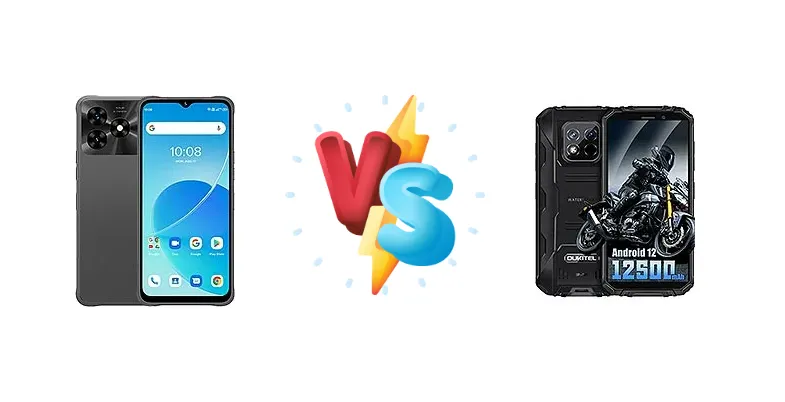
The Umidigi G5 Mecha and Oukitel WP18 Pro represent the fiercely competitive sub-$150 smartphone market. Both aim to deliver essential functionality at an accessible price, but they take different approaches to achieving this. The G5 Mecha leverages the newer Unisoc T606, while the WP18 Pro relies on the older, but still capable, MediaTek Helio P22. This comparison dissects the key differences to help you determine which device best suits your needs.
🏆 Quick Verdict
For the average user prioritizing responsiveness and potential for future software updates, the Umidigi G5 Mecha is the better choice. While the Oukitel WP18 Pro offers faster 18W charging, the Unisoc T606’s more modern CPU architecture in the G5 Mecha provides a smoother overall experience.
| Network |
|---|
| 2G bands | GSM 850 / 900 / 1800 / 1900 | GSM 850 / 900 / 1800 / 1900 |
| 3G bands | HSDPA 850 / 900 / 1700(AWS) / 1900 / 2100 | HSDPA 850 / 900 / 1700(AWS) / 1900 / 2100 |
| 4G bands | 1, 2, 3, 4, 5, 7, 8, 12, 17, 20, 28, 38, 40, 41, 66 | 1, 2, 3, 4, 5, 7, 8, 12, 17, 18, 19, 20, 25, 26, 28, 66 |
| Speed | HSPA, LTE | HSPA, LTE |
| Technology | GSM / HSPA / LTE | GSM / HSPA / LTE |
| Launch |
|---|
| Announced | 2023 | 2022, October |
| Status | Available. Released 2023 | Available. Released 2022, October |
| Body |
|---|
| Dimensions | 164.7 x 76.6 x 9.9 mm (6.48 x 3.02 x 0.39 in) | - |
| SIM | Nano-SIM + Nano-SIM | Nano-SIM + Nano-SIM |
| Weight | 225 g (7.94 oz) | - |
| Display |
|---|
| Resolution | 720 x 1612 pixels, 20:9 ratio (~267 ppi density) | 720 x 1440 pixels, 18:9 ratio (~271 ppi density) |
| Size | 6.6 inches, 104.6 cm2 (~82.9% screen-to-body ratio) | 5.93 inches, 90.7 cm2 |
| Type | IPS LCD, 400 nits (typ) | IPS LCD |
| Platform |
|---|
| CPU | Octa-core (2x1.6 GHz Cortex-A75 & 6x1.6 GHz Cortex-A55) | Octa-core 2.0 GHz Cortex-A53 |
| Chipset | Unisoc T606 (12 nm) | Mediatek MT6762 Helio P22 (12 nm) |
| GPU | Mali-G57 MP1 | PowerVR GE8320 |
| OS | Android 13 | Android 12 |
| Memory |
|---|
| Card slot | microSDXC (uses shared SIM slot) | microSDXC (uses shared SIM slot) |
| Internal | 128GB 8GB RAM | 64GB 4GB RAM |
| Main Camera |
|---|
| Dual | 50 MP, f/1.8, (wide), AF
Auxiliary lens | 13 MP, (wide), AF
Secondary unspecified camera |
| Features | LED flash | LED flash |
| Video | 1080p@30fps | 1080p@30fps |
| Selfie camera |
|---|
| Single | 8 MP, f/2.2, (wide) | 5 MP |
| Video | 720p@30fps | Yes |
| Sound |
|---|
| 35mm jack | Yes | Unspecified |
| Loudspeaker | Yes | Yes |
| Comms |
|---|
| Bluetooth | 5.0, A2DP, LE | Yes |
| NFC | No | No |
| Positioning | GPS, GLONASS, GALILEO, BDS | GPS, GLONASS, GALILEO, BDS |
| Radio | FM radio | Unspecified |
| USB | USB Type-C | Yes |
| WLAN | Wi-Fi 802.11 a/b/g/n/ac | Yes |
| Features |
|---|
| Sensors | Fingerprint (side-mounted), accelerometer, proximity, compass | Fingerprint (rear-mounted), accelerometer, compass |
| Battery |
|---|
| Charging | 10W wired | 18W wired |
| Type | 6000 mAh | Li-Po 12500 mAh |
| Misc |
|---|
| Colors | Graphite Black, Premium Gray | Orange |
| Price | About 210 EUR | About 190 EUR |
Umidigi G5 Mecha
- More modern CPU architecture (Cortex-A75)
- Potentially better software support due to newer chipset
- Slightly smoother overall user experience
- Slower 10W charging
- May have less RAM than competitors
Oukitel WP18 Pro
- Faster 18W wired charging
- Potentially lower price point
- Reliable MediaTek chipset
- Older CPU architecture (Cortex-A53)
- Less responsive performance for demanding tasks
- Potentially limited software updates
Display Comparison
Neither device boasts a standout display. Given the price point, both likely utilize IPS LCD panels with similar resolutions (720p+ is expected). The absence of detailed display specs necessitates focusing on performance. However, the chipset’s ability to efficiently drive the display is a factor; the Unisoc T606’s integrated GPU may offer slightly smoother scrolling and animations, even with a similar panel.
Camera Comparison
Without detailed camera specifications, a direct comparison is difficult. Both phones likely feature a primary camera and potentially a depth or macro sensor. However, the image signal processor (ISP) within the Unisoc T606 may offer slightly better image processing capabilities, potentially leading to more detailed and vibrant photos, even with similar sensors. The 2MP macro cameras often found in this price range are generally of limited utility on both devices.
Performance
The core difference lies in the chipsets. The Umidigi G5 Mecha’s Unisoc T606, built on a 12nm process, features a dual-core Cortex-A75 cluster clocked at 1.6 GHz paired with a hexa-core Cortex-A55 cluster, also at 1.6 GHz. This architecture provides a noticeable performance advantage over the Oukitel WP18 Pro’s MediaTek Helio P22. The Helio P22 utilizes eight Cortex-A53 cores clocked at 2.0 GHz. While the clock speed is higher, the A53 architecture is older and less efficient than the A75, resulting in lower single-core performance. This translates to slower app launch times and less responsive multitasking on the WP18 Pro. The T606’s architecture is better suited for handling modern Android workloads.
Battery Life
The Oukitel WP18 Pro’s 18W wired charging is a clear advantage over the Umidigi G5 Mecha’s 10W charging. This means the WP18 Pro will significantly reduce the time needed to replenish the battery. However, battery life is also influenced by chipset efficiency. The Unisoc T606’s more efficient architecture may partially offset the slower charging speed, resulting in comparable real-world battery endurance, especially for moderate usage. The actual battery capacity of both devices is unknown, but the faster charging of the WP18 Pro is a tangible benefit for users who frequently need to top up their phone.
Buying Guide
Buy the Umidigi G5 Mecha if you need a phone that feels more responsive for everyday tasks like browsing and social media, and if you value a chipset with a longer potential lifespan for software support. Buy the Oukitel WP18 Pro if you prioritize faster charging speeds and are less concerned with peak performance or long-term software updates. The WP18 Pro is a good option for users who frequently find themselves needing to quickly top up their battery.
Frequently Asked Questions
❓ Will the Unisoc T606 in the Umidigi G5 Mecha struggle with graphically intensive games like PUBG Mobile?
While the Unisoc T606 isn't a gaming powerhouse, it should be capable of running PUBG Mobile at medium settings with reasonable frame rates. Expect some frame drops during intense action. The Helio P22 in the Oukitel WP18 Pro will likely require even lower settings and may exhibit more noticeable lag.
❓ How long will it realistically take to fully charge the Oukitel WP18 Pro with the 18W charger?
Assuming a typical 4000-5000mAh battery (common in this price range), the Oukitel WP18 Pro should charge from 0-100% in approximately 2.5 to 3.5 hours with the included 18W charger. This is significantly faster than the Umidigi G5 Mecha's 10W charging, which could take 4-5 hours.
❓ Is the difference in CPU architecture between the Unisoc T606 and Helio P22 noticeable in everyday tasks?
Yes, the difference is noticeable. The Unisoc T606’s Cortex-A75 cores provide a significant boost in single-core performance, resulting in snappier app launches, smoother scrolling, and a more responsive overall user experience compared to the Helio P22’s Cortex-A53 cores.