
Umidigi G5 Mecha vs Doogee S98 Pro: A Deep Dive into Affordable Rugged Phones
| Phones Images | |||||
|---|---|---|---|---|---|
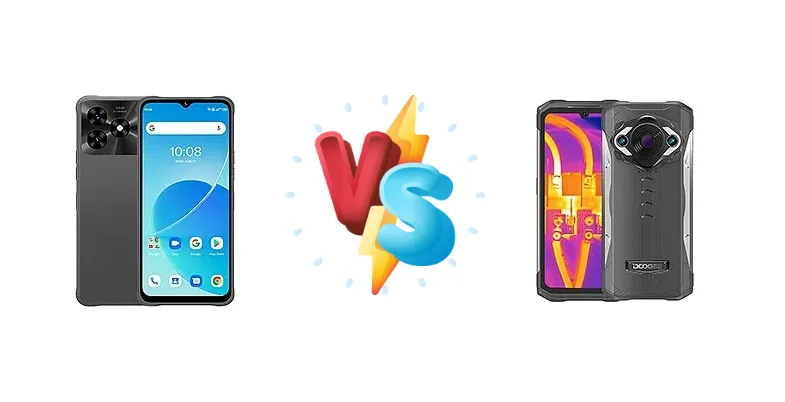
|
🏆 Quick Verdict
For most users, the Doogee S98 Pro is the superior choice. Its Mediatek Helio G96 chipset provides a noticeable performance uplift over the Umidigi G5 Mecha’s Unisoc T606, and the inclusion of 33W wired and 15W wireless charging significantly improves usability. While the G5 Mecha is cheaper, the performance trade-offs are substantial.
| PHONES | ||
|---|---|---|
| Phone Names | Umidigi G5 Mecha | Doogee S98 Pro |
| Network | ||
|---|---|---|
| 2G bands | GSM 850 / 900 / 1800 / 1900 | GSM 850 / 900 / 1800 / 1900 |
| 3G bands | HSDPA 850 / 900 / 1700(AWS) / 1900 / 2100 | HSDPA 800 / 850 / 900 / 1700(AWS) / 1900 / 2100 |
| 4G bands | 1, 2, 3, 4, 5, 7, 8, 12, 17, 20, 28, 38, 40, 41, 66 | 1, 2, 3, 4, 5, 7, 8, 12, 13, 17, 18, 19, 20, 25, 26, 28, 34, 38, 39, 40, 41, 66 |
| Speed | HSPA, LTE | HSPA, LTE |
| Technology | GSM / HSPA / LTE | GSM / CDMA / HSPA / LTE |
| Launch | ||
|---|---|---|
| Announced | 2023 | 2022, May 27 |
| Status | Available. Released 2023 | Available. Released 2022, June 06 |
| Body | ||
|---|---|---|
| Dimensions | 164.7 x 76.6 x 9.9 mm (6.48 x 3.02 x 0.39 in) | 172 x 82 x 15.5 mm (6.77 x 3.23 x 0.61 in) |
| SIM | Nano-SIM + Nano-SIM | Nano-SIM + Nano-SIM |
| Weight | 225 g (7.94 oz) | 320 g (11.29 oz) |
| Display | ||
|---|---|---|
| Protection | - | Corning Gorilla Glass |
| Resolution | 720 x 1612 pixels, 20:9 ratio (~267 ppi density) | 1080 x 2340 pixels, 19.5:9 ratio (~409 ppi density) |
| Size | 6.6 inches, 104.6 cm2 (~82.9% screen-to-body ratio) | 6.3 inches, 97.4 cm2 (~69.1% screen-to-body ratio) |
| Type | IPS LCD, 400 nits (typ) | IPS LCD, 500 nits (peak) |
| Platform | ||
|---|---|---|
| CPU | Octa-core (2x1.6 GHz Cortex-A75 & 6x1.6 GHz Cortex-A55) | Octa-core (2x2.05 GHz Cortex-A76 & 6x2.0 GHz Cortex-A55) |
| Chipset | Unisoc T606 (12 nm) | Mediatek MT6781 Helio G96 (12 nm) |
| GPU | Mali-G57 MP1 | Mali-G57 MC2 |
| OS | Android 13 | Android 12 |
| Memory | ||
|---|---|---|
| Card slot | microSDXC (uses shared SIM slot) | microSDXC (dedicated slot) |
| Internal | 128GB 8GB RAM | 256GB 8GB RAM |
| Main Camera | ||
|---|---|---|
| Dual | 50 MP, f/1.8, (wide), AF Auxiliary lens | - |
| Features | LED flash | Dual-LED flash, HDR, panorama |
| Triple | - | 48 MP, f/1.8, (wide), PDAF 20 MP, f/1.8, (night vision), 2 infrared night vision lights Thermal imaging camera |
| Video | 1080p@30fps | 1440p, 1080p |
| Selfie camera | ||
|---|---|---|
| Single | 8 MP, f/2.2, (wide) | 16 MP, f/2.0, (wide) |
| Video | 720p@30fps | 1080p |
| Sound | ||
|---|---|---|
| 35mm jack | Yes | Unspecified |
| Loudspeaker | Yes | Yes |
| Comms | ||
|---|---|---|
| Bluetooth | 5.0, A2DP, LE | 5.1, A2DP, LE |
| NFC | No | Yes |
| Positioning | GPS, GLONASS, GALILEO, BDS | GPS, GLONASS, BDS, GALILEO |
| Radio | FM radio | FM radio |
| USB | USB Type-C | USB Type-C 2.0, OTG |
| WLAN | Wi-Fi 802.11 a/b/g/n/ac | Wi-Fi 802.11 a/b/g/n/ac, dual-band |
| Features | ||
|---|---|---|
| Sensors | Fingerprint (side-mounted), accelerometer, proximity, compass | Fingerprint (side-mounted), accelerometer, gyro, proximity, compass |
| Battery | ||
|---|---|---|
| Charging | 10W wired | 33W wired 15W wireless |
| Type | 6000 mAh | 6000 mAh |
| Misc | ||
|---|---|---|
| Colors | Graphite Black, Premium Gray | Black |
| Price | About 210 EUR | About 470 EUR |
Umidigi G5 Mecha
- Most affordable option
- Rugged design for durability
- Acceptable for basic tasks
- Slow charging speed (10W)
- Underpowered Unisoc T606 chipset
- Limited performance for demanding apps
Doogee S98 Pro
- Faster Helio G96 processor
- 33W wired and 15W wireless charging
- Smoother user experience
- Higher price point
- May still lack high-end features
- Rugged design may add bulk
Display Comparison
Neither device boasts a standout display. Both likely utilize LCD panels, common in this price bracket. The key difference lies elsewhere. We lack specific display specs, but the focus here is on durability, not visual fidelity. Expect adequate viewing angles and color reproduction, but don't anticipate vibrant colors or high peak brightness. The ruggedized construction will likely prioritize impact resistance over display quality.
Camera Comparison
Without detailed camera specs beyond the chipsets, a direct comparison is difficult. However, the processing capabilities of the Helio G96 in the Doogee S98 Pro will likely result in better image quality, particularly in low-light conditions. The G96’s ISP (Image Signal Processor) is more advanced, enabling better noise reduction and dynamic range. Expect both phones to feature a primary camera and potentially a depth or macro sensor, but the G96’s processing power will be crucial for usable results. We can assume both will have similar limitations in terms of zoom capabilities.
Performance
The Doogee S98 Pro’s Mediatek Helio G96 is the clear winner in performance. Its octa-core configuration, featuring 2x2.05 GHz Cortex-A76 cores, offers a significant advantage over the Umidigi G5 Mecha’s Unisoc T606 (2x1.6 GHz Cortex-A75). The Cortex-A76 architecture is demonstrably more efficient and powerful than the A75, translating to faster app loading times, smoother multitasking, and improved gaming performance. While both are 12nm chips, the G96’s architecture provides a tangible benefit. The G5 Mecha will struggle with graphically intensive tasks.
Battery Life
The Doogee S98 Pro’s charging capabilities are a major advantage. 33W wired charging will significantly reduce charging times compared to the Umidigi G5 Mecha’s slow 10W charging. While battery capacity isn’t specified, the faster charging speed makes the S98 Pro more convenient for users who need to quickly top up their device. The addition of 15W wireless charging further enhances usability, offering a cable-free charging option. The G5 Mecha’s 10W charging will require considerably longer to reach a full charge, making it less ideal for users with limited time.
Buying Guide
Buy the Umidigi G5 Mecha if you prioritize absolute affordability and only need a phone for basic tasks like calls, texts, and light social media. It’s a viable option for those who need a durable device as a secondary phone or for harsh work environments where damage is likely. Buy the Doogee S98 Pro if you value a smoother user experience, faster charging, and the ability to handle more demanding applications like gaming or video editing. It’s the better all-rounder for everyday use.