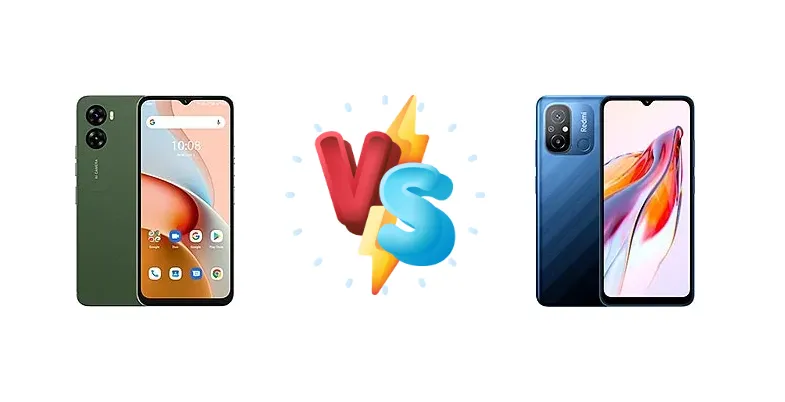
The sub-$150 smartphone market is fiercely competitive. Both the Umidigi G3 and Xiaomi Redmi 12C aim to deliver essential smartphone functionality at an incredibly affordable price. However, significant differences in their core hardware, particularly the chipset, dictate vastly different user experiences. This comparison will dissect those differences to help you choose the best option for your needs.
🏆 Quick Verdict
For most users, the Xiaomi Redmi 12C is the superior choice. Its Mediatek Helio G85 chipset, featuring a more modern CPU architecture, provides a noticeably smoother and more responsive experience for everyday tasks and even light gaming. While both phones share the same slow 10W charging, the Redmi 12C’s performance advantage justifies the often minimal price difference.
| Network |
|---|
| 2G bands | GSM 850 / 900 / 1800 / 1900 | GSM 850 / 900 / 1800 / 1900 |
| 3G bands | HSDPA 850 / 900 / 1700(AWS) / 1900 / 2100 | HSDPA 850 / 900 / 2100 |
| 4G bands | 1, 2, 3, 4, 5, 7, 8, 12, 17, 20, 28, 38, 40, 41 | 1, 3, 5, 7, 8, 20, 28, 38, 40, 41 - International |
| Speed | HSPA, LTE | HSPA, LTE |
| Technology | GSM / HSPA / LTE | GSM / CDMA / HSPA / EVDO / LTE |
| | - | CDMA2000 1xEV-DO |
| Launch |
|---|
| Announced | 2023 | 2022, December 31 |
| Status | Available. Released 2023 | Available. Released 2023, January 01 |
| Body |
|---|
| Dimensions | 163.9 x 75.7 x 8.8 mm (6.45 x 2.98 x 0.35 in) | 168.8 x 76.4 x 8.8 mm (6.65 x 3.01 x 0.35 in) |
| SIM | Nano-SIM + Nano-SIM | Nano-SIM + Nano-SIM |
| Weight | 192 g (6.77 oz) | 192 g (6.77 oz) |
| Display |
|---|
| Resolution | 720 x 1600 pixels, 20:9 ratio (~269 ppi density) | 720 x 1650 pixels (~268 ppi density) |
| Size | 6.52 inches, 102.6 cm2 (~82.7% screen-to-body ratio) | 6.71 inches, 106.5 cm2 (~82.6% screen-to-body ratio) |
| Type | IPS LCD | IPS LCD, 500 nits (typ) |
| Platform |
|---|
| CPU | Quad-core 2.0 GHz Cortex-A53 | Octa-core (2x2.0 GHz Cortex-A75 & 6x1.8 GHz Cortex-A55) |
| Chipset | Mediatek Helio A22 (12 nm) | Mediatek MT6769Z Helio G85 (12 nm) |
| GPU | PowerVR GE8320 | Mali-G52 MC2 |
| OS | Android 13 | Android 12, MIUI 13 |
| Memory |
|---|
| Card slot | microSDXC (uses shared SIM slot) | microSDXC (dedicated slot) |
| Internal | 64GB 4GB RAM | 32GB 2GB RAM, 32GB 3GB RAM, 32GB 4GB RAM, 64GB 3GB RAM, 64GB 4GB RAM, 128GB 3GB RAM, 128GB 4GB RAM, 128GB 6GB RAM |
| | - | eMMC 5.1 |
| Main Camera |
|---|
| Dual | 13 MP, f/2.2, (wide), AF
Auxiliary lens | 50 MP, (wide), PDAF
0.08 MP (depth) |
| Features | Dual-LED flash, HDR | LED flash, HDR |
| Single | - | 50 MP, f/1.8, (wide), 1/2.76", PDAF
Auxiliary lens |
| Video | 1080p@30fps | 1080p@30fps |
| Selfie camera |
|---|
| Single | 5 MP, f/2.2, (wide) | 5 MP, f/2.2, (wide) |
| Video | 720p@30fps | 1080p@30fps |
| Sound |
|---|
| 3.5mm jack | - | Yes |
| 35mm jack | Yes | Yes |
| Loudspeaker | Yes | Yes |
| Comms |
|---|
| Bluetooth | 5.0, A2DP, LE | 5.1, A2DP, LE |
| NFC | No | Yes (market/region dependent) |
| Positioning | GPS, GLONASS, GALILEO | GPS, GLONASS, BDS, GALILEO |
| Radio | No | FM radio |
| USB | USB Type-C, OTG | microUSB 2.0 |
| WLAN | Wi-Fi 802.11 b/g/n/ac, dual-band, Wi-Fi Direct | Wi-Fi 802.11 a/b/g/n/ac, dual-band, Wi-Fi Direct |
| Features |
|---|
| Sensors | Fingerprint (side-mounted), accelerometer, proximity, compass | Fingerprint (rear-mounted), accelerometer |
| | - | Virtual proximity sensing |
| Battery |
|---|
| Charging | 10W wired | 10W wired |
| Type | 5150 mAh | Li-Po 5000 mAh |
| Misc |
|---|
| Colors | Graphite Black, Dark Green, Lavender Purple | Graphite Gray, Ocean Blue, Mint Green, Lavender Purple |
| Models | - | 22120RN86G, 22120RN86I, 22126RN91Y, 2212ARNC4L |
| Price | - | £ 132.99 / € 107.41 |
| SAR | - | 1.08 W/kg (head) 0.64 W/kg (body) |
| SAR EU | - | 0.98 W/kg (head) 0.99 W/kg (body) |
Umidigi G3
- Lowest possible price point
- Functional for basic communication
- Simple and straightforward Android experience
- Significantly underpowered processor
- Poor multitasking performance
- Slow charging speed
Xiaomi Redmi 12C
- More powerful Helio G85 chipset
- Smoother user experience
- Better multitasking capabilities
- Slow 10W charging
- Basic camera system
- Still limited by budget constraints
Display Comparison
Neither device boasts a standout display. Both likely utilize LCD panels, a common cost-saving measure in this segment. The focus here isn't on visual fidelity, but on functionality. While specific display specs (resolution, brightness) are unavailable, the Redmi 12C’s larger market share suggests a potentially better-optimized panel. The Umidigi G3’s display will likely suffice for basic viewing, but expect limited outdoor visibility and color accuracy.
Camera Comparison
Camera performance on both devices will be limited. Without specific sensor details, it’s safe to assume both rely on basic sensors. The Redmi 12C’s larger user base and potential for software optimization may yield slightly better results, but don’t expect flagship-level image quality. The presence of a 2MP macro camera on the Redmi 12C is largely a marketing gimmick; its limited resolution offers minimal practical benefit. Focusing on the main sensor’s performance is more relevant, and the G85’s image signal processor (ISP) likely provides better image processing capabilities.
Performance
This is where the Redmi 12C truly shines. The Mediatek Helio G85 (12nm) is a significant upgrade over the Umidigi G3’s Helio A22 (12nm). The G85’s octa-core CPU, comprised of 2x2.0 GHz Cortex-A75 and 6x1.8 GHz Cortex-A55 cores, offers substantially more processing power than the G3’s quad-core 2.0 GHz Cortex-A53. The Cortex-A75 cores in the G85 are architecturally superior, providing faster single-core performance crucial for app responsiveness. This translates to quicker app launch times, smoother multitasking, and a more enjoyable overall user experience. The G3 will struggle with demanding applications and multitasking.
Battery Life
Both phones are equipped with 10W wired charging, a significant drawback in today’s fast-charging landscape. Expect approximately 2.5-3.5 hours for a full charge on both devices. While battery capacity isn’t specified, the Redmi 12C’s more efficient chipset may translate to slightly better battery life in real-world usage, offsetting any potential capacity differences. The slow charging speed means both phones require overnight charging to ensure a full battery for the next day.
Buying Guide
Buy the Umidigi G3 if you prioritize absolute lowest cost and only need a phone for the most basic tasks – calls, texts, and very light web browsing. It’s a functional device for those on an extremely tight budget. Buy the Xiaomi Redmi 12C if you want a more fluid user experience, the ability to run more apps simultaneously, and a slightly better chance of enjoying mobile games without significant lag. The Redmi 12C offers a better long-term investment for most users.
Frequently Asked Questions
❓ Will the Redmi 12C be able to run popular games like PUBG Mobile or Call of Duty Mobile?
The Redmi 12C’s Helio G85 chipset can run PUBG Mobile and Call of Duty Mobile, but expect to play at lower graphics settings (Low or Medium) and frame rates to maintain a playable experience. The G3’s Helio A22 will struggle significantly with these titles, offering a choppy and frustrating gaming experience.
❓ Is the 10W charging speed on either phone a major drawback?
Yes, 10W charging is quite slow by today’s standards. Both the Umidigi G3 and Redmi 12C will take over 2.5 hours to fully charge from 0%. This necessitates overnight charging to ensure a full battery for daily use. It’s a significant compromise made to keep the price point low.
❓ How much storage does each phone offer, and can it be expanded?
While specific storage configurations vary by region, the Redmi 12C typically comes in 32GB/64GB options with microSD card support for expansion. The Umidigi G3 also likely offers similar storage options with microSD expansion. Checking the specific retailer listing is crucial to confirm the storage capacity.
❓ Which phone is better for someone who primarily uses their phone for social media and web browsing?
The Xiaomi Redmi 12C is the better choice for social media and web browsing. The Helio G85’s faster processor will result in smoother scrolling, quicker page loading times, and a more responsive experience when using apps like Facebook, Instagram, and Chrome.