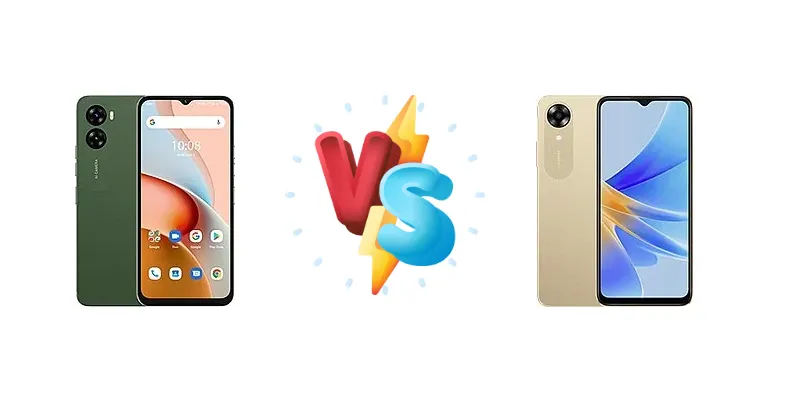
The Umidigi G3 and Oppo A17k represent the extreme end of the smartphone price spectrum, targeting users who prioritize affordability above all else. While both devices offer basic smartphone functionality, significant differences in their underlying hardware dictate their real-world performance and suitability for different users. This comparison dives deep into the specifications to determine which device delivers the best value.
🏆 Quick Verdict
For the average user prioritizing basic tasks like calling, messaging, and light social media, the Oppo A17k emerges as the better choice. Its Helio G35 chipset, featuring an octa-core CPU, provides a noticeable performance uplift over the Umidigi G3’s quad-core Helio A22, making for a smoother overall experience.
| Network |
|---|
| 2G bands | GSM 850 / 900 / 1800 / 1900 | GSM 850 / 900 / 1800 / 1900 |
| 3G bands | HSDPA 850 / 900 / 1700(AWS) / 1900 / 2100 | HSDPA 850 / 900 / 2100 |
| 4G bands | 1, 2, 3, 4, 5, 7, 8, 12, 17, 20, 28, 38, 40, 41 | 1, 3, 5, 8, 38, 40, 41 |
| Speed | HSPA, LTE | HSPA, LTE |
| Technology | GSM / HSPA / LTE | GSM / HSPA / LTE |
| Launch |
|---|
| Announced | 2023 | 2022, October 13 |
| Status | Available. Released 2023 | Available. Released 2022, October 18 |
| Body |
|---|
| Dimensions | 163.9 x 75.7 x 8.8 mm (6.45 x 2.98 x 0.35 in) | 164.2 x 75.6 x 8.3 mm (6.46 x 2.98 x 0.33 in) |
| SIM | Nano-SIM + Nano-SIM | Nano-SIM + Nano-SIM |
| Weight | 192 g (6.77 oz) | 189 g (6.67 oz) |
| | - | IPX4 water resistance |
| Display |
|---|
| Protection | - | Panda Glass |
| Resolution | 720 x 1600 pixels, 20:9 ratio (~269 ppi density) | 720 x 1612 pixels, 20:9 ratio (~269 ppi density) |
| Size | 6.52 inches, 102.6 cm2 (~82.7% screen-to-body ratio) | 6.56 inches, 103.4 cm2 (~83.3% screen-to-body ratio) |
| Type | IPS LCD | IPS LCD, 480 nits (typ), 600 nits (HBM) |
| Platform |
|---|
| CPU | Quad-core 2.0 GHz Cortex-A53 | Octa-core (4x2.3 GHz Cortex-A53 & 4x1.8 GHz Cortex-A53) |
| Chipset | Mediatek Helio A22 (12 nm) | Mediatek MT6765 Helio G35 (12 nm) |
| GPU | PowerVR GE8320 | PowerVR GE8320 |
| OS | Android 13 | Android 12, ColorOS 12.1 |
| Memory |
|---|
| Card slot | microSDXC (uses shared SIM slot) | microSDXC |
| Internal | 64GB 4GB RAM | 64GB 3GB RAM |
| | - | eMMC 5.1 |
| Main Camera |
|---|
| Dual | 13 MP, f/2.2, (wide), AF
Auxiliary lens | - |
| Features | Dual-LED flash, HDR | LED flash, panorama |
| Single | - | 8 MP, f/2.0, (wide), AF |
| Video | 1080p@30fps | 1080p@30fps |
| Selfie camera |
|---|
| Single | 5 MP, f/2.2, (wide) | 5 MP, f/2.2, (wide) |
| Video | 720p@30fps | 1080p@30fps |
| Sound |
|---|
| 3.5mm jack | - | Yes |
| 35mm jack | Yes | Yes |
| Loudspeaker | Yes | Yes |
| Comms |
|---|
| Bluetooth | 5.0, A2DP, LE | 5.3, A2DP, LE, aptX HD |
| NFC | No | No |
| Positioning | GPS, GLONASS, GALILEO | GPS, GLONASS, BDS, GALILEO |
| Radio | No | Unspecified |
| USB | USB Type-C, OTG | microUSB 2.0, OTG |
| WLAN | Wi-Fi 802.11 b/g/n/ac, dual-band, Wi-Fi Direct | Wi-Fi 802.11 a/b/g/n/ac, dual-band |
| Features |
|---|
| Sensors | Fingerprint (side-mounted), accelerometer, proximity, compass | Fingerprint (side-mounted), accelerometer, proximity, compass |
| Battery |
|---|
| Charging | 10W wired | - |
| Type | 5150 mAh | Li-Po 5000 mAh |
| Misc |
|---|
| Colors | Graphite Black, Dark Green, Lavender Purple | Navy Blue, Gold |
| Models | - | CPH2471 |
| Price | - | About 130 EUR |
Umidigi G3
- Lowest possible price point
- Functional for basic tasks
- Simple and straightforward experience
- Slow performance with Helio A22
- Limited multitasking capabilities
- Potentially outdated software
Oppo A17k
- Faster performance with Helio G35
- Smoother user experience
- Better multitasking capabilities
- Slightly higher price
- Still limited for demanding tasks
- 10W charging is slow
Display Comparison
Neither device boasts a standout display. Both likely utilize LCD panels, common in this price bracket. The focus here isn't on visual fidelity, but on basic usability. Without specific display specs, it's reasonable to assume both offer similar resolutions (likely 720p+) and brightness levels. The real difference lies in the processing power needed to drive the UI, which the Oppo A17k handles more efficiently.
Camera Comparison
Camera performance is likely to be similar on both devices, given the typical sensor choices in this segment. Without specific sensor details, it’s safe to assume both feature a primary camera and potentially a depth or macro sensor. The image processing capabilities of the Helio G35 in the Oppo A17k *may* offer slightly better results, but don't expect flagship-level image quality. The focus should be on capturing usable photos in good lighting conditions.
Performance
The core difference between these two phones is the chipset. The Oppo A17k’s MediaTek Helio G35 is a significant upgrade over the Umidigi G3’s Helio A22. The G35’s octa-core configuration (4x2.3 GHz Cortex-A53 & 4x1.8 GHz Cortex-A53) provides substantially more processing power than the G3’s quad-core 2.0 GHz Cortex-A53. This translates to faster app loading times, smoother multitasking, and a more responsive user interface. While neither chipset is designed for demanding games, the G35 will handle less intensive titles with greater ease. The 12nm process node is shared between both, meaning thermal efficiency differences will be minimal.
Battery Life
Both devices feature 10W wired charging, indicating a similar charging experience. Without knowing the battery capacity of the Umidigi G3, it’s difficult to make a definitive statement about battery life. However, the more efficient Helio G35 in the Oppo A17k will likely result in slightly longer battery life, even with a similar capacity, due to reduced power consumption during typical usage. Expect both phones to require daily charging with moderate use.
Buying Guide
Buy the Umidigi G3 if you need a functional smartphone for the absolute lowest possible price and are willing to accept compromises in performance. It’s ideal for first-time smartphone users or as a temporary device. Buy the Oppo A17k if you prefer a more responsive experience for everyday tasks, and are willing to spend a little more for improved performance and potentially better software support.
Frequently Asked Questions
❓ Will the Oppo A17k be able to run popular social media apps like TikTok and Instagram smoothly?
Yes, the Helio G35 chipset in the Oppo A17k provides enough processing power to run popular social media apps like TikTok and Instagram without significant lag. While it won't offer the same experience as a flagship device, it will be a usable and reasonably smooth experience for most users.
❓ Is the Umidigi G3 suitable for playing mobile games?
The Umidigi G3 is not well-suited for playing most modern mobile games. The Helio A22 chipset lacks the processing power and graphics capabilities to deliver a playable experience in demanding titles. It may be able to handle very simple games, but expect significant lag and low frame rates in anything more complex.
❓ How long will it take to fully charge both phones from 0%?
With both phones utilizing 10W charging, expect a full charge to take approximately 2.5 to 3.5 hours, depending on battery capacity. 10W charging is a relatively slow standard, so patience is required.
❓ Which phone is likely to receive more software updates?
Oppo, as a larger and more established brand, is more likely to provide software updates and security patches for the A17k compared to Umidigi. While updates aren't guaranteed, Oppo generally offers better software support for its devices.