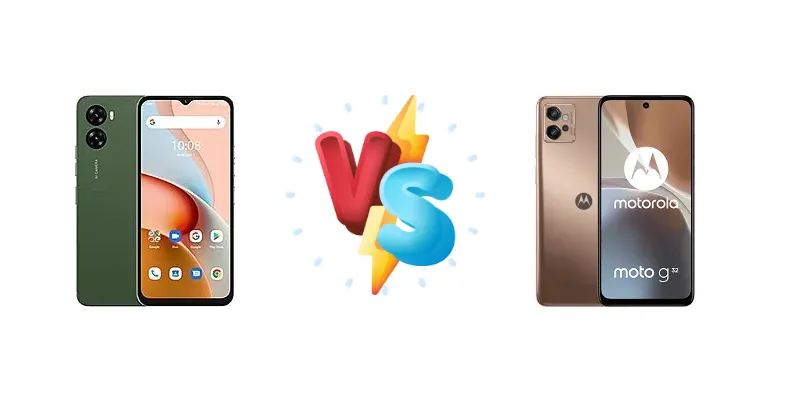
The sub-$150 smartphone market is fiercely competitive. The Umidigi G3 and Motorola Moto G32 both aim to deliver essential smartphone functionality at an accessible price point, but they take drastically different approaches to achieving this. The G3 relies on an older, power-efficient chipset, while the Moto G32 opts for a more modern, albeit still entry-level, Snapdragon processor. This comparison will dissect the key differences to determine which device offers the best value.
🏆 Quick Verdict
For the average user, the Motorola Moto G32 is the clear winner. Its Snapdragon 680 chipset provides a significantly faster and more responsive experience than the Umidigi G3’s Helio A22. While the G3 offers a slightly simpler experience, the G32’s performance advantage justifies the potential price difference.
| Network |
|---|
| 2G bands | GSM 850 / 900 / 1800 / 1900 | GSM 850 / 900 / 1800 / 1900 |
| 3G bands | HSDPA 850 / 900 / 1700(AWS) / 1900 / 2100 | HSDPA 850 / 900 / 1900 / 2100 |
| 4G bands | 1, 2, 3, 4, 5, 7, 8, 12, 17, 20, 28, 38, 40, 41 | 1, 3, 5, 7, 8, 20, 28, 38, 40, 41 |
| Speed | HSPA, LTE | HSPA, LTE |
| Technology | GSM / HSPA / LTE | GSM / HSPA / LTE |
| Launch |
|---|
| Announced | 2023 | 2022, July 28 |
| Status | Available. Released 2023 | Available. Released 2022, August 16 |
| Body |
|---|
| Build | - | Glass front, plastic frame, plastic back |
| Dimensions | 163.9 x 75.7 x 8.8 mm (6.45 x 2.98 x 0.35 in) | 161.8 x 73.8 x 8.5 mm (6.37 x 2.91 x 0.33 in) |
| SIM | Nano-SIM + Nano-SIM | · Nano-SIM· Nano-SIM + Nano-SIM |
| Weight | 192 g (6.77 oz) | 184 g (6.49 oz) |
| | - | Water-repellent design |
| Display |
|---|
| Resolution | 720 x 1600 pixels, 20:9 ratio (~269 ppi density) | 1080 x 2400 pixels, 20:9 ratio (~405 ppi density) |
| Size | 6.52 inches, 102.6 cm2 (~82.7% screen-to-body ratio) | 6.5 inches, 102.0 cm2 (~85.4% screen-to-body ratio) |
| Type | IPS LCD | IPS LCD, 90Hz |
| Platform |
|---|
| CPU | Quad-core 2.0 GHz Cortex-A53 | Octa-core (4x2.4 GHz Kryo 265 Gold & 4x1.9 GHz Kryo 265 Silver) |
| Chipset | Mediatek Helio A22 (12 nm) | Qualcomm SM6225 Snapdragon 680 4G (6 nm) |
| GPU | PowerVR GE8320 | Adreno 610 |
| OS | Android 13 | Android 12, upgradable to Android 13 |
| Memory |
|---|
| Card slot | microSDXC (uses shared SIM slot) | microSDXC (dedicated slot) |
| Internal | 64GB 4GB RAM | 64GB 4GB RAM, 128GB 4GB RAM, 128GB 6GB RAM, 128GB 8GB RAM, 256GB 8GB RAM |
| Main Camera |
|---|
| Dual | 13 MP, f/2.2, (wide), AF
Auxiliary lens | - |
| Features | Dual-LED flash, HDR | LED flash, HDR, panorama |
| Triple | - | 50 MP, f/1.8 (wide), 1/2.76", 0.64µm, PDAF
8 MP, f/2.2, 118˚ (ultrawide), 1/4.0", 1.12µm
2 MP, f/2.4, (macro/depth) |
| Video | 1080p@30fps | 1080p@30fps |
| Selfie camera |
|---|
| Single | 5 MP, f/2.2, (wide) | 16 MP, f/2.4, (wide), 1.0µm |
| Video | 720p@30fps | 1080p@30fps |
| Sound |
|---|
| 3.5mm jack | - | Yes |
| 35mm jack | Yes | Yes |
| Loudspeaker | Yes | Yes, with stereo speakers |
| Comms |
|---|
| Bluetooth | 5.0, A2DP, LE | 5.2, A2DP, LE |
| NFC | No | Yes (market/region dependent) |
| Positioning | GPS, GLONASS, GALILEO | GPS, GLONASS, GALILEO |
| Radio | No | FM radio |
| USB | USB Type-C, OTG | USB Type-C 2.0 |
| WLAN | Wi-Fi 802.11 b/g/n/ac, dual-band, Wi-Fi Direct | Wi-Fi 802.11 a/b/g/n/ac, dual-band, Wi-Fi Direct |
| Features |
|---|
| Sensors | Fingerprint (side-mounted), accelerometer, proximity, compass | Fingerprint (side-mounted), accelerometer, gyro, proximity, compass |
| Battery |
|---|
| Charging | 10W wired | 30W wired |
| Type | 5150 mAh | Li-Po 5000 mAh |
| Misc |
|---|
| Colors | Graphite Black, Dark Green, Lavender Purple | Mineral Grey, Satin Silver, Rose Gold |
| Models | - | XT2235-2, XT2235-3 |
| Price | - | ₹ 8,990 |
Umidigi G3
- Extremely affordable price point
- Simple and easy-to-use interface
- Potentially longer battery life due to power-efficient chipset (though slower charging)
- Significantly slower performance
- Struggles with multitasking and demanding apps
- Limited future-proofing
Motorola Moto G32
- Faster and more responsive performance
- More efficient processor for better battery life under load
- 30W fast charging for quicker top-ups
- Slightly higher price point
- May not be significantly better in ideal lighting conditions
- Still an entry-level processor, not suitable for heavy gaming
Display Comparison
Neither device boasts a standout display. While specific display specs (resolution, panel type) are not provided, the focus here is on the underlying processing power impacting the user interface. The G3’s Helio A22 will struggle to deliver a fluid 60Hz experience consistently, potentially resulting in noticeable lag when scrolling. The Moto G32’s Snapdragon 680, however, should provide a smoother experience, even with a similar display panel.
Camera Comparison
Without detailed camera specifications, a direct comparison is limited. However, the processing power of the Snapdragon 680 in the Moto G32 will likely result in better image processing, including noise reduction and dynamic range. The G3’s Helio A22 will struggle with complex image algorithms. It’s reasonable to assume the Moto G32 will deliver more consistently pleasing photos, especially in challenging lighting conditions. The presence of a more powerful ISP (Image Signal Processor) within the Snapdragon 680 is a key advantage.
Performance
The core difference lies in the chipsets. The Umidigi G3’s MediaTek Helio A22, a quad-core processor built on a 12nm process, is designed for basic tasks. Its Cortex-A53 cores are aging and lack the performance headroom for demanding applications. Conversely, the Motorola Moto G32 features the Qualcomm Snapdragon 680, an octa-core processor fabricated on a more efficient 6nm node. This translates to significantly improved CPU performance – the Kryo 265 Gold cores reach 2.4 GHz, compared to the G3’s 2.0 GHz – and a more capable GPU for light gaming. The 6nm process also contributes to better thermal management, reducing the likelihood of throttling under sustained load.
Battery Life
While battery capacity isn’t specified, the Moto G32’s 30W wired charging is a significant advantage over the Umidigi G3’s 10W charging. This means the G32 can replenish its battery much faster, minimizing downtime. Even if the G32 has a slightly smaller battery, the faster charging speed will likely result in a more convenient user experience. The Snapdragon 680’s 6nm process also contributes to better power efficiency, potentially offsetting any capacity difference.
Buying Guide
Buy the Umidigi G3 if you prioritize extreme affordability and a basic, no-frills smartphone experience for essential tasks like calls and messaging. It’s a suitable choice for first-time smartphone users or as a backup device. Buy the Motorola Moto G32 if you value smoother multitasking, faster app loading times, and a more future-proofed experience, even if it means spending a little more. It’s ideal for users who occasionally browse social media, stream videos, or play light games.
Frequently Asked Questions
❓ Will the Umidigi G3 struggle with popular apps like Facebook or WhatsApp?
The Umidigi G3’s Helio A22 processor is designed for basic tasks. While it can run apps like Facebook and WhatsApp, you may experience noticeable lag when scrolling through feeds or loading images. Multitasking between these apps and others will likely be slow and frustrating.
❓ Is the Snapdragon 680 in the Moto G32 powerful enough for any mobile games?
The Snapdragon 680 can handle light mobile games like Candy Crush or Subway Surfers without issue. However, it will struggle with more demanding titles like PUBG Mobile or Call of Duty Mobile, even on low settings. Expect frame rate drops and potential stuttering.
❓ How long will it take to fully charge each phone?
With 10W charging, the Umidigi G3 will likely take over 3 hours to fully charge. The Motorola Moto G32, with its 30W charging, should fully charge in approximately 1.5 to 2 hours, offering a much faster turnaround time.
❓ Does the Moto G32's faster processor significantly impact battery life?
Surprisingly, the Snapdragon 680's 6nm process is more power-efficient than the Helio A22's 12nm process. While the G32's screen and usage patterns will ultimately determine battery life, it's likely to offer comparable, or even better, battery endurance despite its increased performance.