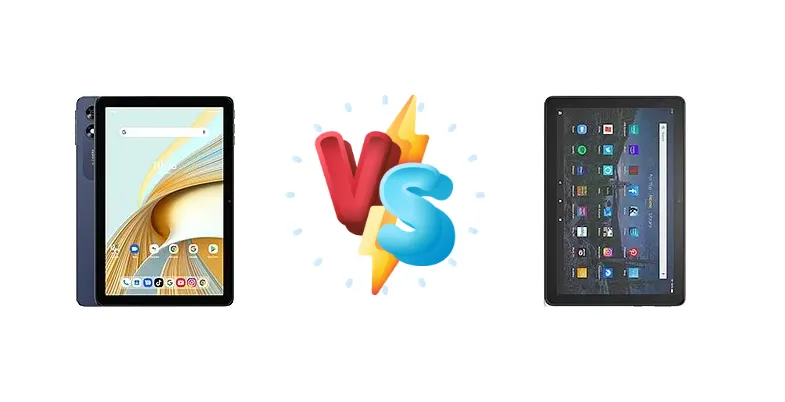
The budget tablet market is fiercely competitive, offering options for casual users and media consumers. We pit the Umidigi G3 Tab, a straightforward Android experience, against the Amazon Fire HD 10 Plus (2021), known for its ecosystem integration and aggressive pricing. This comparison dives deep into the hardware differences to determine which tablet provides the best overall experience.
🏆 Quick Verdict
For users prioritizing performance and a standard Android experience, the Amazon Fire HD 10 Plus (2021) is the clear winner. Its Helio P60T chipset offers a significant performance advantage over the Umidigi G3 Tab’s Helio A22, making it better suited for multitasking and demanding applications. However, the Fire OS experience isn't for everyone.
| Network |
|---|
| 2G bands | N/A | N/A |
| 4G bands | N/A | - |
| EDGE | N/A | No |
| GPRS | N/A | No |
| Technology | No cellular connectivity | No cellular connectivity |
| Launch |
|---|
| Announced | 2021. Released 2021 | 2021, April 27. Released 2021, May 26 |
| Status | Discontinued | Discontinued |
| Body |
|---|
| Dimensions | 244.8 x 162.2 x 10.7 mm (9.64 x 6.39 x 0.42 in) | 247 x 166 x 9.2 mm (9.72 x 6.54 x 0.36 in) |
| SIM | No | No |
| Weight | 570 g (1.26 lb) | 468 g (1.03 lb) |
| Display |
|---|
| Protection | - | Aluminosilicate glass |
| Resolution | 800 x 1280 pixels, 16:10 ratio (~149 ppi density) | 1920 x 1200 pixels, 16:10 ratio (~224 ppi density) |
| Size | 10.1 inches, 295.8 cm2 (~74.5% screen-to-body ratio) | 10.1 inches, 295.8 cm2 (~72.1% screen-to-body ratio) |
| Type | TFT | IPS LCD |
| Platform |
|---|
| CPU | Quad-core 2.0 GHz Cortex-A53 | Octa-core (4x2.0 GHz Cortex-A73 & 4x2.0 GHz Cortex-A53) |
| Chipset | Mediatek Helio A22 (12 nm) | Mediatek MT8183 Helio P60T (12 nm) |
| GPU | PowerVR GE8300 | Mali-G72 MP3 |
| OS | Android 13 | Android 9.0 (Pie), Fire OS 7 |
| Memory |
|---|
| Card slot | microSDXC | microSDXC (dedicated slot) |
| Internal | 32GB 3GB RAM | 32GB 4GB RAM, 64GB 4GB RAM |
| | - | eMMC 5.1 |
| Main Camera |
|---|
| Features | LED flash | - |
| Single | 8 MP, f/2.2, (wide) | 5 MP |
| Video | 1080p@30fps | 720p |
| Selfie camera |
|---|
| Single | 8 MP, f/2.2, (wide) | 2 MP |
| Video | 720p@30fps | 720p |
| Sound |
|---|
| 3.5mm jack | - | Yes |
| 35mm jack | Yes | Yes |
| Loudspeaker | Yes, with stereo speakers | Yes, with stereo speakers |
| Comms |
|---|
| Bluetooth | 5.0, A2DP, LE | 5.0, A2DP, LE |
| NFC | No | No |
| Positioning | GPS, GALILEO, GLONASS | No |
| Radio | No | No |
| USB | USB Type-C 2.0, OTG | USB Type-C 2.0, OTG |
| WLAN | Wi-Fi 802.11 b/g/n/ac, dual-band | Wi-Fi 802.11 a/b/g/n/ac, dual-band |
| Features |
|---|
| Sensors | Accelerometer, proximity (accessories only), compass | Accelerometer |
| | - | Text-to-Speech English-language content reader |
| Battery |
|---|
| Charging | 10W wired | Wireless |
| Type | 6000 mAh | Li-Ion |
| Misc |
|---|
| Colors | Graphite Black, Dark Green, Midnight Blue | Slate |
| Models | - | T76N2P |
| Price | - | About 150 EUR |
Umidigi G3 Tab
- Clean Android Experience: No Amazon bloatware or ecosystem lock-in.
- Potentially Lower Cost: Likely to be more affordable than the Fire HD 10 Plus.
- Standard USB-C Charging: Universal compatibility with chargers.
- Weak Performance: Helio A22 chipset struggles with demanding tasks.
- Limited Features: Likely lacks features like wireless charging.
Amazon Fire HD 10 Plus (2021)
- Superior Performance: Helio P60T provides a significantly smoother experience.
- Wireless Charging: Adds convenience and flexibility.
- Amazon Ecosystem Integration: Seamless access to Prime Video, Kindle, and other services.
- Fire OS Restrictions: Limited access to the Google Play Store and potential bloatware.
- Amazon Account Required: Full functionality requires an Amazon account.
Display Comparison
Both tablets utilize 12nm chipsets, suggesting similar power efficiency constraints impacting display capabilities. While specific display specs (resolution, panel type) are missing for the Umidigi G3 Tab, the Fire HD 10 Plus boasts a 10.1-inch IPS LCD. The key difference lies in the processing power driving the display; the Helio P60T in the Fire HD 10 Plus can handle more complex graphics rendering, potentially resulting in smoother animations and a more responsive user interface. The lack of information on the Umidigi G3 Tab’s panel makes a direct comparison of color accuracy and brightness impossible, but it’s likely to be a more basic implementation.
Camera Comparison
Neither tablet is positioned as a photography powerhouse. Given the context, detailed camera analysis is limited. Both are likely to feature basic camera sensors suitable for video calls and occasional snapshots. The absence of specific camera specs for the Umidigi G3 Tab makes a direct comparison impossible. However, the Fire HD 10 Plus’s camera performance is generally considered adequate for its price point, but not a key selling feature. Focusing on camera quality with these devices would be a misdirection of analysis.
Performance
The performance gap is the most significant differentiator. The Amazon Fire HD 10 Plus (2021) features the Mediatek MT8183 Helio P60T, an octa-core processor with a heterogeneous architecture – four Cortex-A73 cores clocked at 2.0 GHz and four Cortex-A53 cores, also at 2.0 GHz. This contrasts sharply with the Umidigi G3 Tab’s Mediatek Helio A22, a quad-core Cortex-A53 processor at 2.0 GHz. The A73 cores in the P60T offer substantially higher single-core performance, crucial for app responsiveness, while the eight cores provide better multitasking capabilities. The Helio A22 is designed for entry-level smartphones and will struggle with demanding applications. This translates to a noticeably snappier experience on the Fire HD 10 Plus.
Battery Life
Both tablets utilize 12nm chipsets, suggesting comparable power efficiency. The Amazon Fire HD 10 Plus (2021) offers the convenience of wireless charging, a feature absent on the Umidigi G3 Tab, which relies solely on 10W wired charging. While battery capacity isn’t specified for either device, the more powerful processor in the Fire HD 10 Plus will likely consume more power during intensive tasks. However, the wireless charging capability provides flexibility and convenience, potentially offsetting the slightly faster charging speed of a wired connection.
Buying Guide
Buy the Umidigi G3 Tab if you need a simple, unadulterated Android tablet experience without Amazon’s ecosystem lock-in, and your usage is limited to basic tasks like reading and light web browsing. Buy the Amazon Fire HD 10 Plus (2021) if you prefer a tablet deeply integrated with Amazon services, enjoy streaming content from Prime Video, and require noticeably better performance for a slightly more restrictive software experience.
Frequently Asked Questions
❓ Does the Fire HD 10 Plus’s Fire OS significantly limit app availability compared to standard Android?
Yes, Fire OS is based on Android but lacks full Google Play Store support. While Amazon’s Appstore offers a selection of popular apps, many Android applications require sideloading or aren’t compatible. This is a key consideration for users heavily reliant on specific Google Play Store apps.
❓ Is the Umidigi G3 Tab a viable option for running multiple apps simultaneously?
The Umidigi G3 Tab’s Mediatek Helio A22 chipset and limited RAM will struggle with multitasking. Running more than a few lightweight apps simultaneously will likely result in noticeable slowdowns and lag. It’s best suited for single-app usage.
❓ How does the wireless charging on the Fire HD 10 Plus compare to fast wired charging in terms of speed?
Wireless charging on the Fire HD 10 Plus is slower than wired charging. While convenient, expect a significantly longer charge time compared to using a 10W wired charger. It's best for overnight or top-up charging rather than quickly replenishing the battery.