
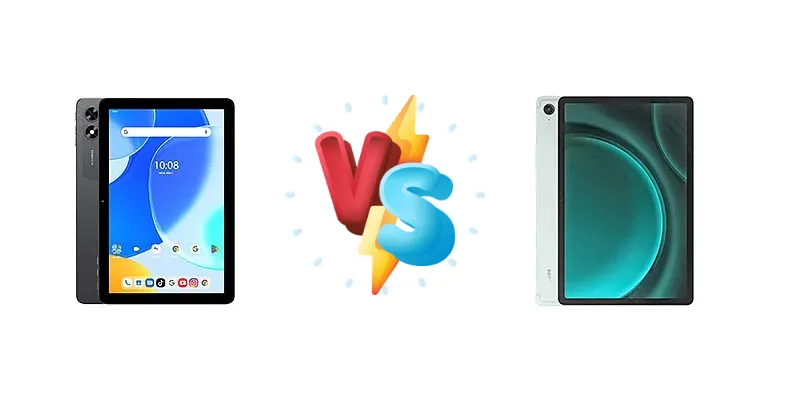
Umidigi G3 Tab Ultra vs Samsung Galaxy Tab S9 FE: A Detailed Comparison
| Phones Images | |||||
|---|---|---|---|---|---|
|
🏆 Quick Verdict
For the average user prioritizing performance and long-term software support, the Samsung Galaxy Tab S9 FE is the superior choice. Its Exynos 1380 chipset, coupled with faster charging, provides a smoother and more responsive experience. However, the Umidigi G3 Tab Ultra presents a compelling option for budget-conscious users who prioritize cost savings.
| PHONES | ||
|---|---|---|
| Phone Names | Umidigi G3 Tab Ultra | Samsung Galaxy Tab S9 FE |
| Network | ||
|---|---|---|
| 2G bands | GSM 850 / 900 / 1800 / 1900 | GSM 850 / 900 / 1800 / 1900 |
| 3G bands | HSDPA 850 / 900 / 1700(AWS) / 1900 / 2100 | HSDPA 850 / 900 / 1700(AWS) / 1900 / 2100 |
| 4G bands | 1, 2, 3, 4, 5, 7, 8, 12, 13, 17, 18, 19, 20, 25, 26, 28, 34, 38, 39, 40, 41, 66 | 1, 2, 3, 4, 5, 7, 8, 12, 13, 17, 20, 26, 28, 32, 38, 40, 41, 66 |
| 5G bands | - | 1, 3, 5, 7, 8, 20, 28, 38, 40, 41, 66, 77, 78 SA/NSA/Sub6 |
| Speed | HSPA, LTE | HSPA, LTE, 5G - cellular model only |
| Technology | GSM / HSPA / LTE | GSM / HSPA / LTE / 5G |
| Launch | ||
|---|---|---|
| Announced | 2024 | 2023, October 04 |
| Status | Available. Released 2024 | Available. Released 2023, October 16 |
| Body | ||
|---|---|---|
| Build | - | Glass front, aluminum back, aluminum frame |
| Dimensions | 244.8 x 162.2 x 9.3 mm (9.64 x 6.39 x 0.37 in) | 254.3 x 165.8 x 6.5 mm (10.01 x 6.53 x 0.26 in) |
| SIM | Nano-SIM + Nano-SIM | Nano-SIM + eSIM (cellular model only) |
| Weight | 482 g (1.06 lb) | 523 g or 524 g (1.15 lb) |
| Display | ||
|---|---|---|
| Resolution | 800 x 1280 pixels, 16:10 ratio (~149 ppi density) | 1440 x 2304 pixels, 16:10 ratio (~249 ppi density) |
| Size | 10.1 inches, 295.8 cm2 (~74.5% screen-to-body ratio) | 10.9 inches, 344.5 cm2 (~81.7% screen-to-body ratio) |
| Type | IPS LCD | IPS LCD, 90Hz |
| Platform | ||
|---|---|---|
| CPU | Octa-core (2x2.2 GHz Cortex-A76 & 6x2.0 GHz Cortex-A55) | Octa-core (4x2.4 GHz Cortex-A78 & 4x2.0 GHz Cortex-A55) |
| Chipset | Mediatek Helio G99 (6 nm) | Exynos 1380 (5 nm) |
| GPU | Mali-G57 MC2 | Mali-G68 MP5 |
| OS | Android 13 | Android 13, up to 4 major Android upgrades, One UI 6 |
| Memory | ||
|---|---|---|
| Card slot | microSDXC (uses shared SIM slot) | microSDXC (dedicated slot) |
| Internal | 128GB 8GB RAM | 128GB 6GB RAM, 128GB 8GB RAM, 256GB 8GB RAM |
| Main Camera | ||
|---|---|---|
| Features | LED flash | - |
| Single | 8 MP, f/2.2, (wide) | 8 MP, (wide) |
| Video | 720p@30fps | 4K@30fps, 1080p@30fps |
| Selfie camera | ||
|---|---|---|
| Single | 8 MP, f/2.2, (wide) | 12 MP, (ultrawide) |
| Video | 720p@30fps | Yes |
| Sound | ||
|---|---|---|
| 35mm jack | Yes | No |
| Loudspeaker | Yes, with stereo speakers | Yes, with stereo speakers |
| Comms | ||
|---|---|---|
| Bluetooth | 5.2, A2DP, LE | 5.3, A2DP, LE |
| NFC | No | No |
| Positioning | GPS, GLONASS, GALILEO | GPS, GALILEO, GLONASS, BDS, QZSS - cellular model only |
| Radio | FM radio | No |
| USB | USB Type-C | USB Type-C 2.0, magnetic connector |
| WLAN | Wi-Fi 802.11 a/b/g/n/ac | Wi-Fi 802.11 a/b/g/n/ac/6, dual-band, Wi-Fi Direct |
| Features | ||
|---|---|---|
| Sensors | Accelerometer, proximity (accessories only), compass | Fingerprint (side-mounted), accelerometer, gyro, compass, proximity (accessories only) |
| Battery | ||
|---|---|---|
| Charging | 18W wired | 45W wired, QC2.0 |
| Type | 6000 mAh | Li-Po 8000 mAh |
| Misc | ||
|---|---|---|
| Colors | Space Grey | Mint, Silver, Gray, Lavender |
| Models | - | SM-X510, SM-X516B |
| Price | - | About 300 EUR |
| SAR | - | 1.55 W/kg (body) |
| SAR EU | - | 0.59 W/kg (body) |
Umidigi G3 Tab Ultra
- Significantly lower price point
- Decent performance for basic tasks
- Potentially longer battery life due to less powerful chipset (depending on battery capacity)
- Slower processor and less responsive performance
- Slower charging speed (18W)
- Likely limited software update support
Samsung Galaxy Tab S9 FE
- Faster and more efficient Exynos 1380 processor
- 45W fast charging with Quick Charge 2.0
- Samsung's software support and ecosystem integration
- Higher price tag
- Potentially shorter battery life compared to a larger battery on the Umidigi (depending on usage)
- May include Samsung's bloatware
Display Comparison
While display specifications aren't provided for the Umidigi G3 Tab Ultra, the Samsung Galaxy Tab S9 FE's display is likely to offer a superior viewing experience. The Exynos 1380's image signal processor (ISP) will contribute to more accurate color reproduction. The S9 FE's panel likely benefits from Samsung's display expertise, potentially offering wider color gamut coverage and better viewing angles. The lack of detailed display specs for the Umidigi makes a direct comparison difficult, but it's reasonable to assume the S9 FE will have a more vibrant and accurate display.
Camera Comparison
Without detailed camera specifications for the Umidigi G3 Tab Ultra, a comprehensive comparison is limited. However, Samsung typically prioritizes camera quality, and the Exynos 1380's ISP will likely deliver superior image processing. The S9 FE's camera system will likely feature better dynamic range and noise reduction capabilities. While both tablets may include multiple cameras, the quality of the main sensor and image processing algorithms will be the deciding factors, and Samsung generally excels in these areas.
Performance
The core difference lies in the chipsets: the Umidigi G3 Tab Ultra utilizes the Mediatek Helio G99 (6nm), while the Samsung Galaxy Tab S9 FE boasts the Exynos 1380 (5nm). The Exynos 1380, built on a smaller 5nm process, inherently offers better power efficiency and thermal performance compared to the 6nm Helio G99. The CPU architecture also favors the Samsung tablet; its octa-core configuration with 4x2.4 GHz Cortex-A78 cores provides a significant performance uplift over the Umidigi's 2x2.2 GHz Cortex-A76 cores, particularly in demanding tasks. This translates to faster app loading times, smoother multitasking, and a more responsive user interface on the S9 FE. The S9 FE is also likely to have faster RAM (LPDDR5x) compared to the Umidigi, further enhancing performance.
Battery Life
Battery capacity isn't specified for either device, making a direct mAh comparison impossible. However, the charging capabilities reveal a significant advantage for the Samsung Galaxy Tab S9 FE with its 45W wired charging and Quick Charge 2.0 support. This allows for significantly faster charging times compared to the Umidigi G3 Tab Ultra's 18W charging. While a larger battery capacity on the Umidigi could offset the slower charging, the Exynos 1380's superior power efficiency means the S9 FE will likely offer comparable or even better battery life despite potentially having a smaller battery. The faster charging of the S9 FE is a major convenience factor.
Buying Guide
Buy the Umidigi G3 Tab Ultra if you need a functional tablet for basic tasks like web browsing, video streaming, and light productivity, and your budget is a primary concern. You're willing to accept compromises in performance and software updates to save money. Buy the Samsung Galaxy Tab S9 FE if you prefer a more refined experience with a faster processor, quicker charging, and the assurance of Samsung's software support and ecosystem integration, even at a higher price point.