
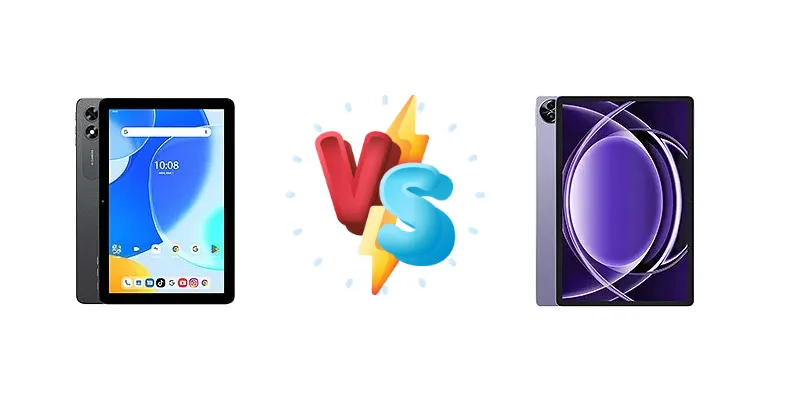
Umidigi G3 Tab Ultra vs Realme Pad 2 Lite: Which Budget Tablet Delivers More?
| Phones Images | |||||
|---|---|---|---|---|---|
|
🏆 Quick Verdict
For most users, the Umidigi G3 Tab Ultra edges out the Realme Pad 2 Lite. While both share the same Helio G99 processor, the G3 Tab Ultra’s slightly faster 18W charging offers a more convenient experience, mitigating the impact of a potentially similar battery capacity. The difference is small, but noticeable in daily use.
| PHONES | ||
|---|---|---|
| Phone Names | Umidigi G3 Tab Ultra | Realme Pad 2 Lite |
| Network | ||
|---|---|---|
| 2G bands | GSM 850 / 900 / 1800 / 1900 | GSM 850 / 900 / 1800 / 1900 |
| 3G bands | HSDPA 850 / 900 / 1700(AWS) / 1900 / 2100 | HSDPA 850 / 900 / 2100 |
| 4G bands | 1, 2, 3, 4, 5, 7, 8, 12, 13, 17, 18, 19, 20, 25, 26, 28, 34, 38, 39, 40, 41, 66 | 1, 3, 5, 7, 8, 20, 28, 38, 40, 41 |
| Speed | HSPA, LTE | HSPA, LTE |
| Technology | GSM / HSPA / LTE | GSM / HSPA / LTE |
| Launch | ||
|---|---|---|
| Announced | 2024 | 2024, September 13 |
| Status | Available. Released 2024 | Available. Released 2024, September 26 |
| Body | ||
|---|---|---|
| Dimensions | 244.8 x 162.2 x 9.3 mm (9.64 x 6.39 x 0.37 in) | 258 x 169.5 x 8.3 mm (10.16 x 6.67 x 0.33 in) |
| SIM | Nano-SIM + Nano-SIM | No |
| Weight | 482 g (1.06 lb) | 525 g (1.16 lb) |
| Display | ||
|---|---|---|
| Resolution | 800 x 1280 pixels, 16:10 ratio (~149 ppi density) | 1200 x 1920 pixels, 16:10 ratio (~207 ppi density) |
| Size | 10.1 inches, 295.8 cm2 (~74.5% screen-to-body ratio) | 10.95 inches, 347.7 cm2 (~79.5% screen-to-body ratio) |
| Type | IPS LCD | IPS LCD, 1B colors, 90Hz, 450 nits (peak) |
| Platform | ||
|---|---|---|
| CPU | Octa-core (2x2.2 GHz Cortex-A76 & 6x2.0 GHz Cortex-A55) | Octa-core (2x2.2 GHz Cortex-A76 & 6x2.0 GHz Cortex-A55) |
| Chipset | Mediatek Helio G99 (6 nm) | Mediatek Helio G99 (6 nm) |
| GPU | Mali-G57 MC2 | Mali-G57 MC2 |
| OS | Android 13 | Android 14, Realme UI 5.0 for Pad |
| Memory | ||
|---|---|---|
| Card slot | microSDXC (uses shared SIM slot) | Unspecified |
| Internal | 128GB 8GB RAM | 128GB 4GB RAM, 128GB 8GB RAM |
| Main Camera | ||
|---|---|---|
| Features | LED flash | Panorama |
| Single | 8 MP, f/2.2, (wide) | 8 MP, f/2.0 |
| Video | 720p@30fps | 1080p@30fps |
| Selfie camera | ||
|---|---|---|
| Features | - | Panorama |
| Single | 8 MP, f/2.2, (wide) | 5 MP, f/2.2 |
| Video | 720p@30fps | 1080p@30fps |
| Sound | ||
|---|---|---|
| 35mm jack | Yes | No |
| Loudspeaker | Yes, with stereo speakers | Yes, with stereo speakers (4 speakers) |
| Comms | ||
|---|---|---|
| Bluetooth | 5.2, A2DP, LE | 5.2, A2DP, LE |
| NFC | No | No |
| Positioning | GPS, GLONASS, GALILEO | GPS, GALILEO, GLONASS, BDS |
| Radio | FM radio | No |
| USB | USB Type-C | USB Type-C |
| WLAN | Wi-Fi 802.11 a/b/g/n/ac | Wi-Fi 802.11 a/b/g/n/ac, dual-band |
| Features | ||
|---|---|---|
| Sensors | Accelerometer, proximity (accessories only), compass | Accelerometer |
| Battery | ||
|---|---|---|
| Charging | 18W wired | 15W wired |
| Type | 6000 mAh | 8300 mAh |
| Misc | ||
|---|---|---|
| Colors | Space Grey | Nebula Purple, Space Grey |
| Models | - | RMP2402 |
| Price | - | About 160 EUR |
Umidigi G3 Tab Ultra
- Faster 18W charging for quicker top-ups.
- Potentially better thermal management due to higher charging wattage.
- Competitive price point.
- Umidigi’s software support may be less consistent than Realme’s.
- Camera performance likely similar to the Realme Pad 2 Lite.
Realme Pad 2 Lite
- Realme UI offers a refined software experience.
- Established brand reputation for software updates.
- Competitive price point.
- Slower 15W charging.
- Potential for thermal throttling under sustained load.
Display Comparison
Both tablets are expected to feature IPS LCD panels, typical for this price bracket. Without specific display specs like resolution or peak brightness, it’s difficult to definitively declare a winner. However, Realme often focuses on color calibration, potentially offering a more accurate display experience. The absence of high refresh rates (90Hz or 120Hz) is expected, focusing instead on power efficiency. Bezels are likely to be similar, contributing minimally to the overall user experience.
Camera Comparison
Camera performance is unlikely to be a key differentiator in this segment. Both tablets will likely feature basic camera setups, potentially with a single main sensor and a depth sensor. Without specific sensor details, it’s safe to assume image quality will be adequate for casual snapshots but not competitive with smartphone cameras. Focusing on the main sensor’s megapixel count is misleading; aperture and image processing algorithms are more critical for image quality. Expect similar results in well-lit conditions, with both struggling in low light.
Performance
The core of both tablets is the Mediatek Helio G99 (6 nm) chipset, featuring an octa-core CPU configuration with 2x2.2 GHz Cortex-A76 and 6x2.0 GHz Cortex-A55 cores. This translates to similar performance in everyday tasks like web browsing, video playback, and light gaming. The shared CPU architecture means performance differences will likely stem from RAM management and software optimization. While both likely use LPDDR4X RAM, Realme’s software optimizations could provide a slight edge in multitasking. Thermal management will be crucial; the G99 is known to throttle under sustained load, and the tablet’s design will impact how effectively heat is dissipated.
Battery Life
Battery capacity is not specified, but both tablets will likely house batteries in the 6000-7000 mAh range, typical for tablets of this size. The key difference lies in charging speed: the Umidigi G3 Tab Ultra supports 18W wired charging, while the Realme Pad 2 Lite is limited to 15W. This 3W difference translates to a faster 0-100% charge time for the Umidigi, potentially saving users valuable time. While a larger battery capacity would be ideal, faster charging mitigates the impact of a smaller battery, allowing for quicker top-ups throughout the day.
Buying Guide
Buy the Umidigi G3 Tab Ultra if you prioritize faster charging and potentially longer sustained performance due to better thermal headroom from the slightly higher wattage. This tablet is ideal for users who frequently consume media on the go and need quick top-ups. Buy the Realme Pad 2 Lite if you prefer the Realme UI software experience and brand reputation, and are less concerned about the marginal charging speed difference. It’s a solid choice for home entertainment and light productivity.