
Umidigi G3 Plus vs Nokia G42: A Deep Dive into Budget 5G Performance
| Phones Images | |||||
|---|---|---|---|---|---|
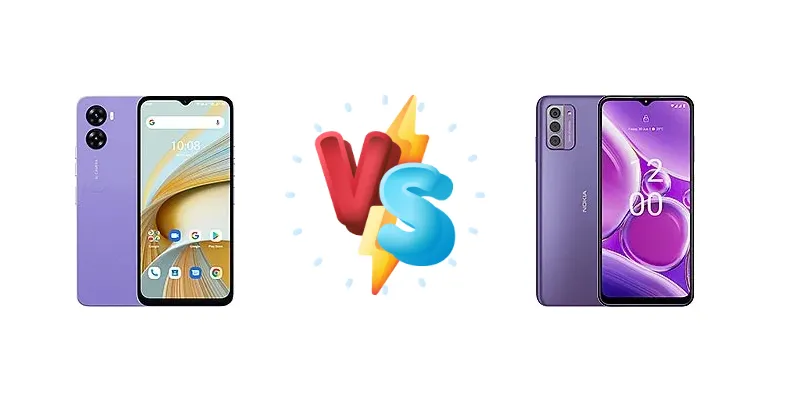
|
🏆 Quick Verdict
For the average user prioritizing 5G connectivity and faster charging, the Nokia G42 emerges as the stronger contender. Its Snapdragon 480+ chipset, built on an 8nm process, provides a noticeable performance advantage over the Umidigi G3 Plus’s Unisoc T606, and the 20W charging with PD3.0/QC3 support significantly reduces downtime.
| PHONES | ||
|---|---|---|
| Phone Names | Umidigi G3 Plus | Nokia G42 |
| Network | ||
|---|---|---|
| 2G bands | GSM 850 / 900 / 1800 / 1900 | GSM 850 / 900 / 1800 / 1900 |
| 3G bands | HSDPA 850 / 900 / 1700(AWS) / 1900 / 2100 | HSDPA 850 / 900 / 1700(AWS) / 1900 / 2100 |
| 4G bands | 1, 2, 3, 4, 5, 7, 8, 12, 17, 20, 28, 38, 40, 41, 66 | 1, 2, 3, 4, 5, 7, 8, 12, 17, 13, 20, 28, 38, 39, 40, 41, 66 |
| 5G bands | - | 1, 2, 3, 5, 7, 8, 28, 40, 41, 66, 77, 78 SA/NSA |
| Speed | HSPA, LTE | HSPA, LTE, 5G |
| Technology | GSM / HSPA / LTE | GSM / HSPA / LTE / 5G |
| Launch | ||
|---|---|---|
| Announced | 2023 | 2023, June 28 |
| Status | Available. Released 2023 | Available. Released 2023, June 28 |
| Body | ||
|---|---|---|
| Build | - | Glass front, plastic back, plastic frame |
| Dimensions | 163.9 x 75.7 x 8.8 mm (6.45 x 2.98 x 0.35 in) | 165 x 75.8 x 8.6 mm (6.50 x 2.98 x 0.34 in) |
| SIM | Nano-SIM + Nano-SIM | · Nano-SIM· Nano-SIM + Nano-SIM |
| Weight | 192 g (6.77 oz) | 193.8 g (6.84 oz) |
| Display | ||
|---|---|---|
| Protection | - | Corning Gorilla Glass 3 |
| Resolution | 720 x 1600 pixels, 20:9 ratio (~269 ppi density) | 720 x 1612 pixels, 20:9 ratio (~269 ppi density) |
| Size | 6.52 inches, 102.6 cm2 (~82.7% screen-to-body ratio) | 6.56 inches, 103.4 cm2 (~82.7% screen-to-body ratio) |
| Type | IPS LCD | IPS LCD, 90Hz, 450 nits (typ), 560 nits (peak) |
| Platform | ||
|---|---|---|
| CPU | Octa-core (2x1.6 GHz Cortex-A75 & 6x1.6 GHz Cortex-A55) | Octa-core (2x2.2 GHz Kryo 460 & 6x1.8 GHz Kryo 460) |
| Chipset | Unisoc T606 (12 nm) | Qualcomm SM4350-AC Snapdragon 480+ 5G (8 nm) |
| GPU | Mali-G57 MP1 | Adreno 619 |
| OS | Android 13 | Android 13, upgradable to Android 14 |
| Memory | ||
|---|---|---|
| Card slot | microSDXC (uses shared SIM slot) | microSDXC |
| Internal | 128GB 4GB RAM | 128GB 4GB RAM, 128GB 6GB RAM, 256GB 8GB RAM |
| Main Camera | ||
|---|---|---|
| Dual | 16 MP, f/2.2, (wide), AF Auxiliary lens | - |
| Features | Dual-LED flash, HDR, panorama | LED flash, HDR, panorama |
| Triple | - | 50 MP, f/1.8, (wide), AF 2 MP (macro) Auxiliary lens |
| Video | 1080p@30fps | 1080p@30fps |
| Selfie camera | ||
|---|---|---|
| Single | 8 MP, f/2.2, (wide) | 8 MP |
| Video | 720p@30fps | Yes |
| Sound | ||
|---|---|---|
| 35mm jack | Yes | Yes |
| Loudspeaker | Yes | Yes |
| Comms | ||
|---|---|---|
| Bluetooth | 5.0, A2DP, LE | 5.1, A2DP, LE |
| NFC | No | Yes (market/region dependent) |
| Positioning | GPS, GLONASS, GALILEO | GPS, GLONASS, GALILEO, BDS |
| Radio | No | FM radio |
| USB | USB Type-C, OTG | USB Type-C 2.0, OTG |
| WLAN | Wi-Fi 802.11 b/g/n/ac, dual-band, Wi-Fi Direct | Wi-Fi 802.11 a/b/g/n/ac/6, dual-band |
| Features | ||
|---|---|---|
| Sensors | Fingerprint (side-mounted), accelerometer, proximity, compass | Fingerprint (side-mounted), accelerometer, proximity, compass |
| Battery | ||
|---|---|---|
| Charging | 10W wired | 20W wired, PD3.0, QC3 |
| Type | 5150 mAh | Li-Po 5000 mAh |
| Misc | ||
|---|---|---|
| Colors | Graphite Black, Dark Green, Lavender Purple | Gray, Purple, Red |
| Price | - | $ 545.00 / £ 124.99 |
Umidigi G3 Plus
- Potentially better standby battery life due to the 12nm process.
- Lower price point (likely).
- Simple, straightforward Android experience.
- Significantly slower performance compared to the Snapdragon 480+.
- Slow 10W charging.
- Limited 5G capabilities (if any).
Nokia G42
- Faster Snapdragon 480+ chipset for smoother performance.
- 20W fast charging with PD3.0/QC3.
- 5G connectivity for future-proofing.
- Potentially slightly shorter battery life during active use.
- May be slightly more expensive.
- Nokia's software update policy, while generally good, can sometimes be slower than other brands.
Display Comparison
Neither device boasts a standout display. Both likely utilize IPS LCD panels, common in this price bracket. However, the lack of detailed display specs (resolution, brightness) necessitates a focus on the chipset’s ability to drive the UI smoothly. The Nokia G42’s more powerful GPU will likely translate to slightly smoother animations and faster app loading times, even if the panel itself is similar.
Camera Comparison
Without detailed camera specs beyond the chipsets, a direct comparison is limited. Both phones likely feature a primary camera and potentially depth/macro sensors. The Snapdragon 480+ includes a more capable ISP (Image Signal Processor) which will result in better image processing, improved dynamic range, and potentially better low-light performance on the Nokia G42. The Umidigi G3 Plus will likely rely more heavily on software processing, which may not be as refined.
Performance
The core difference lies in the chipsets. The Nokia G42’s Qualcomm Snapdragon 480+ (8nm) is a significant step up from the Umidigi G3 Plus’s Unisoc T606 (12nm). The 8nm process inherently offers better power efficiency and thermal performance. The Snapdragon’s Kryo 460 cores, clocked at 2.2 GHz, outperform the Unisoc’s Cortex-A75 cores at 1.6 GHz. This translates to faster app launches, smoother multitasking, and a more responsive user experience, particularly noticeable when switching between applications. The G42 is better suited for users who occasionally play mobile games or use demanding apps.
Battery Life
While battery capacity isn’t specified, the charging capabilities are a clear differentiator. The Nokia G42’s 20W charging with PD3.0 and QC3 support is a substantial advantage. This allows for significantly faster charging times compared to the Umidigi G3 Plus’s 10W wired charging. Even with a similar battery capacity, the Nokia G42 will spend less time tethered to a charger. The Unisoc T606’s 12nm process, while less powerful, *may* offer slightly better standby battery life due to its lower power consumption, but this advantage is likely offset by the faster charging of the Nokia.
Buying Guide
Buy the Umidigi G3 Plus if you prioritize maximizing battery life with minimal background drain and are comfortable with slower charging speeds. It’s a solid choice for users who primarily need a reliable phone for basic tasks. Buy the Nokia G42 if you value faster performance for multitasking and light gaming, require 5G connectivity for future-proofing, and appreciate the convenience of quicker 20W charging with modern protocols.