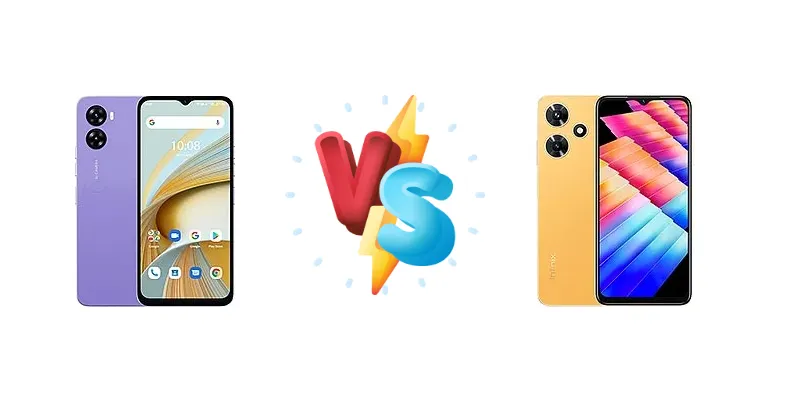
The Umidigi G3 Plus and Infinix Hot 30i represent a fiercely competitive segment of the smartphone market – the sub-$150 arena. Both devices leverage the Unisoc T606 chipset, making core performance similar. However, key differences in charging capabilities and potentially other areas dictate which phone is the better fit for different users. This comparison will dissect those differences to help you make an informed decision.
🏆 Quick Verdict
For the average user prioritizing faster charging and potentially better software support, the Infinix Hot 30i emerges as the slightly better choice. While both phones share the same processor, the 18W charging significantly reduces downtime compared to the Umidigi G3 Plus’s 10W charging, a crucial advantage for on-the-go users.
| Network |
|---|
| 2G bands | GSM 850 / 900 / 1800 / 1900 | GSM 850 / 900 / 1800 / 1900 |
| 3G bands | HSDPA 850 / 900 / 1700(AWS) / 1900 / 2100 | HSDPA 850 / 900 / 1700(AWS) / 1900 / 2100 |
| 4G bands | 1, 2, 3, 4, 5, 7, 8, 12, 17, 20, 28, 38, 40, 41, 66 | 1, 2, 3, 4, 5, 7, 8, 20, 28, 38, 40, 41 |
| Speed | HSPA, LTE | HSPA, LTE |
| Technology | GSM / HSPA / LTE | GSM / HSPA / LTE |
| Launch |
|---|
| Announced | 2023 | 2023, March 31 |
| Status | Available. Released 2023 | Available. Released 2023, March 31 |
| Body |
|---|
| Build | - | Glass front, plastic frame, plastic back |
| Dimensions | 163.9 x 75.7 x 8.8 mm (6.45 x 2.98 x 0.35 in) | 164 x 75.8 x 8.4 mm (6.46 x 2.98 x 0.33 in) |
| SIM | Nano-SIM + Nano-SIM | Nano-SIM + Nano-SIM |
| Weight | 192 g (6.77 oz) | 191 g (6.74 oz) |
| Display |
|---|
| Resolution | 720 x 1600 pixels, 20:9 ratio (~269 ppi density) | 720 x 1612 pixels, 20:9 ratio (~269 ppi density) |
| Size | 6.52 inches, 102.6 cm2 (~82.7% screen-to-body ratio) | 6.56 inches, 103.4 cm2 (~83.2% screen-to-body ratio) |
| Type | IPS LCD | IPS LCD, 90Hz, 500 nits (peak) |
| Platform |
|---|
| CPU | Octa-core (2x1.6 GHz Cortex-A75 & 6x1.6 GHz Cortex-A55) | Octa-core (2x1.6 GHz Cortex-A75 & 6x1.6 GHz Cortex-A55) |
| Chipset | Unisoc T606 (12 nm) | Unisoc T606 (12 nm) |
| GPU | Mali-G57 MP1 | Mali-G57 MP1 |
| OS | Android 13 | Android 12, XOS 10.6 |
| Memory |
|---|
| Card slot | microSDXC (uses shared SIM slot) | microSDXC (dedicated slot) |
| Internal | 128GB 4GB RAM | 64GB 4GB RAM, 128GB 4GB RAM, 128GB 8GB RAM |
| | - | UFS 2.2 |
| Main Camera |
|---|
| Dual | 16 MP, f/2.2, (wide), AF
Auxiliary lens | 13 MP, f/1.9, (wide), AF
0.08 MP, (depth) |
| Features | Dual-LED flash, HDR, panorama | Dual-LED flash, HDR, panorama |
| Single | - | 13 MP, f/1.9, (wide), 1/3.07", AF
Auxiliary lens |
| Video | 1080p@30fps | 1080p@30fps |
| Selfie camera |
|---|
| Features | - | Dual-LED flash |
| Single | 8 MP, f/2.2, (wide) | 8 MP, f/2.0, (wide), 1/3.94" |
| Video | 720p@30fps | 1080p@30fps |
| Sound |
|---|
| 3.5mm jack | - | Yes |
| 35mm jack | Yes | Yes |
| Loudspeaker | Yes | Yes |
| Comms |
|---|
| Bluetooth | 5.0, A2DP, LE | Yes |
| NFC | No | Yes (Hot 30i NFC only) |
| Positioning | GPS, GLONASS, GALILEO | GPS |
| Radio | No | FM radio |
| USB | USB Type-C, OTG | USB Type-C 2.0, OTG |
| WLAN | Wi-Fi 802.11 b/g/n/ac, dual-band, Wi-Fi Direct | Wi-Fi 802.11 a/b/g/n/ac, dual-band |
| Features |
|---|
| Sensors | Fingerprint (side-mounted), accelerometer, proximity, compass | Fingerprint (side-mounted), accelerometer, proximity, compass |
| Battery |
|---|
| Charging | 10W wired | 18W wired |
| Type | 5150 mAh | 5000 mAh |
| Misc |
|---|
| Colors | Graphite Black, Dark Green, Lavender Purple | Mirror Black, Glacier Blue, Diamond White, Marigold |
| Models | - | X669, X669D |
Umidigi G3 Plus
- Potentially lower price point
- Unisoc T606 provides adequate performance for basic tasks
- Likely large battery capacity (around 5000mAh)
- Slow 10W charging
- Potentially less frequent software updates
- May have a less refined user experience
Infinix Hot 30i
- Faster 18W charging
- Potentially better software support from Infinix
- Slightly more modern design aesthetic (likely)
- May be slightly more expensive than the Umidigi G3 Plus
- Shares the same Unisoc T606 chipset, so no performance advantage
- Camera quality likely similar to the Umidigi G3 Plus
Display Comparison
Both the Umidigi G3 Plus and Infinix Hot 30i likely feature LCD panels, common in this price bracket. Specific details like resolution and peak brightness are not provided, but we can assume they are similar, targeting a 720p+ resolution. The absence of information regarding refresh rates suggests both are likely capped at the standard 60Hz. Bezels are expected to be noticeable on both devices, as manufacturers prioritize cost savings over ultra-slim designs in this segment. Color accuracy will likely be standard for budget LCDs, meaning it won't be color-critical for professional work.
Camera Comparison
Without detailed camera specifications, a direct comparison is difficult. Both phones likely feature a multi-camera setup, but the quality will heavily depend on the main sensor and image processing algorithms. It's reasonable to assume both will include a primary sensor, a depth sensor, and potentially a macro lens. Given the price point, image quality will be acceptable in good lighting conditions but will struggle in low-light scenarios. The absence of Optical Image Stabilization (OIS) on either device means relying on software stabilization for video recording. The 2MP macro cameras commonly found in this segment offer limited practical value.
Performance
The core of both devices is the Unisoc T606 (12 nm) chipset, featuring an octa-core CPU configuration with 2x1.6 GHz Cortex-A75 and 6x1.6 GHz Cortex-A55 cores. This means CPU performance will be virtually identical between the two phones. The GPU performance will also be the same. However, real-world performance can be affected by RAM management and software optimization, areas where Infinix often demonstrates a slight edge due to more frequent software updates. The lack of information on RAM type (LPDDR4X vs LPDDR5) prevents a deeper analysis, but it's likely both utilize LPDDR4X to maintain cost-effectiveness. Thermal throttling is unlikely to be a major concern with this chipset, as it's designed for efficiency rather than raw power.
Battery Life
While battery capacity isn't specified, both phones likely house batteries in the 5000mAh range, a standard for budget smartphones. The key differentiator is charging speed. The Infinix Hot 30i boasts 18W wired charging, significantly faster than the Umidigi G3 Plus’s 10W charging. This translates to a considerably quicker 0-100% charge time for the Infinix, potentially shaving off an hour or more. For users who frequently find themselves needing to top up their phone throughout the day, the 18W charging is a substantial advantage. The efficiency of the charging circuitry also plays a role, but the wattage difference is the dominant factor.
Buying Guide
Buy the Umidigi G3 Plus if you prioritize a potentially lower initial cost and are comfortable with slower charging speeds. It’s a solid option for users who primarily use their phone for basic tasks and don’t mind topping up overnight. Buy the Infinix Hot 30i if you value faster charging, potentially more responsive software updates, and a slightly more modern user experience, even if it means paying a small premium.
Frequently Asked Questions
❓ Will the Unisoc T606 in the Infinix Hot 30i handle demanding games like PUBG Mobile?
The Unisoc T606 can run PUBG Mobile, but you'll likely need to lower the graphics settings to medium or low to achieve a playable frame rate. Expect some occasional stuttering during intense firefights. It's not a gaming-focused chipset, so don't expect flagship-level performance.
❓ How long will it take to fully charge the Infinix Hot 30i with the 18W charger?
While a precise time isn't available, the Infinix Hot 30i should fully charge from 0% to 100% in approximately 2 to 2.5 hours with the included 18W charger. This is significantly faster than the Umidigi G3 Plus, which could take 4+ hours with its 10W charger.
❓ Does the Infinix Hot 30i support fast charging protocols beyond 18W?
While the Infinix Hot 30i supports 18W charging, it's unlikely to benefit significantly from a higher wattage charger. The phone's internal charging circuitry is designed to handle up to 18W, and using a more powerful charger won't necessarily result in faster charging speeds.