
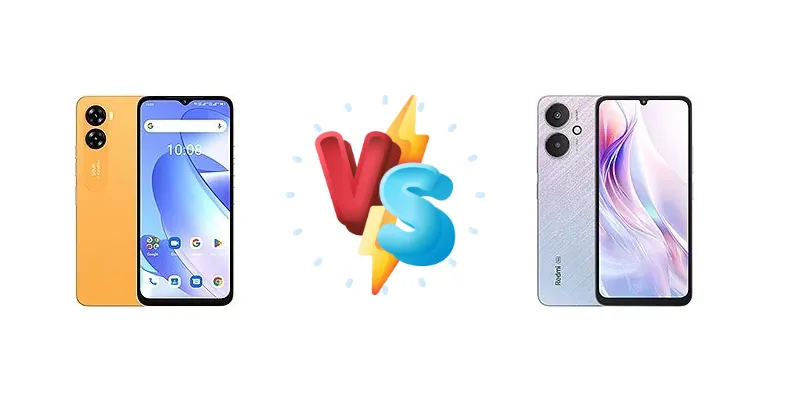
Umidigi G3 Max vs Xiaomi Redmi 13C 5G: A Deep Dive into Budget 5G
| Phones Images | |||||
|---|---|---|---|---|---|
|
🏆 Quick Verdict
For the average user, the Xiaomi Redmi 13C 5G is the better choice. Its Mediatek Dimensity 6100+ chipset, built on a more efficient 6nm process, delivers noticeably improved performance and future-proofing compared to the Umidigi G3 Max’s Unisoc T606. The faster 18W charging with PD support is also a significant advantage.
| PHONES | ||
|---|---|---|
| Phone Names | Umidigi G3 Max | Xiaomi Redmi 13C 5G |
| Network | ||
|---|---|---|
| 2G bands | GSM 850 / 900 / 1800 / 1900 | GSM 850 / 900 / 1800 / 1900 |
| 3G bands | HSDPA 850 / 900 / 1700(AWS) / 1900 / 2100 | HSDPA 800 / 850 / 900 / 1700(AWS) / 1900 / 2100 - International |
| 4G bands | 1, 2, 3, 4, 5, 7, 8, 12, 17, 20, 28, 38, 40, 41, 66 | 1, 2, 3, 4, 5, 7, 8, 12, 13, 17, 18, 19, 20, 26, 28, 32, 38, 40, 41, 66 - International |
| 5G bands | - | 1, 3, 5, 7, 8, 20, 28, 38, 40, 41, 66, 77, 78 SA/NSA - International |
| Speed | HSPA, LTE | HSPA, LTE, 5G |
| Technology | GSM / HSPA / LTE | GSM / HSPA / LTE / 5G |
| Launch | ||
|---|---|---|
| Announced | 2023 | 2023, December 06 |
| Status | Available. Released 2023 | Available. Released 2023, December 16 |
| Body | ||
|---|---|---|
| Build | - | Glass front (Gorilla Glass 3), plastic frame, plastic back |
| Dimensions | 163.9 x 75.7 x 8.8 mm (6.45 x 2.98 x 0.35 in) | 168.1 x 77.9 x 8.2 mm (6.62 x 3.07 x 0.32 in) |
| SIM | Nano-SIM + Nano-SIM | Nano-SIM + Nano-SIM |
| Weight | 192 g (6.77 oz) | 192 g or 195 g (6.77 oz) |
| Display | ||
|---|---|---|
| Protection | - | Corning Gorilla Glass 3 |
| Resolution | 1080 x 2408 pixels, 20:9 ratio (~400 ppi density) | 720 x 1600 pixels, 20:9 ratio (~260 ppi density) |
| Size | 6.6 inches, 104.9 cm2 (~84.6% screen-to-body ratio) | 6.74 inches, 109.7 cm2 (~83.8% screen-to-body ratio) |
| Type | IPS LCD | IPS LCD, 90Hz, 450 nits (typ), 600 nits (HBM) |
| Platform | ||
|---|---|---|
| CPU | Octa-core (2x1.6 GHz Cortex-A75 & 6x1.6 GHz Cortex-A55) | Octa-core (2x2.2 GHz Cortex-A76 & 6x2.0 GHz Cortex-A55) |
| Chipset | Unisoc T606 (12 nm) | Mediatek Dimensity 6100+ (6 nm) |
| GPU | Mali-G57 MP1 | Mali-G57 MC2 |
| OS | Android 13 | Android 13, MIUI 14 |
| Memory | ||
|---|---|---|
| Card slot | microSDXC (uses shared SIM slot) | microSDXC (dedicated slot) |
| Internal | 128GB 8GB RAM | 64GB 4GB RAM, 128GB 4GB RAM, 128GB 6GB RAM, 256GB 8GB RAM |
| Main Camera | ||
|---|---|---|
| Dual | 50 MP, f/1.8, (wide), AF Auxiliary lens | - |
| Features | Dual-LED flash, HDR, panorama | LED flash, HDR |
| Single | - | 50 MP, f/1.8, 28mm (wide), 1/2.76", 1.12µm, PDAF Auxiliary lens |
| Video | 1080p@30fps | 1080p@30fps |
| Selfie camera | ||
|---|---|---|
| Features | - | HDR |
| Single | 8 MP, f/2.2, (wide) | 5 MP, f/2.2, (wide) |
| Video | 720p@30fps | 1080p@30fps |
| Sound | ||
|---|---|---|
| 35mm jack | Yes | Yes |
| Loudspeaker | Yes | Yes |
| Comms | ||
|---|---|---|
| Bluetooth | 5.0, A2DP, LE | 5.3, A2DP, LE |
| NFC | No | Yes (market/region dependent) |
| Positioning | GPS, GLONASS, GALILEO | GPS, GLONASS, GALILEO, BDS |
| Radio | No | FM radio |
| USB | USB Type-C, OTG | USB Type-C 2.0, OTG |
| WLAN | Wi-Fi 802.11 b/g/n/ac, dual-band, Wi-Fi Direct | Wi-Fi 802.11 a/b/g/n/ac, dual-band |
| Features | ||
|---|---|---|
| Sensors | Fingerprint (side-mounted), accelerometer, proximity, compass | Fingerprint (side-mounted), accelerometer, compass |
| Battery | ||
|---|---|---|
| Charging | 10W wired | 18W wired, PD |
| Type | 5150 mAh | 5000 mAh |
| Misc | ||
|---|---|---|
| Colors | Midnight Blue, Iceland Blue, Premium Orange | Starry Black, Twilight Blue, Starry Silver, Starlight Black, Startrail Green, Startrail Silver |
| Models | - | 23124RN87G, 23124RN87I, 23124RN87C |
| Price | - | $ 198.99 / £ 119.00 / € 116.99 / ₹ 10,895 |
| SAR | - | 1.09 W/kg (head) 1.09 W/kg (body) |
| SAR EU | - | 0.98 W/kg (head) 0.98 W/kg (body) |
Umidigi G3 Max
- Lowest possible price point
- Acceptable for basic tasks
- Likely large battery capacity
- Outdated Unisoc T606 chipset
- Slow 10W charging
- Limited performance for gaming or multitasking
Xiaomi Redmi 13C 5G
- Significantly faster Mediatek Dimensity 6100+ chipset
- Faster 18W charging with PD
- Better thermal efficiency
- Slightly higher price
- Display specs are unknown
- Camera performance relies on software optimization
Display Comparison
Neither device boasts a standout display. Both likely utilize LCD panels, common in this price bracket. However, the lack of detailed display specs (resolution, brightness) makes a direct comparison difficult. The Redmi 13C 5G’s potential for a slightly higher peak brightness, given Mediatek’s display optimization, is a possibility, but without concrete data, it remains speculative. Bezels are expected to be substantial on both devices, reflecting their budget positioning.
Camera Comparison
Camera performance is likely to be similar, with both phones relying on budget sensors. Without detailed sensor size information, it’s difficult to make a definitive judgment. However, the Redmi 13C 5G’s image signal processor (ISP), integrated within the Dimensity 6100+, likely offers more sophisticated image processing capabilities, potentially resulting in better dynamic range and noise reduction. The prevalence of 2MP macro lenses on both devices suggests limited utility; these sensors typically produce low-quality images. Focus should be on the main sensor performance, which remains unspecified for both.
Performance
The performance gap is the most significant differentiator. The Xiaomi Redmi 13C 5G’s Mediatek Dimensity 6100+ (6nm) is a substantial upgrade over the Umidigi G3 Max’s Unisoc T606 (12nm). The Dimensity 6100+ features newer Cortex-A76 cores clocked at 2.2 GHz, compared to the G3 Max’s Cortex-A75 cores at 1.6 GHz. This translates to a roughly 30-40% performance increase in CPU-intensive tasks and a more noticeable improvement in GPU performance. The 6nm process also contributes to better thermal efficiency, reducing the likelihood of throttling during sustained workloads. The Redmi 13C 5G will handle multitasking and gaming far more capably.
Battery Life
While both phones likely feature similar battery capacities (estimated around 5000mAh based on market trends), the Redmi 13C 5G’s 18W charging with Power Delivery (PD) is a clear advantage. The Umidigi G3 Max is limited to 10W charging, resulting in significantly longer charge times. The faster charging of the Redmi 13C 5G allows for quicker top-ups, minimizing downtime. The more efficient Dimensity 6100+ chipset may also contribute to slightly better battery life under heavy use.
Buying Guide
Buy the Umidigi G3 Max if you absolutely need the lowest possible upfront cost and are willing to compromise on performance and charging speed. It’s suitable for very basic tasks like calls, texts, and light social media. Buy the Xiaomi Redmi 13C 5G if you prioritize a smoother user experience, faster app loading times, and quicker charging, even if it means spending a little more. This phone is better suited for users who enjoy occasional gaming or multitasking.