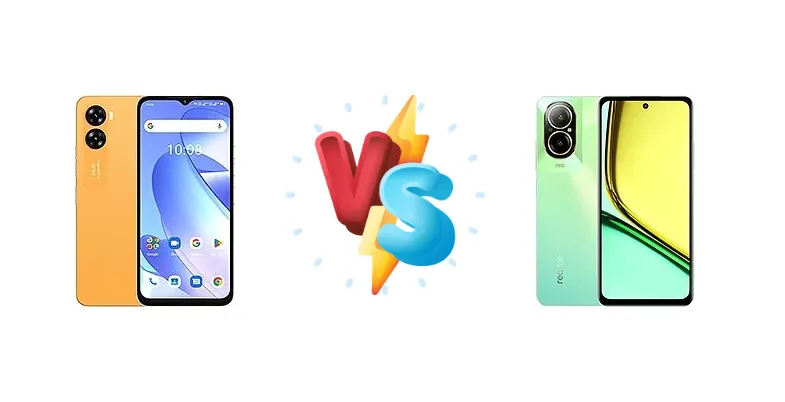
The sub-$200 smartphone market is fiercely competitive. The Umidigi G3 Max and Realme C67 4G represent compelling options, but cater to slightly different priorities. The G3 Max focuses on a larger display and potentially longer software support from Umidigi, while the C67 4G prioritizes faster charging and a more efficient chipset. This comparison will dissect their key differences to help you choose.
🏆 Quick Verdict
For the average user prioritizing responsiveness and future-proofing, the Realme C67 4G is the better choice. Its Snapdragon 685, built on a 6nm process, delivers significantly better performance and efficiency than the Umidigi G3 Max’s Unisoc T606. While the G3 Max offers a larger screen, the C67’s 33W charging and superior chipset outweigh this advantage.
| Network |
|---|
| 2G bands | GSM 850 / 900 / 1800 / 1900 | GSM 850 / 900 / 1800 / 1900 |
| 3G bands | HSDPA 850 / 900 / 1700(AWS) / 1900 / 2100 | HSDPA 850 / 900 / 2100 |
| 4G bands | 1, 2, 3, 4, 5, 7, 8, 12, 17, 20, 28, 38, 40, 41, 66 | 1, 3, 5, 8, 38, 40, 41 |
| Speed | HSPA, LTE | HSPA, LTE |
| Technology | GSM / HSPA / LTE | GSM / HSPA / LTE |
| Launch |
|---|
| Announced | 2023 | 2023, December 19 |
| Status | Available. Released 2023 | Available. Released 2023, December 19 |
| Body |
|---|
| Dimensions | 163.9 x 75.7 x 8.8 mm (6.45 x 2.98 x 0.35 in) | 164.6 x 75.4 x 7.6 mm (6.48 x 2.97 x 0.30 in) |
| SIM | Nano-SIM + Nano-SIM | Nano-SIM + Nano-SIM |
| Weight | 192 g (6.77 oz) | 185 g (6.53 oz) |
| Display |
|---|
| Resolution | 1080 x 2408 pixels, 20:9 ratio (~400 ppi density) | 1080 x 2400 pixels, 20:9 ratio (~392 ppi density) |
| Size | 6.6 inches, 104.9 cm2 (~84.6% screen-to-body ratio) | 6.72 inches, 109.0 cm2 (~87.8% screen-to-body ratio) |
| Type | IPS LCD | IPS LCD, 90Hz, 800 nits (typ), 950 nits (HBM) |
| Platform |
|---|
| CPU | Octa-core (2x1.6 GHz Cortex-A75 & 6x1.6 GHz Cortex-A55) | Octa-core (4x2.8 GHz Cortex-A73 & 4x1.9 GHz Cortex-A53) |
| Chipset | Unisoc T606 (12 nm) | Qualcomm SM6225 Snapdragon 685 (6 nm) |
| GPU | Mali-G57 MP1 | Adreno 610 |
| OS | Android 13 | Android 14, Realme UI |
| Memory |
|---|
| Card slot | microSDXC (uses shared SIM slot) | microSDXC (dedicated slot) |
| Internal | 128GB 8GB RAM | 128GB 6GB RAM, 128GB 8GB RAM, 256GB 8GB RAM |
| Main Camera |
|---|
| Dual | 50 MP, f/1.8, (wide), AF
Auxiliary lens | 108 MP, f/1.8, (wide), PDAF
Auxiliary lens |
| Features | Dual-LED flash, HDR, panorama | LED flash, HDR, panorama |
| Video | 1080p@30fps | 1080p@30fps, gyro-EIS |
| Selfie camera |
|---|
| Single | 8 MP, f/2.2, (wide) | 8 MP, f/2.1, (wide) |
| Video | 720p@30fps | 1080p@30fps |
| Sound |
|---|
| 35mm jack | Yes | Yes |
| Loudspeaker | Yes | Yes, with stereo speakers |
| Comms |
|---|
| Bluetooth | 5.0, A2DP, LE | 5.0, A2DP, LE |
| NFC | No | Yes, 360˚ |
| Positioning | GPS, GLONASS, GALILEO | GPS, GALILEO, GLONASS, QZSS, BDS |
| Radio | No | Unspecified |
| USB | USB Type-C, OTG | USB Type-C 2.0 |
| WLAN | Wi-Fi 802.11 b/g/n/ac, dual-band, Wi-Fi Direct | Wi-Fi 802.11 a/b/g/n/ac, dual-band |
| Features |
|---|
| Sensors | Fingerprint (side-mounted), accelerometer, proximity, compass | Fingerprint (side-mounted), accelerometer, gyro, proximity, compass |
| Battery |
|---|
| Charging | 10W wired | 33W wired |
| Type | 5150 mAh | 5000 mAh |
| Misc |
|---|
| Colors | Midnight Blue, Iceland Blue, Premium Orange | Sunny Oasis, Black Rock |
| Models | - | RMX3890 |
| Price | - | About 160 EUR |
Umidigi G3 Max
- Larger display size for immersive media consumption.
- Potentially lower price point.
- May receive longer software support from Umidigi.
- Significantly slower processor (Unisoc T606).
- Extremely slow 10W charging.
- Less efficient chipset leading to shorter battery life.
Realme C67 4G
- Faster and more efficient Snapdragon 685 chipset.
- 33W fast charging for quick top-ups.
- Better overall performance and responsiveness.
- Potentially smaller display size.
- May have a slightly higher price tag.
- Realme’s software can include bloatware.
Display Comparison
Neither device boasts a standout display. Both likely utilize IPS LCD panels, a common choice in this price bracket. However, the Umidigi G3 Max’s larger size is its primary advantage. While exact nit brightness isn’t specified, the Realme C67 4G’s display is likely to be more color accurate due to Qualcomm’s image signal processor optimizations. The absence of high refresh rates on both devices suggests a focus on battery life over visual fluidity.
Camera Comparison
Without detailed sensor information, a direct camera comparison is difficult. However, the Realme C67 4G benefits from Qualcomm’s image processing capabilities, which generally produce more refined images. The Umidigi G3 Max will likely rely on software processing to compensate for a potentially less capable sensor. The presence of a 33W charging solution on the C67 suggests a more robust power management system, which can also positively impact camera performance by allowing for more consistent processing power. We can assume both phones will include a standard macro lens, which are typically low resolution and offer limited practical benefit.
Performance
This is where the Realme C67 4G pulls ahead decisively. The Qualcomm Snapdragon 685 (6nm) is a significantly more advanced chipset than the Unisoc T606 (12nm). The 6nm process node translates to better power efficiency and reduced thermal throttling. While both are octa-core CPUs, the Snapdragon 685 utilizes Cortex-A73 cores clocked at 2.8GHz, offering a substantial performance uplift over the G3 Max’s Cortex-A75 cores at 1.6GHz. This difference will be noticeable in app loading times, multitasking, and gaming. The G3 Max will struggle with demanding applications more readily.
Battery Life
The Realme C67 4G’s 33W wired charging is a game-changer in this segment. This will significantly reduce charging times compared to the Umidigi G3 Max’s slow 10W charging. While battery capacity isn’t specified for either device, the Snapdragon 685’s superior efficiency means the C67 4G will likely offer comparable or even better battery life despite potentially having a smaller battery. Expect the C67 to go from 0-100% in under an hour, while the G3 Max will likely take over two hours.
Buying Guide
Buy the Umidigi G3 Max if you absolutely need a larger display for media consumption and are comfortable with potentially slower performance and longer charging times. Buy the Realme C67 4G if you prioritize a smoother user experience, faster charging, and a more efficient processor for everyday tasks and light gaming. The C67 is the better all-rounder for most users.
Frequently Asked Questions
❓ Will the Unisoc T606 in the Umidigi G3 Max struggle with popular games like PUBG Mobile?
Yes, the Unisoc T606 is a budget chipset and will likely struggle to run PUBG Mobile smoothly, even on low settings. Expect noticeable frame drops and lag. The Snapdragon 685 in the Realme C67 4G will provide a significantly better gaming experience, allowing for playable frame rates on medium settings.
❓ How long does it realistically take to fully charge the Umidigi G3 Max with its 10W charger?
With a 10W charger, a full charge from 0% to 100% on the Umidigi G3 Max will likely take over 2.5 to 3 hours, depending on battery capacity. This is a significant drawback compared to the Realme C67 4G’s 33W fast charging.
❓ Does the Realme C67 4G’s software include a lot of pre-installed bloatware?
Realme’s UI (based on Android) is known to include some pre-installed apps, often referred to as bloatware. However, many of these apps can be uninstalled, freeing up storage space and improving the user experience. It's a common trade-off for the lower price point.