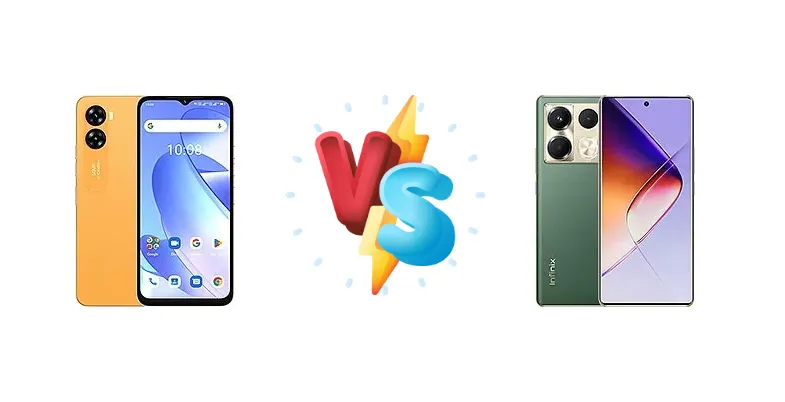
The sub-$200 smartphone market is fiercely competitive. The Umidigi G3 Max and Infinix Note 40S both aim to deliver a compelling experience without breaking the bank, but they take different approaches. The G3 Max focuses on a simple, streamlined experience, while the Note 40S pushes the boundaries with faster charging and a more powerful chipset. This comparison will dissect their key differences to help you choose the right device.
🏆 Quick Verdict
For most users, the Infinix Note 40S is the superior choice. Its Mediatek Helio G99 Ultimate chipset provides a noticeable performance boost over the Umidigi G3 Max’s Unisoc T606, and the 33W charging (plus wireless charging) significantly reduces downtime. While the G3 Max offers a basic experience, the Note 40S delivers more power and convenience.
| Network |
|---|
| 2G bands | GSM 850 / 900 / 1800 / 1900 | GSM 850 / 900 / 1800 / 1900 |
| 3G bands | HSDPA 850 / 900 / 1700(AWS) / 1900 / 2100 | HSDPA 850 / 900 / 1700(AWS) / 1900 / 2100 |
| 4G bands | 1, 2, 3, 4, 5, 7, 8, 12, 17, 20, 28, 38, 40, 41, 66 | 1, 2, 3, 4, 5, 7, 8, 20, 28, 38, 40, 41 |
| Speed | HSPA, LTE | HSPA, LTE |
| Technology | GSM / HSPA / LTE | GSM / HSPA / LTE |
| Launch |
|---|
| Announced | 2023 | 2024, September |
| Status | Available. Released 2023 | Available. Released 2024, October |
| Body |
|---|
| Dimensions | 163.9 x 75.7 x 8.8 mm (6.45 x 2.98 x 0.35 in) | 164.1 x 74.6 x 7.8 mm (6.46 x 2.94 x 0.31 in) |
| SIM | Nano-SIM + Nano-SIM | Nano-SIM + Nano-SIM |
| Weight | 192 g (6.77 oz) | 176 g (6.21 oz) |
| Display |
|---|
| Protection | - | Corning Gorilla Glass |
| Resolution | 1080 x 2408 pixels, 20:9 ratio (~400 ppi density) | 1080 x 2436 pixels (~393 ppi density) |
| Size | 6.6 inches, 104.9 cm2 (~84.6% screen-to-body ratio) | 6.78 inches, 109.9 cm2 (~89.8% screen-to-body ratio) |
| Type | IPS LCD | AMOLED, 1B colors, 120Hz, 550 nits (typ), 1300 nits (peak) |
| Platform |
|---|
| CPU | Octa-core (2x1.6 GHz Cortex-A75 & 6x1.6 GHz Cortex-A55) | Octa-core (2x2.2 GHz Cortex-A76 & 6x2.0 GHz Cortex-A55) |
| Chipset | Unisoc T606 (12 nm) | Mediatek Helio G99 Ultimate |
| GPU | Mali-G57 MP1 | Mali-G57 MC2 |
| OS | Android 13 | Android 14, up to 2 major Android upgrades, XOS 14 |
| Memory |
|---|
| Card slot | microSDXC (uses shared SIM slot) | Unspecified |
| Internal | 128GB 8GB RAM | 256GB 8GB RAM |
| Main Camera |
|---|
| Dual | 50 MP, f/1.8, (wide), AF
Auxiliary lens | - |
| Features | Dual-LED flash, HDR, panorama | Quad-LED flash, HDR, panorama |
| Triple | - | 108 MP, f/1.9, 24mm (wide), 1/1.52", PDAF
2 MP (macro)
3rd unspecified camera |
| Video | 1080p@30fps | 1440p@30fps, 1080p@30/60fps |
| Selfie camera |
|---|
| Features | - | Dual-LED flash |
| Single | 8 MP, f/2.2, (wide) | 32 MP, f/2.2, (wide), 1/3.1" |
| Video | 720p@30fps | 1080p@30fps |
| Sound |
|---|
| 35mm jack | Yes | No |
| Loudspeaker | Yes | Yes, with stereo speakers |
| Comms |
|---|
| Bluetooth | 5.0, A2DP, LE | Yes |
| NFC | No | Yes (market/region dependent) |
| Positioning | GPS, GLONASS, GALILEO | GPS |
| Radio | No | FM radio |
| USB | USB Type-C, OTG | USB Type-C 2.0, OTG |
| WLAN | Wi-Fi 802.11 b/g/n/ac, dual-band, Wi-Fi Direct | Wi-Fi 802.11 a/b/g/n/ac, dual-band |
| Features |
|---|
| Sensors | Fingerprint (side-mounted), accelerometer, proximity, compass | Fingerprint (under display, optical), accelerometer, gyro, proximity, compass |
| Battery |
|---|
| Charging | 10W wired | 33W wired, 50% in 31 min
20W wireless MagCharge
Reverse wired
Reverse wireless
Bypass charging |
| Type | 5150 mAh | 5000 mAh |
| Misc |
|---|
| Colors | Midnight Blue, Iceland Blue, Premium Orange | Obsidian Black, Vintage Green |
| Models | - | X6850B |
Umidigi G3 Max
- Potentially cleaner software experience (depending on Umidigi's skin)
- Simpler, more straightforward user interface
- Likely more affordable
- Significantly slower processor
- Extremely slow 10W charging
- Limited performance for demanding tasks
Infinix Note 40S
- Faster and more efficient Mediatek Helio G99 Ultimate chipset
- 33W fast charging with 50% in 31 minutes
- Wireless charging (MagCharge) and reverse charging capabilities
- Better overall performance for gaming and multitasking
- Software experience may be more cluttered (depending on Infinix's skin)
- Potentially slightly higher price
Display Comparison
Neither device boasts a standout display. While specific display specs (resolution, panel type) are missing for the Umidigi G3 Max, it's likely a standard LCD panel given its price point. The Infinix Note 40S, similarly, doesn't advertise advanced display features like high refresh rates or LTPO. The key difference will likely be color accuracy and peak brightness, where the Note 40S, benefiting from a more modern chipset, may have a slight edge in rendering vibrant colors. Bezels are expected to be comparable on both devices, reflecting their budget positioning.
Camera Comparison
Without detailed camera specs, a direct comparison is challenging. However, it's safe to assume both phones will feature a primary camera and potentially a depth or macro sensor. The Infinix Note 40S, given its more powerful chipset, likely benefits from more sophisticated image processing algorithms, potentially resulting in better dynamic range and noise reduction. The Umidigi G3 Max will likely rely on simpler processing, which may lead to less refined images. The presence of Optical Image Stabilization (OIS) on either device is unlikely at this price point.
Performance
The performance gap is the most significant differentiator. The Infinix Note 40S’s Mediatek Helio G99 Ultimate, with its 2x2.2 GHz Cortex-A76 cores, represents a substantial upgrade over the Umidigi G3 Max’s Unisoc T606 (2x1.6 GHz Cortex-A75). The Cortex-A76 architecture is demonstrably more efficient and powerful than the A75, translating to faster app loading times, smoother multitasking, and improved gaming performance. While both utilize a 6x1.6 GHz Cortex-A55 cluster for efficiency, the G99 Ultimate’s overall processing power will be noticeably superior. The Note 40S is likely to handle graphically intensive games with higher frame rates and fewer stutters.
Battery Life
The battery capacity is not specified for the Umidigi G3 Max, but it's reasonable to assume it's in the 5000mAh range, common for budget phones. The Infinix Note 40S’s battery capacity is also likely around 5000mAh. However, the charging speed is where the Note 40S truly shines. Its 33W wired charging, capable of reaching 50% in 31 minutes, is significantly faster than the Umidigi G3 Max’s slow 10W charging. Furthermore, the Note 40S adds 20W wireless MagCharge, reverse wired charging, and reverse wireless charging – features entirely absent on the G3 Max. This makes the Note 40S far more convenient for users who frequently need to top up their battery or charge other devices.
Buying Guide
Buy the Umidigi G3 Max if you prioritize extreme simplicity and a minimal software experience, and your usage is limited to basic tasks like calls, texts, and light social media. You're willing to trade performance and charging speed for a potentially cleaner Android build. Buy the Infinix Note 40S if you want a phone that can handle more demanding apps, occasional gaming, and appreciate the convenience of fast wired and wireless charging, alongside features like reverse charging.
Frequently Asked Questions
❓ Does the Mediatek Helio G99 Ultimate in the Infinix Note 40S get hot during extended gaming sessions?
The Helio G99 Ultimate is known for its efficiency, but it can still generate heat under sustained load. However, Infinix typically implements thermal management solutions to mitigate overheating. Expect some warmth, but not to the point of significant performance throttling during typical gaming sessions. The Umidigi G3 Max, with its less powerful chipset, will likely run cooler but also offer a less enjoyable gaming experience.
❓ Is the 20W MagCharge on the Infinix Note 40S compatible with all MagSafe accessories?
While the Infinix Note 40S utilizes MagCharge, which is magnetically attached wireless charging, full compatibility with all MagSafe accessories isn't guaranteed. Some accessories may require a specific adapter or may not adhere securely. It's best to check compatibility reviews or test with your existing MagSafe accessories before purchasing.
❓ How does the software experience differ between the Umidigi G3 Max and the Infinix Note 40S?
Umidigi typically uses a lighter software skin on top of Android, aiming for a cleaner experience. Infinix, on the other hand, often includes more pre-installed apps and features in their XOS skin. This can lead to a more feature-rich experience but also potential bloatware. The Note 40S will likely receive more frequent software updates due to Infinix's larger user base and resources.