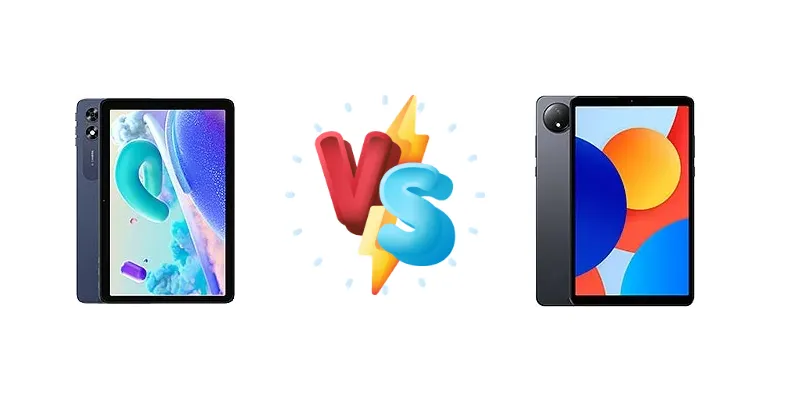
The sub-$200 tablet market is heating up, with the Umidigi G2 Tab and Xiaomi Redmi Pad SE 8.7 vying for dominance. Both aim to deliver a capable Android experience without breaking the bank, but they take different approaches to achieving this. This comparison dives deep into their core components to determine which tablet offers the best value for your money.
🏆 Quick Verdict
For most users, the Xiaomi Redmi Pad SE 8.7 is the better choice. Its Mediatek Helio G85 chipset, built on a more efficient 12nm process, provides a noticeable performance advantage over the Umidigi G2 Tab’s RK3562, especially in multitasking and light gaming. The faster 18W (International) charging also adds convenience.
| Network |
|---|
| 2G bands | N/A | GSM 850 / 900 / 1800 / 1900 |
| 3G bands | - | HSDPA 800 / 850 / 900 / 1700(AWS) / 1900 / 2100 |
| 4G bands | N/A | 1, 2, 3, 4, 5, 7, 8, 13, 18, 19, 20, 26, 28, 38, 40, 41, 66 |
| EDGE | N/A | - |
| GPRS | N/A | - |
| Speed | - | HSPA, LTE - cellular model only |
| Technology | No cellular connectivity | GSM / HSPA / LTE |
| Launch |
|---|
| Announced | 2023 | 2024, July 29 |
| Status | Available. Released 2023 | Available. Released 2024, August 08 |
| Body |
|---|
| Build | - | Glass front (Gorilla Glass 3) |
| Dimensions | 244.8 x 162.2 x 9.3 mm (9.64 x 6.39 x 0.37 in) | 211.6 x 125.5 x 8.8 mm (8.33 x 4.94 x 0.35 in) |
| SIM | No | Nano-SIM + Nano-SIM (cellular model only) |
| Weight | 576 g (1.27 lb) | 370 / 373 / 375 g (13.05 oz) |
| Display |
|---|
| Protection | - | Corning Gorilla Glass 3 |
| Resolution | 800 x 1280 pixels, 16:10 ratio (~149 ppi density) | 800 x 1340 pixels, 5:3 ratio (~179 ppi density) |
| Size | 10.1 inches, 295.8 cm2 (~74.5% screen-to-body ratio) | 8.7 inches, 214.9 cm2 (~80.9% screen-to-body ratio) |
| Type | IPS LCD | IPS LCD, 1B colors, 90Hz, 600 nits (HBM) |
| Platform |
|---|
| CPU | Quad-core 2.0 GHz | Octa-core (2x2.0 GHz Cortex-A75 & 6x1.8 GHz Cortex-A55) |
| Chipset | RK3562 (22 nm) | Mediatek Helio G85 (12 nm) |
| GPU | - | Mali-G52 MC2 |
| OS | Android 13 | Android 14, HyperOS |
| Memory |
|---|
| Card slot | microSDXC (dedicated slot) | microSDXC (dedicated slot) |
| Internal | 64GB 4GB RAM | 64GB 4GB RAM, 128GB 4GB RAM, 128GB 6GB RAM |
| Main Camera |
|---|
| Features | LED flash | LED flash |
| Single | 8 MP, f/2.2, (wide) | 8 MP, f/2.0, (wide), 1/4.0", 1.12µm |
| Video | 720p@30fps | 1080p@30fps |
| Selfie camera |
|---|
| Single | 8 MP, f/2.2, (wide) | 5 MP, f/2.2, (wide), 1/5.0", 1.12µm |
| Video | 720p@30fps | 1080p@30fps |
| Sound |
|---|
| 35mm jack | Yes | Yes |
| Loudspeaker | Yes, with stereo speakers | Yes, with stereo speakers |
| Comms |
|---|
| Bluetooth | 5.0, A2DP, LE | 5.3, A2DP, LE |
| Infrared port | - | Yes |
| NFC | No | No |
| Positioning | No | GPS, GALILEO, GLONASS, BDS - cellular model only |
| Radio | No | FM radio |
| USB | USB Type-C | USB Type-C 2.0 |
| WLAN | Wi-Fi 802.11 a/b/g/n/ac/6, dual-band | Wi-Fi 802.11 a/b/g/n/ac, dual-band |
| Features |
|---|
| Sensors | Accelerometer | Accelerometer, proximity (accessories only), compass |
| Battery |
|---|
| Charging | 10W wired | 18W wired (Int'l)
10W wired (India) |
| Type | 6000 mAh | 6650 mAh |
| Misc |
|---|
| Colors | Midnight Blue | Aurora Green (Forest Green), Sky Blue (Ocean Blue), Graphite Gray (Urban Grey) |
| Models | - | 220233L2G |
| Price | - | About 120 EUR |
| SAR | - | 0.90 W/kg (head) 0.65 W/kg (body) |
| SAR EU | - | 0.40 W/kg (head) 0.99 W/kg (body) |
Umidigi G2 Tab
- Potentially lower price point
- Acceptable for basic tasks
- Android OS
- Less powerful RK3562 chipset
- Slower 10W charging
- Likely lower performance in demanding apps
Xiaomi Redmi Pad SE 8.7
- More powerful Mediatek Helio G85 chipset
- Faster 18W charging (International)
- Smoother multitasking and gaming
- Slightly higher price
- Camera performance is still basic
- May not be available in all regions with 18W charging
Display Comparison
Neither device boasts a particularly standout display. Both are likely to utilize IPS LCD panels, common in this price bracket. However, the Redmi Pad SE 8.7’s 8.7-inch size offers a slightly more immersive viewing experience than the G2 Tab’s unspecified screen size. Without detailed specifications on the Umidigi G2 Tab’s panel, it’s difficult to assess color accuracy or brightness, but we can assume it will be comparable to other tablets in its class. The Redmi Pad SE 8.7 benefits from Xiaomi’s software optimizations, potentially offering better color calibration.
Camera Comparison
Camera performance is unlikely to be a deciding factor for either tablet. Both are positioned as budget devices, and camera quality typically takes a backseat. Without specific sensor details for the Umidigi G2 Tab, it’s safe to assume it will feature a basic camera setup. The Redmi Pad SE 8.7’s camera specifications are also modest, suggesting similar limitations. Image quality will likely be acceptable for casual snapshots in good lighting conditions, but don’t expect flagship-level results.
Performance
The core difference lies in the chipsets. The Xiaomi Redmi Pad SE 8.7’s Mediatek Helio G85, fabricated on a 12nm process, features an octa-core configuration (2x2.0 GHz Cortex-A75 & 6x1.8 GHz Cortex-A55). This architecture provides a significant advantage over the Umidigi G2 Tab’s RK3562, a quad-core 2.0 GHz processor built on a less efficient 22nm node. The Helio G85’s more modern design and higher core count translate to smoother multitasking, faster app loading times, and improved gaming performance. The RK3562 will handle basic tasks, but will likely struggle with demanding applications. The Redmi Pad SE 8.7 is the clear winner in this category.
Battery Life
Battery life will depend heavily on usage patterns. While the exact battery capacity of the Umidigi G2 Tab is unknown, the Redmi Pad SE 8.7’s battery size is also not specified. However, the Redmi Pad SE 8.7 offers a significant advantage in charging speed, supporting 18W wired charging (International markets) compared to the Umidigi G2 Tab’s slow 10W charging. This means the Redmi Pad SE 8.7 can be topped up much faster, reducing downtime. The more efficient Helio G85 chipset may also contribute to slightly better battery life during typical use.
Buying Guide
Buy the Umidigi G2 Tab if you prioritize absolute affordability and need a basic tablet for simple tasks like reading ebooks or light web browsing. Its lower price point makes it an accessible entry point into the tablet world. Buy the Xiaomi Redmi Pad SE 8.7 if you value smoother performance for everyday use, enjoy occasional gaming, and appreciate faster charging speeds. The slightly higher investment translates to a more responsive and versatile experience.
Frequently Asked Questions
❓ Is the Mediatek Helio G85 in the Redmi Pad SE 8.7 powerful enough for gaming?
The Helio G85 is capable of handling many popular mobile games at medium settings. While it won't deliver a flagship gaming experience, it provides a noticeable improvement over the RK3562 in the Umidigi G2 Tab, allowing for smoother gameplay in titles like PUBG Mobile and Call of Duty: Mobile.
❓ Does the Umidigi G2 Tab support Google Play Services and app updates?
The Umidigi G2 Tab runs on Android, and generally supports Google Play Services. However, budget tablets sometimes experience delays in receiving the latest Android updates. It's important to check user reviews and forums for information on the current software support situation.
❓ What is the charging time for the Xiaomi Redmi Pad SE 8.7 with the 18W charger?
With the included 18W charger (available in international markets), the Redmi Pad SE 8.7 should fully charge from 0% to 100% in approximately 2.5 to 3 hours. The 10W charging in India will take considerably longer.
❓ Is the RK3562 chipset in the Umidigi G2 Tab suitable for video streaming?
The RK3562 can handle video streaming from services like YouTube and Netflix, but you may experience occasional buffering or lag, especially with higher resolution content. The Redmi Pad SE 8.7’s Helio G85 will provide a smoother streaming experience.