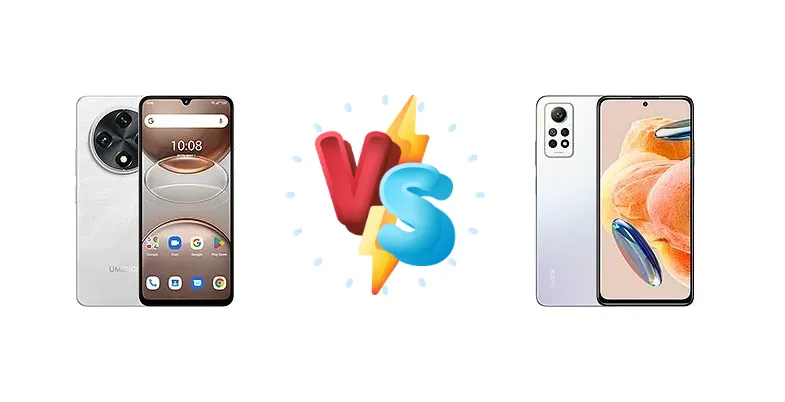
The sub-$200 4G smartphone market is fiercely competitive. The Umidigi G100A and Xiaomi Redmi Note 12 Pro 4G both aim to deliver a solid experience without breaking the bank, but they take different approaches. The G100A focuses on affordability, while the Redmi Note 12 Pro 4G prioritizes faster charging and a more powerful chipset.
🏆 Quick Verdict
For the average user prioritizing responsiveness and future-proofing, the Xiaomi Redmi Note 12 Pro 4G is the better choice. Its Snapdragon 732G chipset, built on an 8nm process, offers significantly better performance than the Umidigi G100A’s Unisoc T615, and the 67W charging is a game-changer.
| Network |
|---|
| 2G bands | GSM 850 / 900 / 1800 / 1900 | GSM 850 / 900 / 1800 / 1900 |
| 3G bands | HSDPA 850 / 900 / 1700(AWS) / 1900 / 2100 | HSDPA 850 / 900 / 1700(AWS) / 1900 / 2100 |
| 4G bands | 1, 2, 3, 4, 5, 7, 8, 17, 18, 19, 20, 26, 28, 38, 40, 41, 66 | 1, 2, 3, 4, 5, 7, 8, 20, 28, 38, 40, 41, 66 |
| Speed | HSPA, LTE | HSPA, LTE |
| Technology | GSM / HSPA / LTE | GSM / HSPA / LTE |
| Launch |
|---|
| Announced | 2022, December | 2023, March 03 |
| Status | Available. Released 2024, December 27 | Available. Released 2023, April 11 |
| Body |
|---|
| Build | Glass front, plastic back, plastic frame | - |
| Dimensions | 171 x 77.6 x 8.1 mm (6.73 x 3.06 x 0.32 in) | 164.2 x 76.1 x 8.1 mm (6.46 x 3.00 x 0.32 in) |
| SIM | Nano-SIM + Nano-SIM | Nano-SIM + Nano-SIM |
| Weight | 205 g (7.23 oz) | 201.8 g (7.13 oz) |
| Display |
|---|
| Resolution | 720 x 1640 pixels (~260 ppi density) | 1080 x 2400 pixels, 20:9 ratio (~395 ppi density) |
| Size | 6.9 inches, 113.1 cm2 (~85.2% screen-to-body ratio) | 6.67 inches, 107.4 cm2 (~86.0% screen-to-body ratio) |
| Type | IPS LCD, 120Hz | AMOLED, 120Hz, Dolby Vision, 700 nits (HBM), 1100 nits (peak) |
| Platform |
|---|
| CPU | Octa-core (2x1.8 GHz Cortex-A75 & 6x1.6 GHz Cortex-A55) | Octa-core (2x2.2 GHz Kryo 470 Gold & 6x1.8 GHz Kryo 470 Silver) |
| Chipset | Unisoc T615 (12 nm) | Qualcomm SM7150 Snapdragon 732G (8 nm) |
| GPU | Mali-G57 MP1 | Adreno 618 |
| OS | Android 14 | Android 11, MIUI 13 |
| Memory |
|---|
| Card slot | microSDXC (uses shared SIM slot) | microSDXC (uses shared SIM slot) |
| Internal | 128GB 4GB RAM, 256GB 4GB RAM | 128GB 6GB RAM, 128GB 8GB RAM, 256GB 8GB RAM |
| | - | UFS 2.2 |
| Main Camera |
|---|
| Dual | 13 MP, (wide)
Auxiliary lens | - |
| Features | LED flash | LED flash, HDR, panorama |
| Quad | - | 108 MP, f/1.9, (wide), 1/1.52", 0.7µm, PDAF
8 MP, 120˚, (ultrawide)
2 MP (macro)
Auxiliary lens |
| Video | 1080p@30fps | 4K@30fps, 1080p@30/60fps |
| Selfie camera |
|---|
| Single | 8 MP, (wide) | 16 MP, f/2.4, (wide) |
| Video | Yes | 1080p@30fps |
| Sound |
|---|
| 3.5mm jack | - | Yes |
| 35mm jack | Yes | Yes |
| Loudspeaker | Yes | Yes, with stereo speakers |
| Comms |
|---|
| Bluetooth | 5.2, A2DP, LE | 5.0, A2DP, LE |
| Infrared port | - | Yes |
| NFC | No | Yes (market/region dependent) |
| Positioning | GPS, GLONASS, GALILEO, BDS | GPS, GLONASS, GALILEO, BDS |
| Radio | FM radio | Unspecified |
| USB | USB Type-C, OTG | USB Type-C 2.0, OTG |
| WLAN | Wi-Fi 802.11 a/b/g/n/ac, dual-band | Wi-Fi 802.11 a/b/g/n/ac, dual-band |
| Features |
|---|
| Sensors | Fingerprint (side-mounted), accelerometer, compass | Fingerprint (side-mounted), accelerometer, gyro, compass |
| Battery |
|---|
| Charging | 20W wired | 67W wired |
| Type | 6000 mAh | Li-Po 5000 mAh |
| Misc |
|---|
| Colors | Rock Black, Interstellar Blue, Lake Green, Starry White | Star Blue, Graphite Gray, Polar White, Ice blue |
| Models | - | 2209116AG, 2209116AG |
| Price | About 130 EUR | About 150 EUR |
Umidigi G100A
- Most affordable option
- Functional for basic tasks
- Decent battery life (assuming moderate usage)
- Significantly slower performance
- Slow charging speed
- Inferior camera performance
Xiaomi Redmi Note 12 Pro 4G
- Faster and more responsive performance
- Ultra-fast 67W charging
- Likely better camera quality
- Slightly higher price
- May not be significantly better for *extremely* light users
- Potentially more expensive repairs
Display Comparison
Neither device boasts a standout display. While specific panel details (like peak brightness or color gamut coverage) are unavailable, the focus here is on the core chipsets. Both likely utilize IPS LCD panels, common in this price bracket. Bezels are expected to be similar, and color accuracy will likely be adequate but not exceptional. The display isn't a differentiating factor.
Camera Comparison
Without detailed camera specs, a direct comparison is difficult. However, the Redmi Note 12 Pro 4G, given Xiaomi’s camera-focused marketing, likely features a more sophisticated image processing pipeline and potentially a larger main sensor. The Unisoc T615’s ISP is less capable than Qualcomm’s, meaning the G100A will likely struggle in low-light conditions. Expect the Redmi Note 12 Pro 4G to deliver more detailed and vibrant photos, especially in challenging lighting scenarios. The presence or absence of OIS (Optical Image Stabilization) on the Redmi Note 12 Pro 4G would further solidify its camera advantage.
Performance
The core difference lies in the chipsets. The Xiaomi Redmi Note 12 Pro 4G’s Qualcomm Snapdragon 732G (8nm) is a clear upgrade over the Umidigi G100A’s Unisoc T615 (12nm). The 8nm process node allows for greater transistor density and improved power efficiency, translating to better sustained performance and less thermal throttling. The Snapdragon 732G’s Kryo 470 Gold cores, clocked at 2.2 GHz, outperform the Unisoc T615’s Cortex-A75 cores at 1.8 GHz. This difference will be most noticeable in demanding applications like gaming and video editing. While both have octa-core CPUs, the architectural advantages of the Snapdragon are substantial.
Battery Life
The Redmi Note 12 Pro 4G’s 67W wired charging is a massive advantage. This allows for a full charge in under an hour, a significant convenience compared to the Umidigi G100A’s 20W charging. While battery capacity isn’t specified, the faster charging speed effectively mitigates any potential capacity difference. Users who frequently top up their phones or need a quick boost before leaving the house will greatly appreciate the Redmi Note 12 Pro 4G’s charging capabilities.
Buying Guide
Buy the Umidigi G100A if you need a functional smartphone for basic tasks like calling, texting, and light social media use, and your budget is extremely tight. Buy the Xiaomi Redmi Note 12 Pro 4G if you prefer a smoother user experience, faster app loading times, and the convenience of incredibly rapid charging, even if it means spending a bit more.
Frequently Asked Questions
❓ Will the Unisoc T615 in the Umidigi G100A struggle with multitasking?
Yes, the Unisoc T615 is a budget chipset. While it can handle basic multitasking, expect slowdowns and lag when running multiple demanding apps simultaneously. The Redmi Note 12 Pro 4G’s Snapdragon 732G offers a much smoother multitasking experience.
❓ How long does it *actually* take to charge the Redmi Note 12 Pro 4G from 0% to 100%?
With 67W charging, the Redmi Note 12 Pro 4G can typically charge from 0% to 100% in around 45-50 minutes, depending on battery health and charging conditions. This is a substantial improvement over the Umidigi G100A’s 20W charging, which will likely take over 2 hours.
❓ Is the Snapdragon 732G capable of playing demanding games like PUBG Mobile?
Yes, the Snapdragon 732G can play PUBG Mobile at medium to high settings with reasonable frame rates. While it won't deliver a flagship gaming experience, it provides a playable and enjoyable experience. The Unisoc T615 will likely require lower settings and may experience more frequent frame drops.
❓ Does the Umidigi G100A support VoLTE and Wi-Fi calling?
Support for VoLTE and Wi-Fi calling varies by carrier and region. It's crucial to check compatibility with your specific carrier before purchasing the Umidigi G100A, as budget phones sometimes have limited network support.