
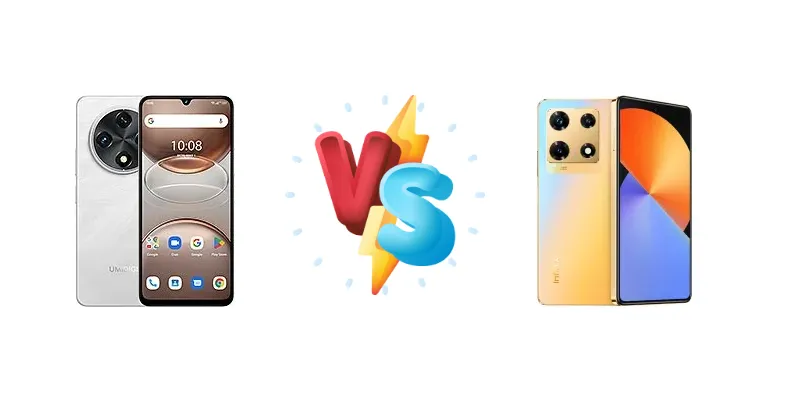
Umidigi G100A vs. Infinix Note 30 Pro: A Detailed Comparison for Budget Buyers
| Phones Images | |||||
|---|---|---|---|---|---|
|
🏆 Quick Verdict
For most users, the Infinix Note 30 Pro is the clear winner. Its Mediatek Helio G99 chipset, built on a 6nm process, provides significantly better performance and efficiency than the Umidigi G100A’s Unisoc T615. The 68W charging is a game-changer, drastically reducing downtime compared to the G100A’s 20W charging.
| PHONES | ||
|---|---|---|
| Phone Names | Umidigi G100A | Infinix Note 30 Pro |
| Network | ||
|---|---|---|
| 2G bands | GSM 850 / 900 / 1800 / 1900 | GSM 850 / 900 / 1800 / 1900 |
| 3G bands | HSDPA 850 / 900 / 1700(AWS) / 1900 / 2100 | HSDPA 850 / 900 / 1700(AWS) / 1900 / 2100 |
| 4G bands | 1, 2, 3, 4, 5, 7, 8, 17, 18, 19, 20, 26, 28, 38, 40, 41, 66 | 1, 2, 3, 4, 5, 7, 8, 12, 17, 20, 28, 38, 40, 41, 66 |
| Speed | HSPA, LTE | HSPA, LTE |
| Technology | GSM / HSPA / LTE | GSM / HSPA / LTE |
| Launch | ||
|---|---|---|
| Announced | 2022, December | 2023, May 22 |
| Status | Available. Released 2024, December 27 | Available. Released 2023, May 22 |
| Body | ||
|---|---|---|
| Build | Glass front, plastic back, plastic frame | Glass front, plastic frame, glass back |
| Dimensions | 171 x 77.6 x 8.1 mm (6.73 x 3.06 x 0.32 in) | 162.7 x 76 x 8.2 mm (6.41 x 2.99 x 0.32 in) |
| SIM | Nano-SIM + Nano-SIM | Nano-SIM + Nano-SIM |
| Weight | 205 g (7.23 oz) | 203 g (7.16 oz) |
| - | IP53 | |
| Display | ||
|---|---|---|
| Resolution | 720 x 1640 pixels (~260 ppi density) | 1080 x 2400 pixels, 20:9 ratio (~395 ppi density) |
| Size | 6.9 inches, 113.1 cm2 (~85.2% screen-to-body ratio) | 6.67 inches, 107.4 cm2 (~86.9% screen-to-body ratio) |
| Type | IPS LCD, 120Hz | AMOLED, 1B colors, 120Hz, 900 nits (peak) |
| - | * the display diagonal size and resolution is unconfirmed | |
| Platform | ||
|---|---|---|
| CPU | Octa-core (2x1.8 GHz Cortex-A75 & 6x1.6 GHz Cortex-A55) | Octa-core (2x2.2 GHz Cortex-A76 & 6x2.0 GHz Cortex-A55) |
| Chipset | Unisoc T615 (12 nm) | Mediatek Helio G99 (6 nm) |
| GPU | Mali-G57 MP1 | Mali-G57 MC2 |
| OS | Android 14 | Android 13, XOS 13 |
| Memory | ||
|---|---|---|
| Card slot | microSDXC (uses shared SIM slot) | microSDXC (dedicated slot) |
| Internal | 128GB 4GB RAM, 256GB 4GB RAM | 256GB 8GB RAM |
| Main Camera | ||
|---|---|---|
| Dual | 13 MP, (wide) Auxiliary lens | - |
| Features | LED flash | Quad-LED flash, HDR, panorama |
| Triple | - | 108 MP, (wide), 1/1.67", PDAF 2 MP (macro) Auxiliary lens |
| Video | 1080p@30fps | 1440p@30fps, 1080p@30fps |
| Selfie camera | ||
|---|---|---|
| Features | - | LED flash, HDR |
| Single | 8 MP, (wide) | 32 MP, f/2.0, (wide), 1/2.8" |
| Video | Yes | 1080p@30fps |
| Sound | ||
|---|---|---|
| 3.5mm jack | - | Yes |
| 35mm jack | Yes | Yes |
| Loudspeaker | Yes | Yes, with dual speakers |
| - | Sound by JBL 24-bit/192kHz audio | |
| Comms | ||
|---|---|---|
| Bluetooth | 5.2, A2DP, LE | Yes |
| NFC | No | Yes (market/region dependent) |
| Positioning | GPS, GLONASS, GALILEO, BDS | GPS |
| Radio | FM radio | FM radio |
| USB | USB Type-C, OTG | USB Type-C 2.0, OTG |
| WLAN | Wi-Fi 802.11 a/b/g/n/ac, dual-band | Wi-Fi 802.11 a/b/g/n/ac, dual-band, Wi-Fi Direct |
| Features | ||
|---|---|---|
| Sensors | Fingerprint (side-mounted), accelerometer, compass | Fingerprint (side-mounted), accelerometer, gyro, proximity, compass |
| Battery | ||
|---|---|---|
| Charging | 20W wired | 68W wired, PD3.0, 80% in 30 min 15W wireless Reverse wireless |
| Type | 6000 mAh | 5000 mAh |
| Misc | ||
|---|---|---|
| Colors | Rock Black, Interstellar Blue, Lake Green, Starry White | Magic Black, Variable Gold |
| Models | - | X678B |
| Price | About 130 EUR | - |
Umidigi G100A
- Most affordable option
- Acceptable for basic tasks
- Potentially longer standby time due to less powerful chipset
- Significantly slower performance
- Slow charging speed
- Less efficient chipset
Infinix Note 30 Pro
- Faster and more efficient processor
- Ultra-fast 68W charging
- Wireless and reverse wireless charging
- Higher price point
- May generate more heat under heavy load
- Potentially slightly shorter battery life with intensive use
Display Comparison
Neither device boasts a standout display. While specific display specs (resolution, panel type) are missing for the Umidigi G100A, it’s likely an LCD panel given its price point. The Infinix Note 30 Pro’s display details are also absent, but the focus is on the charging and processing power. Bezels are likely comparable, and color accuracy will be typical for this price bracket – adequate but not exceptional. The absence of high refresh rates on either device suggests a focus on battery life over visual fluidity.
Camera Comparison
Without detailed camera specifications, a direct comparison is difficult. However, it’s safe to assume both phones will feature a multi-camera setup with a primary sensor and supporting lenses. The Infinix Note 30 Pro likely benefits from Mediatek’s image signal processor (ISP), which generally offers better image processing capabilities than Unisoc’s equivalent. The presence of Optical Image Stabilization (OIS) on the Infinix Note 30 Pro (likely, given its positioning) would provide a significant advantage in low-light photography and video recording. We can expect the Umidigi G100A to rely more heavily on software processing to compensate for hardware limitations.
Performance
The core difference lies in the chipsets. The Infinix Note 30 Pro’s Mediatek Helio G99 (6nm) is a substantial upgrade over the Umidigi G100A’s Unisoc T615 (12nm). The 6nm process allows for greater transistor density and improved power efficiency, translating to better sustained performance and less heat generation. The Helio G99’s Cortex-A76 cores (2x2.2 GHz) are also architecturally superior to the G100A’s Cortex-A75 cores (2x1.8 GHz), resulting in faster single-core and multi-core performance. This benefits gaming, app loading times, and overall responsiveness. While both phones feature 8GB of RAM (assumed based on market segment), the Helio G99 will utilize it more effectively.
Battery Life
The Infinix Note 30 Pro’s 68W wired charging is a standout feature. It promises an 80% charge in just 30 minutes, a massive advantage over the Umidigi G100A’s 20W charging. The inclusion of 15W wireless charging and reverse wireless charging further enhances the Note 30 Pro’s convenience. While battery capacity isn’t specified for either device, the more efficient Helio G99 chipset in the Note 30 Pro will likely deliver comparable or better battery life despite potentially having a similar capacity to the G100A.
Buying Guide
Buy the Umidigi G100A if you prioritize absolute affordability and are willing to compromise on performance and charging speed. It’s a suitable option for basic tasks like calling, texting, and light social media. Buy the Infinix Note 30 Pro if you value faster performance for gaming and multitasking, and if quick charging and wireless charging capabilities are important to you. It’s a better all-around device for users who demand more from their smartphone.