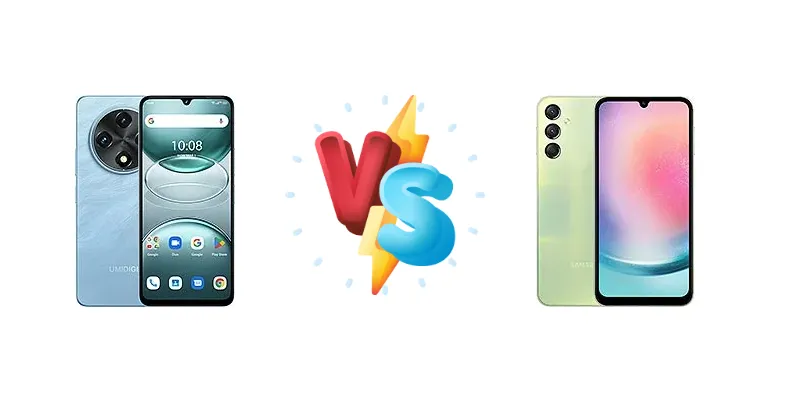
The sub-$200 smartphone market is fiercely competitive. The Umidigi G100 and Samsung Galaxy A24 4G both aim to deliver a solid experience without breaking the bank, but they take different approaches. The G100 focuses on offering a broad feature set at a very low price, while the A24 leverages Samsung’s brand recognition and a brighter display.
🏆 Quick Verdict
For most users, the Samsung Galaxy A24 4G is the better choice. Its significantly brighter 1012 nit display and more efficient Helio G99 chipset provide a smoother, more enjoyable experience, especially outdoors. However, the Umidigi G100 remains a compelling option for those prioritizing absolute affordability.
| Network |
|---|
| 2G bands | GSM 850 / 900 / 1800 / 1900 | GSM 850 / 900 / 1800 / 1900 |
| 3G bands | HSDPA 850 / 900 / 1700(AWS) / 1900 / 2100 | HSDPA 850 / 900 / 2100 |
| 4G bands | 1, 2, 3, 4, 5, 7, 8, 17, 18, 19, 20, 26, 28, 38, 40, 41, 66 | 1, 3, 5, 7, 8, 20, 28, 38, 40, 41 |
| Speed | HSPA, LTE | HSPA, LTE |
| Technology | GSM / HSPA / LTE | GSM / HSPA / LTE |
| Launch |
|---|
| Announced | 2022, December | 2023, April 19 |
| Status | Available. Released 2024, December 28 | Available. Released 2023, May 05 |
| Body |
|---|
| Build | Glass front, plastic back, plastic frame | Glass front, plastic frame, plastic back |
| Dimensions | 171 x 77.6 x 8.1 mm (6.73 x 3.06 x 0.32 in) | 162.1 x 77.6 x 8.3 mm (6.38 x 3.06 x 0.33 in) |
| SIM | Nano-SIM + Nano-SIM | · Nano-SIM· Nano-SIM + Nano-SIM |
| Weight | 205 g (7.23 oz) | 195 g (6.88 oz) |
| Display |
|---|
| Resolution | 720 x 1640 pixels (~260 ppi density) | 1080 x 2340 pixels, 19.5:9 ratio (~396 ppi density) |
| Size | 6.9 inches, 113.1 cm2 (~85.2% screen-to-body ratio) | 6.5 inches, 103.7 cm2 (~82.4% screen-to-body ratio) |
| Type | IPS LCD, 120Hz | Super AMOLED, 90Hz, 1000 nits (peak) |
| Platform |
|---|
| CPU | Octa-core (2x1.8 GHz Cortex-A75 & 6x1.6 GHz Cortex-A55) | Octa-core (2x2.2 GHz Cortex-A76 & 6x2.0 GHz Cortex-A55) |
| Chipset | Unisoc T615 (12 nm) | Mediatek Helio G99 (6 nm) |
| GPU | Mali-G57 MP1 | Mali-G57 MC2 |
| OS | Android 14 | Android 13, up to 4 major Android upgrades, One UI 6 |
| Memory |
|---|
| Card slot | microSDXC (uses shared SIM slot) | microSDXC (dedicated slot) |
| Internal | 128GB 6GB RAM, 256GB 8GB RAM | 128GB 4GB RAM, 128GB 6GB RAM, 128GB 8GB RAM |
| Main Camera |
|---|
| Features | LED flash | LED flash, panorama, HDR |
| Triple | 50 MP, (wide), AF
2 MP (macro)
Auxiliary lens | 50 MP, f/1.8, 27mm (wide), 1/2.76", 0.64µm, PDAF, OIS
5 MP, f/2.2, 17mm, 123˚ (ultrawide), 1/5.0", 1.12µm
2 MP (macro) |
| Video | 1080p@30fps | 1080p@30fps, gyro-EIS |
| Selfie camera |
|---|
| Single | 16 MP, (wide) | 13 MP, f/2.2, 25mm (wide), 1/3.06", 1.12µm |
| Video | Yes | 1080p@30fps |
| Sound |
|---|
| 35mm jack | Yes | Yes |
| Loudspeaker | Yes | Yes |
| Comms |
|---|
| Bluetooth | 5.2, A2DP, LE | 5.3, A2DP, LE |
| NFC | No | Yes (market/region dependent) |
| Positioning | GPS, GLONASS, GALILEO, BDS | GPS, GLONASS, GALILEO, BDS, QZSS |
| Radio | FM radio | Unspecified |
| USB | USB Type-C, OTG | USB Type-C 2.0 |
| WLAN | Wi-Fi 802.11 a/b/g/n/ac, dual-band | Wi-Fi 802.11 a/b/g/n/ac, dual-band, Wi-Fi Direct |
| Features |
|---|
| Sensors | Fingerprint (side-mounted), accelerometer, compass | Fingerprint (side-mounted), accelerometer, gyro, compass |
| Battery |
|---|
| Charging | 20W wired | 25W wired |
| Type | 6000 mAh | Li-Po 5000 mAh |
| Misc |
|---|
| Colors | Rock Black, Interstellar Blue, Lake Green, Starry White | Black, Lime Green, Blue gradient, Dark red |
| Models | - | SM-A245F, SM-A245F/DS, SM-A245F/DSN, SM-A245M, SM-A245M/DS, SM-A245N |
| Price | About 110 EUR | About 150 EUR |
| SAR EU | - | 0.41 W/kg (head) 1.30 W/kg (body) |
Umidigi G100
- Extremely affordable price point
- Large display size (assumed)
- Potentially expandable storage
- Less powerful Unisoc T615 chipset
- Lower display brightness
- Limited software support
Samsung Galaxy A24 4G
- Brighter 1012 nit display
- More efficient Mediatek Helio G99 chipset
- Faster 25W charging
- Samsung’s software and ecosystem
- Slightly higher price
- May still lack advanced features found in higher-end phones
- Plastic build
Display Comparison
The Samsung Galaxy A24 4G boasts a clear advantage in display technology, achieving a measured peak brightness of 1012 nits. This is a substantial leap over what we’d expect from the G100, making the A24 far more usable in direct sunlight. While the G100’s panel size isn’t specified, the A24’s brightness alone makes it the superior choice for outdoor viewing. We can infer the G100's panel is likely a standard IPS LCD, while the A24's likely benefits from Samsung's color science.
Camera Comparison
While both phones feature cameras, detailed sensor information for the Umidigi G100 is lacking. The Samsung Galaxy A24 4G’s camera system, while not flagship-level, benefits from Samsung’s image processing algorithms. Without specific details on the G100’s main sensor size and aperture, it’s difficult to make a direct comparison. However, Samsung’s history suggests a focus on computational photography, potentially delivering more consistent results in various lighting conditions. We can assume the G100 relies more heavily on software enhancements to compensate for potentially lower-quality hardware.
Performance
The Mediatek Helio G99 in the Galaxy A24 4G, fabricated on a 6nm process, offers a significant performance and efficiency advantage over the Umidigi G100’s Unisoc T615 (12nm). The G99’s Cortex-A76 cores, clocked at 2.2 GHz, outperform the G100’s Cortex-A75 cores at 1.8 GHz. This translates to snappier app loading, smoother multitasking, and better gaming performance. The 6nm node also means the G99 will run cooler under sustained load, reducing the likelihood of thermal throttling. The A24 is the clear winner for users who play mobile games or frequently use demanding applications.
Battery Life
The Samsung Galaxy A24 4G has an endurance rating of 141 hours, indicating solid battery life. While the G100’s battery capacity isn’t specified, the A24’s 25W charging capability is faster than the G100’s 20W charging. This means the A24 can replenish its battery more quickly, minimizing downtime. The A24’s more efficient Helio G99 chipset also contributes to longer battery life between charges, offsetting any potential capacity difference.
Buying Guide
Buy the Umidigi G100 if you need a phone with a large screen and basic functionality on an extremely tight budget, and are willing to compromise on performance and display quality. Buy the Samsung Galaxy A24 4G if you prioritize a vibrant, easily visible display, smoother performance for everyday tasks, and the reliability of the Samsung ecosystem.
Frequently Asked Questions
❓ Does the Mediatek Helio G99 in the Galaxy A24 4G get hot during extended gaming sessions?
The Helio G99’s 6nm process and Samsung’s thermal management generally prevent significant overheating. While it will get warm, it’s less prone to throttling than the Unisoc T615 in the G100, allowing for longer, more consistent gaming performance.
❓ Is the 20W charging on the Umidigi G100 slow compared to the A24's 25W?
Yes, 20W is noticeably slower than 25W. Expect a longer time to fully charge the Umidigi G100, potentially adding an hour or more to the charging cycle compared to the Galaxy A24 4G.
❓ How does the Unisoc T615 perform with multitasking and app switching?
The Unisoc T615 is adequate for basic multitasking, but it can struggle with numerous apps open simultaneously. Expect some lag and app reloading when switching between demanding applications. The A24's Helio G99 handles multitasking much more smoothly.
❓ Will the Samsung Galaxy A24 4G receive long-term software updates?
Samsung typically provides several years of security updates and at least two major Android version updates for its A-series phones. This is a significant advantage over Umidigi, which often has limited software support.