
Motorola Moto G54 vs Umidigi G100: A Deep Dive into Budget Chipsets
| Phones Images | |||||
|---|---|---|---|---|---|
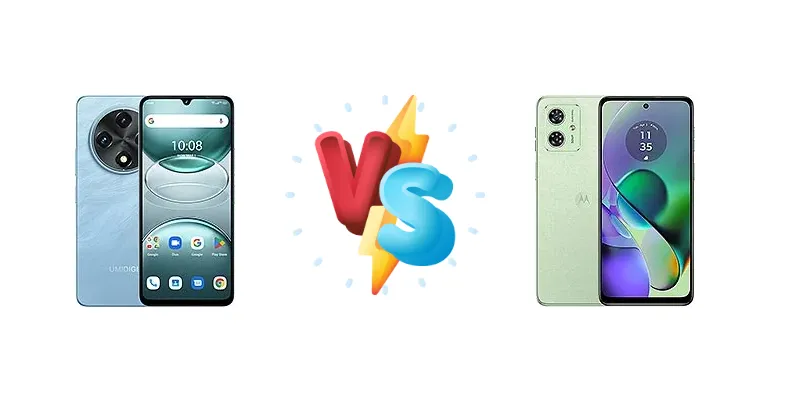
|
🏆 Quick Verdict
For most users, the Motorola Moto G54 is the superior choice. Its Mediatek Dimensity 7020 chipset delivers a substantially better performance experience than the Umidigi G100’s Unisoc T615. While the G100 boasts 20W charging, the G54’s performance advantage outweighs the slower 15W charging for everyday use.
| PHONES | ||
|---|---|---|
| Phone Names | Umidigi G100 | Motorola Moto G54 |
| Network | ||
|---|---|---|
| 2G bands | GSM 850 / 900 / 1800 / 1900 | GSM 850 / 900 / 1800 / 1900 |
| 3G bands | HSDPA 850 / 900 / 1700(AWS) / 1900 / 2100 | HSDPA 850 / 900 / 1900 / 2100 |
| 4G bands | 1, 2, 3, 4, 5, 7, 8, 17, 18, 19, 20, 26, 28, 38, 40, 41, 66 | 1, 2, 3, 5, 7, 8, 20, 26, 28, 32, 38, 40, 41, 42 |
| 5G bands | - | 1, 3, 5, 7, 8, 20, 26, 28, 38, 40, 41, 77, 78 SA/NSA |
| Speed | HSPA, LTE | HSPA, LTE, 5G |
| Technology | GSM / HSPA / LTE | GSM / HSPA / LTE / 5G |
| Launch | ||
|---|---|---|
| Announced | 2022, December | 2023, September 05 |
| Status | Available. Released 2024, December 28 | Available. Released 2023, September 05 |
| Body | ||
|---|---|---|
| Build | Glass front, plastic back, plastic frame | Glass front, plastic back or silicone polymer back (eco leather), plastic frame |
| Dimensions | 171 x 77.6 x 8.1 mm (6.73 x 3.06 x 0.32 in) | 161.6 x 73.8 x 8 mm (6.36 x 2.91 x 0.31 in) |
| SIM | Nano-SIM + Nano-SIM | · Nano-SIM + eSIM· Nano-SIM + Nano-SIM |
| Weight | 205 g (7.23 oz) | 177 g (6.24 oz) |
| Display | ||
|---|---|---|
| Resolution | 720 x 1640 pixels (~260 ppi density) | 1080 x 2400 pixels, 20:9 ratio (~405 ppi density) |
| Size | 6.9 inches, 113.1 cm2 (~85.2% screen-to-body ratio) | 6.5 inches, 102.0 cm2 (~85.5% screen-to-body ratio) |
| Type | IPS LCD, 120Hz | IPS LCD, 120Hz |
| Platform | ||
|---|---|---|
| CPU | Octa-core (2x1.8 GHz Cortex-A75 & 6x1.6 GHz Cortex-A55) | Octa-core (2x2.2 GHz Cortex-A78 & 6x2.0 GHz Cortex-A55) |
| Chipset | Unisoc T615 (12 nm) | Mediatek Dimensity 7020 (6 nm) |
| GPU | Mali-G57 MP1 | IMG BXM-8-256 |
| OS | Android 14 | Android 13, upgradable to Android 15 |
| Memory | ||
|---|---|---|
| Card slot | microSDXC (uses shared SIM slot) | microSDXC (dedicated slot) - InternationalmicroSDXC (uses shared SIM slot) - China |
| Internal | 128GB 6GB RAM, 256GB 8GB RAM | 128GB 4GB RAM, 128GB 8GB RAM, 256GB 4GB RAM, 256GB 8GB RAM, 256GB 12GB RAM |
| Main Camera | ||
|---|---|---|
| Dual | - | 50 MP, f/1.8 (wide), 0.61µm, PDAF, OIS 2 MP (macro) |
| Features | LED flash | Dual-LED dual-tone flash, HDR, panorama |
| Triple | 50 MP, (wide), AF 2 MP (macro) Auxiliary lens | - |
| Video | 1080p@30fps | 1080p@30/60fps |
| Selfie camera | ||
|---|---|---|
| Features | - | HDR |
| Single | 16 MP, (wide) | 16 MP, f/2.4, (wide), 1.0µm |
| Video | Yes | 1080p@30fps |
| Sound | ||
|---|---|---|
| 35mm jack | Yes | Yes |
| Loudspeaker | Yes | Yes, with stereo speakers |
| Comms | ||
|---|---|---|
| Bluetooth | 5.2, A2DP, LE | 5.3, A2DP, LE |
| NFC | No | Yes |
| Positioning | GPS, GLONASS, GALILEO, BDS | GPS, GLONASS, GALILEO, BDS, QZSS |
| Radio | FM radio | FM radio (market/region dependent) |
| USB | USB Type-C, OTG | USB Type-C 2.0, OTG |
| WLAN | Wi-Fi 802.11 a/b/g/n/ac, dual-band | Wi-Fi 802.11 a/b/g/n/ac, dual-band |
| Features | ||
|---|---|---|
| Sensors | Fingerprint (side-mounted), accelerometer, compass | Fingerprint (side-mounted), accelerometer, gyro, proximity, compass |
| Battery | ||
|---|---|---|
| Charging | 20W wired | 15W wired Reverse wired |
| Type | 6000 mAh | Li-Po 5000 mAh |
| Misc | ||
|---|---|---|
| Colors | Rock Black, Interstellar Blue, Lake Green, Starry White | Midnight blue, Indigo blue, Glacier blue, Mint green |
| Models | - | XT2343-1, XT2343-2 |
| Price | About 110 EUR | € 147.00 / $ 189.99 / £ 161.57 |
Umidigi G100
- Faster 20W wired charging
- Potentially lower price point
- Adequate for basic smartphone tasks
- Significantly weaker processor performance
- Less efficient chipset
- Likely inferior camera image processing
Motorola Moto G54
- Much more powerful Dimensity 7020 chipset
- Improved thermal efficiency
- Superior image processing capabilities
- Slower 15W wired charging
- Potentially higher price
- May not be ideal for users who prioritize ultra-fast charging above all else
Display Comparison
Neither device boasts a standout display. While specific panel details (like peak brightness or color gamut coverage) are unavailable, the core difference lies in the processing power driving the display. The Dimensity 7020 in the Moto G54 will likely handle display rendering and animations more fluidly, especially in graphically intensive apps. Bezels are likely comparable given the price point, and both will likely utilize IPS LCD panels.
Camera Comparison
Without detailed camera specs beyond the chipsets, it’s difficult to make definitive claims. However, the Dimensity 7020’s integrated image signal processor (ISP) is more advanced than the one found in the Unisoc T615. This means the Moto G54 will likely deliver better image processing, improved dynamic range, and potentially superior low-light performance. The G100’s camera will likely be functional, but the G54 offers a more capable imaging experience.
Performance
The Mediatek Dimensity 7020 (6nm) in the Moto G54 represents a significant architectural leap over the Unisoc T615 (12nm) in the Umidigi G100. The Dimensity 7020 utilizes two Cortex-A78 cores clocked at 2.2 GHz, offering substantially higher single-core performance than the G100’s Cortex-A75 cores at 1.8 GHz. This translates to snappier app launches, smoother multitasking, and a more enjoyable gaming experience. The 6nm process node also contributes to better thermal efficiency, reducing the likelihood of throttling under sustained load. The G100 will be adequate for basic tasks, but the G54 is the clear winner for demanding users.
Battery Life
The Umidigi G100’s 20W wired charging is its headline battery feature. While the Moto G54 is limited to 15W, the Dimensity 7020’s superior efficiency means it will likely consume less power during typical usage. The actual 0-100% charge time difference will depend on battery capacity (unspecified for both), but the G100 will undoubtedly be faster. However, the G54’s more efficient chipset may offset the slower charging speed in real-world daily use.
Buying Guide
Buy the Umidigi G100 if you absolutely prioritize the fastest possible charging speeds and are willing to compromise on overall performance. This phone suits users who frequently top up their battery throughout the day and primarily use their phone for basic tasks. Buy the Motorola Moto G54 if you value a smoother, more responsive user experience, better gaming capabilities, and a more future-proof chipset, even if it means slightly slower charging.