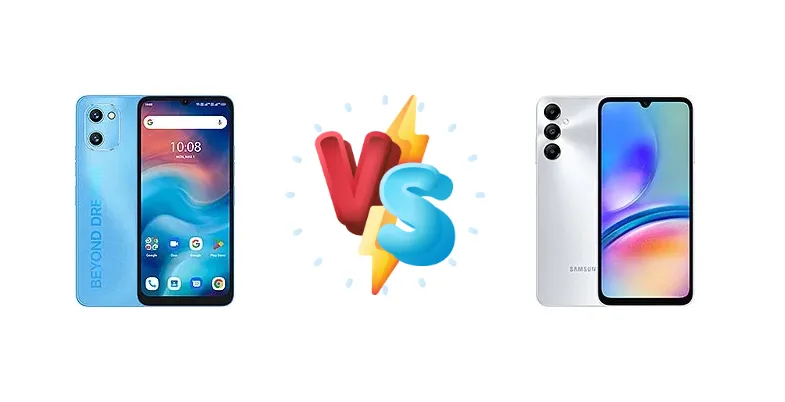
The sub-$150 smartphone market is fiercely competitive. The Umidigi G1, leveraging a Mediatek chipset, aims for affordability. The Samsung Galaxy A05s, while slightly pricier, counters with Qualcomm's Snapdragon 680. This comparison dissects which phone delivers the best experience for the money, focusing on real-world performance and usability.
🏆 Quick Verdict
For most users, the Samsung Galaxy A05s is the superior choice. Its Snapdragon 680 chipset offers significantly better performance and efficiency than the Umidigi G1’s Mediatek MT6739, translating to a smoother user experience and longer software support. The A05s’s brighter display and faster charging further solidify its position.
| Network |
|---|
| 2G bands | GSM 850 / 900 / 1800 / 1900 | GSM 850 / 900 / 1800 / 1900 |
| 3G bands | HSDPA 850 / 900 / 1700(AWS) / 1900 / 2100 | HSDPA 850 / 900 / 2100 |
| 4G bands | 1, 2, 3, 4, 5, 7, 8, 12, 17, 20, 28, 38, 40, 41 | 1, 3, 5, 7, 8, 20, 28, 38, 40, 41 |
| Speed | HSPA, LTE | HSPA, LTE |
| Technology | GSM / HSPA / LTE | GSM / HSPA / LTE |
| Launch |
|---|
| Announced | 2022 | 2023, September 25 |
| Status | Available. Released 2022 | Available. Released 2023, October 18 |
| Body |
|---|
| Build | - | Glass front, plastic back, plastic frame |
| Dimensions | 163.9 x 75.7 x 8.8 mm (6.45 x 2.98 x 0.35 in) | 168 x 77.8 x 8.8 mm (6.61 x 3.06 x 0.35 in) |
| SIM | Nano-SIM + Nano-SIM | · Nano-SIM· Nano-SIM + Nano-SIM |
| Weight | 195 g (6.88 oz) | 194 g (6.84 oz) |
| Display |
|---|
| Resolution | 720 x 1600 pixels, 20:9 ratio (~269 ppi density) | 1080 x 2400 pixels, 20:9 ratio (~393 ppi density) |
| Size | 6.52 inches, 102.6 cm2 (~82.7% screen-to-body ratio) | 6.7 inches, 108.4 cm2 (~82.9% screen-to-body ratio) |
| Type | IPS LCD | PLS LCD, 90Hz |
| Platform |
|---|
| CPU | Quad-core 1.5 GHz Cortex-A53 | Octa-core (4x2.4 GHz Kryo 265 Gold & 4x1.9 GHz Kryo 265 Silver) |
| Chipset | Mediatek MT6739 (28 nm) | Qualcomm SM6225 Snapdragon 680 4G (6 nm) |
| GPU | PowerVR GE8100 | Adreno 610 |
| OS | Android 13 | Android 13, up to 2 major Android upgrades, One UI 7 |
| Memory |
|---|
| Card slot | microSDXC (uses shared SIM slot) | microSDXC (dedicated slot) |
| Internal | 32GB 3GB RAM | 64GB 4GB RAM, 128GB 4GB RAM, 128GB 6GB RAM |
| Main Camera |
|---|
| Dual | 13 MP, f/2.2, (wide), AF
Auxiliary lens | - |
| Features | Dual-LED flash | LED flash |
| Triple | - | 50 MP, f/1.8, (wide), 1/2.8", 0.64µm, AF
2 MP (macro)
Auxiliary lens |
| Video | 1080p@30fps | 1080p@30/60fps |
| Selfie camera |
|---|
| Single | 5 MP, f/2.2, (wide) | 13 MP, f/2.0, (wide), 1/3.X", 1.12µm |
| Video | 720p@30fps | 1080p@30fps |
| Sound |
|---|
| 35mm jack | Yes | Yes |
| Loudspeaker | Yes | Yes |
| Comms |
|---|
| Bluetooth | 4.2, A2DP | 5.1, A2DP, LE |
| NFC | No | Yes (market/region dependent) |
| Positioning | GPS, GALILEO, GLONASS, BDS | GPS, GLONASS, GALILEO, BDS, QZSS |
| Radio | No | Unspecified |
| USB | USB Type-C, OTG | USB Type-C 2.0 |
| WLAN | Wi-Fi 802.11 b/g/n/ac, dual-band, Wi-Fi Direct | Wi-Fi 802.11 a/b/g/n/ac, dual-band, Wi-Fi Direct |
| Features |
|---|
| Sensors | Accelerometer, proximity, compass | Fingerprint (side-mounted), accelerometer, proximity |
| Battery |
|---|
| Charging | 10W wired | 25W wired |
| Type | 5150 mAh | Li-Po 5000 mAh |
| Misc |
|---|
| Colors | Sunglow Gold, Galaxy Blue, Starry Black | Black, Silver, Light Green, Violet |
| Models | - | SM-A057F, SM-A057F/DS, SM-A057M, SM-A057M/DS, SM-A057G/DSN, SM-A057G |
| Price | - | $ 134.00 / C$ 146.99 / £ 83.94 / € 100.99 |
| SAR EU | - | 0.58 W/kg (head) 1.31 W/kg (body) |
Umidigi G1
- Extremely affordable price point
- Functional for basic smartphone tasks
- Potentially longer software support due to simpler hardware
- Significantly weaker performance
- Likely lower quality display
- Slow charging speed (10W)
Samsung Galaxy A05s
- Superior performance with Snapdragon 680
- Brighter and higher contrast display
- Faster 25W charging
- Better camera image processing
- Higher price than Umidigi G1
- May include bloatware (typical for Samsung)
- Potentially shorter software support compared to simpler devices
Display Comparison
The Samsung Galaxy A05s boasts a significantly more usable display. While the Umidigi G1’s display specifications are absent, the A05s delivers a measured 468 nits of peak brightness and a 1418:1 contrast ratio. This means outdoor visibility and content clarity are substantially improved on the Samsung device. The lack of display details for the Umidigi G1 suggests a lower-quality panel, likely with lower brightness and contrast, impacting the viewing experience in various lighting conditions.
Camera Comparison
Both phones feature cameras, but details are limited for the Umidigi G1. The Samsung Galaxy A05s’s camera system, while not flagship-level, benefits from Qualcomm’s image signal processor (ISP) within the Snapdragon 680. This ISP enhances image processing, resulting in better dynamic range and noise reduction. The presence of a 'Photo / Video' capability on the A05s suggests a more versatile camera experience than what is likely offered by the G1, which likely focuses on basic image capture. The inclusion of a 2MP macro camera on the A05s is largely a marketing feature and offers limited practical benefit.
Performance
The performance gap between these two devices is substantial. The Samsung Galaxy A05s’s Qualcomm Snapdragon 680 (6nm) features an octa-core CPU (4x2.4 GHz Kryo 265 Gold & 4x1.9 GHz Kryo 265 Silver), offering a significant leap in processing power compared to the Umidigi G1’s quad-core 1.5 GHz Cortex-A53 processor built on a 28nm process. The 6nm node of the Snapdragon 680 also provides superior power efficiency, leading to less heat generation and sustained performance. The Umidigi G1 will struggle with multitasking and demanding applications, while the A05s offers a much smoother and more responsive experience.
Battery Life
The Samsung Galaxy A05s shines in battery performance, achieving an active use score of 11 hours and 32 minutes. While the Umidigi G1’s battery capacity is unknown, the A05s’s 25W wired charging is a significant advantage over the G1’s 10W charging. This translates to much faster top-ups, minimizing downtime. The Snapdragon 680’s efficiency also contributes to the A05s’s impressive battery life, allowing for all-day usage for most users.
Buying Guide
Buy the Umidigi G1 if your primary need is a functional smartphone for basic tasks like calls, texts, and light social media, and you are operating on an extremely tight budget. Buy the Samsung Galaxy A05s if you prioritize a responsive user experience, enjoy occasional gaming, value a brighter and more visible display, and appreciate faster charging speeds – even if it means spending a bit more.
Frequently Asked Questions
❓ Will the Snapdragon 680 in the Samsung A05s handle popular games like PUBG Mobile?
Yes, the Snapdragon 680 is capable of running PUBG Mobile at medium settings with reasonable frame rates. While it won't deliver a flagship gaming experience, it provides a playable experience that the Mediatek MT6739 in the Umidigi G1 would likely struggle to achieve consistently.
❓ How much faster is the charging on the Samsung Galaxy A05s compared to the Umidigi G1?
The Samsung Galaxy A05s supports 25W wired charging, while the Umidigi G1 is limited to 10W. This means the A05s can charge significantly faster, potentially reducing charging times by over an hour depending on battery level. The difference is substantial for users who need quick top-ups.
❓ Is the Umidigi G1 a good option for someone who primarily uses their phone for calls and texts?
Yes, the Umidigi G1 is a viable option for basic communication. Its Mediatek MT6739 chipset is sufficient for calls, texts, and light social media use. However, users should be aware of its limitations in performance and display quality.
❓ Does the Samsung Galaxy A05s receive regular software updates?
Samsung typically provides a reasonable level of software support for its A-series devices, including security updates. However, the A05s is a budget model, so the duration and frequency of updates may be less extensive than on Samsung's flagship phones.