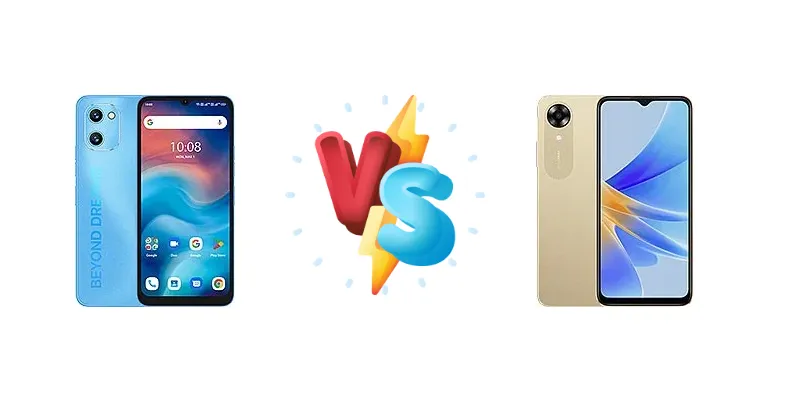
The Umidigi G1 and Oppo A17k represent the extreme end of the smartphone price spectrum. Both aim to deliver essential functionality at a minimal cost, but they achieve this with significantly different hardware. This comparison dissects their core components to determine which device offers the best value for users prioritizing affordability.
🏆 Quick Verdict
For the average user, the Oppo A17k emerges as the better choice. Its newer Mediatek Helio G35 chipset, built on a more efficient 12nm process, provides a noticeable performance uplift over the Umidigi G1’s older MT6739, making it more responsive for everyday tasks.
| Network |
|---|
| 2G bands | GSM 850 / 900 / 1800 / 1900 | GSM 850 / 900 / 1800 / 1900 |
| 3G bands | HSDPA 850 / 900 / 1700(AWS) / 1900 / 2100 | HSDPA 850 / 900 / 2100 |
| 4G bands | 1, 2, 3, 4, 5, 7, 8, 12, 17, 20, 28, 38, 40, 41 | 1, 3, 5, 8, 38, 40, 41 |
| Speed | HSPA, LTE | HSPA, LTE |
| Technology | GSM / HSPA / LTE | GSM / HSPA / LTE |
| Launch |
|---|
| Announced | 2022 | 2022, October 13 |
| Status | Available. Released 2022 | Available. Released 2022, October 18 |
| Body |
|---|
| Dimensions | 163.9 x 75.7 x 8.8 mm (6.45 x 2.98 x 0.35 in) | 164.2 x 75.6 x 8.3 mm (6.46 x 2.98 x 0.33 in) |
| SIM | Nano-SIM + Nano-SIM | Nano-SIM + Nano-SIM |
| Weight | 195 g (6.88 oz) | 189 g (6.67 oz) |
| | - | IPX4 water resistance |
| Display |
|---|
| Protection | - | Panda Glass |
| Resolution | 720 x 1600 pixels, 20:9 ratio (~269 ppi density) | 720 x 1612 pixels, 20:9 ratio (~269 ppi density) |
| Size | 6.52 inches, 102.6 cm2 (~82.7% screen-to-body ratio) | 6.56 inches, 103.4 cm2 (~83.3% screen-to-body ratio) |
| Type | IPS LCD | IPS LCD, 480 nits (typ), 600 nits (HBM) |
| Platform |
|---|
| CPU | Quad-core 1.5 GHz Cortex-A53 | Octa-core (4x2.3 GHz Cortex-A53 & 4x1.8 GHz Cortex-A53) |
| Chipset | Mediatek MT6739 (28 nm) | Mediatek MT6765 Helio G35 (12 nm) |
| GPU | PowerVR GE8100 | PowerVR GE8320 |
| OS | Android 13 | Android 12, ColorOS 12.1 |
| Memory |
|---|
| Card slot | microSDXC (uses shared SIM slot) | microSDXC |
| Internal | 32GB 3GB RAM | 64GB 3GB RAM |
| | - | eMMC 5.1 |
| Main Camera |
|---|
| Dual | 13 MP, f/2.2, (wide), AF
Auxiliary lens | - |
| Features | Dual-LED flash | LED flash, panorama |
| Single | - | 8 MP, f/2.0, (wide), AF |
| Video | 1080p@30fps | 1080p@30fps |
| Selfie camera |
|---|
| Single | 5 MP, f/2.2, (wide) | 5 MP, f/2.2, (wide) |
| Video | 720p@30fps | 1080p@30fps |
| Sound |
|---|
| 3.5mm jack | - | Yes |
| 35mm jack | Yes | Yes |
| Loudspeaker | Yes | Yes |
| Comms |
|---|
| Bluetooth | 4.2, A2DP | 5.3, A2DP, LE, aptX HD |
| NFC | No | No |
| Positioning | GPS, GALILEO, GLONASS, BDS | GPS, GLONASS, BDS, GALILEO |
| Radio | No | Unspecified |
| USB | USB Type-C, OTG | microUSB 2.0, OTG |
| WLAN | Wi-Fi 802.11 b/g/n/ac, dual-band, Wi-Fi Direct | Wi-Fi 802.11 a/b/g/n/ac, dual-band |
| Features |
|---|
| Sensors | Accelerometer, proximity, compass | Fingerprint (side-mounted), accelerometer, proximity, compass |
| Battery |
|---|
| Charging | 10W wired | - |
| Type | 5150 mAh | Li-Po 5000 mAh |
| Misc |
|---|
| Colors | Sunglow Gold, Galaxy Blue, Starry Black | Navy Blue, Gold |
| Models | - | CPH2471 |
| Price | - | About 130 EUR |
Umidigi G1
- Potentially lower price point (depending on retailer)
- Functional for basic communication tasks
- May offer expandable storage via microSD card (unconfirmed)
- Outdated and slow Mediatek MT6739 chipset
- Likely limited software support
- Poor performance in multitasking and gaming
Oppo A17k
- More powerful and efficient Mediatek Helio G35 chipset
- Larger 5000mAh battery for all-day use
- Potentially longer software support lifecycle
- Basic camera system with limited capabilities
- LCD display lacks vibrancy and brightness
- Still an entry-level device with inherent limitations
Display Comparison
Neither device boasts a standout display. Specifications are unavailable for the Umidigi G1's display, suggesting a basic LCD panel. The Oppo A17k also utilizes an LCD, but its focus is on durability rather than visual fidelity. Both will likely offer adequate viewing angles and color reproduction for basic tasks, but neither is suited for media consumption or gaming. Expect similar levels of brightness and contrast, with neither device likely to excel in direct sunlight.
Camera Comparison
Both phones likely feature basic camera setups. Details are sparse, but given the price point, image quality will be heavily reliant on software processing. The Oppo A17k likely has a slight edge due to its newer image signal processor (ISP) integrated within the Helio G35 chipset, potentially offering better noise reduction and dynamic range. The presence of a 2MP macro camera on the A17k is largely a marketing gimmick; its utility is limited by the low resolution and lack of optical image stabilization (OIS). Expect similar performance in good lighting conditions, but both will struggle in low-light scenarios.
Performance
The core difference lies in the chipsets. The Umidigi G1’s Mediatek MT6739, fabricated on a 28nm process, features a quad-core Cortex-A53 CPU clocked at 1.5 GHz. In contrast, the Oppo A17k’s Mediatek Helio G35 (MT6765) is built on a more efficient 12nm node and utilizes an octa-core configuration (4x2.3 GHz Cortex-A53 & 4x1.8 GHz Cortex-A53). This translates to a significant performance advantage for the A17k, particularly in multitasking and app loading times. The Helio G35’s higher clock speeds and additional cores will handle demanding applications more effectively, while the 12nm process reduces heat generation and improves power efficiency. The G1 will struggle with anything beyond basic usage.
Battery Life
Battery capacity details are unavailable for the Umidigi G1. The Oppo A17k packs a 5000mAh battery, which, combined with the more efficient Helio G35 chipset, should provide all-day battery life for moderate users. The Umidigi G1, with its older and less efficient chipset, will likely require more frequent charging. The Oppo A17k supports 10W wired charging, while the Umidigi G1 also supports 10W charging. Given the battery sizes, expect a full charge to take several hours on both devices.
Buying Guide
Buy the Umidigi G1 if you absolutely need a phone *right now* and are constrained by the lowest possible budget, accepting significant performance limitations. Buy the Oppo A17k if you can spend a little more for a smoother user experience, improved multitasking capabilities, and a more modern chipset that will likely receive longer software support.
Frequently Asked Questions
❓ Will the Oppo A17k be able to run popular social media apps like TikTok and Instagram smoothly?
Yes, the Helio G35 chipset in the Oppo A17k is capable of running most popular social media apps without significant lag. While it won't offer a high-end experience, it will provide a usable and reasonably smooth experience for browsing feeds, recording videos, and basic interactions. The Umidigi G1 may struggle with these apps, especially when multitasking.
❓ Is the 10W charging on either phone fast enough for daily use?
10W charging is relatively slow by modern standards. Expect both the Umidigi G1 and Oppo A17k to take several hours (likely 3-4) to fully charge from 0%. However, given the large 5000mAh battery in the Oppo A17k, overnight charging is recommended, and the slower charging speed won't be a major inconvenience for most users.
❓ Can I play games like PUBG Mobile on the Oppo A17k?
PUBG Mobile is playable on the Oppo A17k, but you'll need to lower the graphics settings to the lowest possible levels and accept a lower frame rate. The Helio G35 isn't a gaming powerhouse, and the phone may experience some thermal throttling during extended gaming sessions. The Umidigi G1 is unlikely to provide a playable experience with PUBG Mobile.