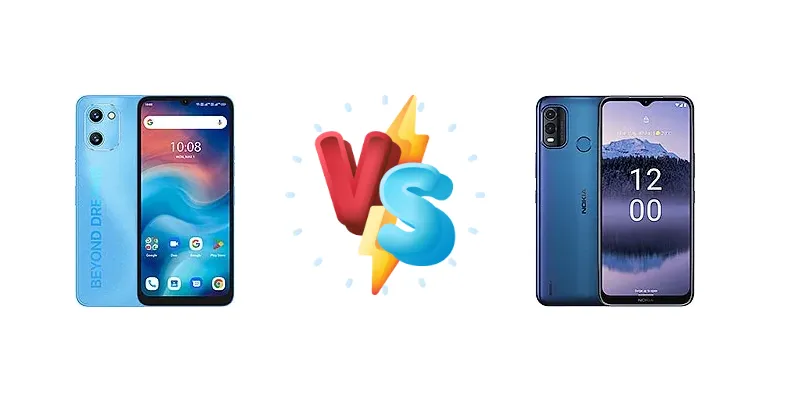
The sub-$150 smartphone market is fiercely competitive. Both the Umidigi G1 and Nokia G11 Plus aim to deliver essential smartphone functionality at an accessible price point. However, significant differences in their core hardware, particularly the chipset, dictate vastly different user experiences. This comparison dives deep into those differences to determine which device offers the best value.
🏆 Quick Verdict
For the average user, the Nokia G11 Plus is the superior choice. While both phones share a 10W charging rate, the Unisoc T606 chipset’s octa-core architecture and 12nm process provide a substantial performance boost over the Umidigi G1’s aging Mediatek MT6739, making it noticeably smoother for everyday tasks.
| Network |
|---|
| 2G bands | GSM 850 / 900 / 1800 / 1900 | GSM 850 / 900 / 1800 / 1900 |
| 3G bands | HSDPA 850 / 900 / 1700(AWS) / 1900 / 2100 | HSDPA 850 / 900 / 2100 - International |
| 4G bands | 1, 2, 3, 4, 5, 7, 8, 12, 17, 20, 28, 38, 40, 41 | 1, 3, 5, 7, 8, 20, 28, 38, 40, 41 - International |
| Speed | HSPA, LTE | HSPA 42.2/5.76 Mbps, LTE Cat4 150/50 Mbps |
| Technology | GSM / HSPA / LTE | GSM / HSPA / LTE |
| | - | 1, 3, 5, 8, 40, 41 - India |
| Launch |
|---|
| Announced | 2022 | 2022, June 29 |
| Status | Available. Released 2022 | Available. Released 2022, July 20 |
| Body |
|---|
| Build | - | Glass front, plastic frame, plastic back |
| Dimensions | 163.9 x 75.7 x 8.8 mm (6.45 x 2.98 x 0.35 in) | 164.8 x 75.9 x 8.6 mm (6.49 x 2.99 x 0.34 in) |
| SIM | Nano-SIM + Nano-SIM | · Nano-SIM· Nano-SIM + Nano-SIM |
| Weight | 195 g (6.88 oz) | 192 g (6.77 oz) |
| | - | Splash protection |
| Display |
|---|
| Resolution | 720 x 1600 pixels, 20:9 ratio (~269 ppi density) | 720 x 1600 pixels, 20:9 ratio (~269 ppi density) |
| Size | 6.52 inches, 102.6 cm2 (~82.7% screen-to-body ratio) | 6.52 inches, 102.6 cm2 (~82.1% screen-to-body ratio) |
| Type | IPS LCD | IPS LCD, 90Hz, 400 nits (typ) |
| Platform |
|---|
| CPU | Quad-core 1.5 GHz Cortex-A53 | Octa-core (2x1.6 GHz Cortex-A75 & 6x1.6 GHz Cortex-A55) |
| Chipset | Mediatek MT6739 (28 nm) | Unisoc T606 (12 nm) |
| GPU | PowerVR GE8100 | Mali-G57 MP1 |
| OS | Android 13 | Android 12, upgradable to Android 13 |
| Memory |
|---|
| Card slot | microSDXC (uses shared SIM slot) | microSDXC (dedicated slot) |
| Internal | 32GB 3GB RAM | 32GB 3GB RAM, 64GB 3GB RAM, 64GB 4GB RAM, 128GB 3GB RAM |
| | - | eMMC 5.1 |
| Main Camera |
|---|
| Dual | 13 MP, f/2.2, (wide), AF
Auxiliary lens | 50 MP, f/1.8, (wide), 1/2.67", PDAF
Auxiliary lens |
| Features | Dual-LED flash | LED flash |
| Single | - | 8 MP, f/2.0, (wide), 1/4.0" |
| Video | 1080p@30fps | 1080p@30fps |
| Selfie camera |
|---|
| Single | 5 MP, f/2.2, (wide) | 8 MP, f/2.0, (wide), 1/4.0" |
| Video | 720p@30fps | 1080p@30fps |
| Sound |
|---|
| 3.5mm jack | - | Yes |
| 35mm jack | Yes | Yes |
| Loudspeaker | Yes | Yes |
| Comms |
|---|
| Bluetooth | 4.2, A2DP | 5.0, A2DP, LE |
| NFC | No | No |
| Positioning | GPS, GALILEO, GLONASS, BDS | GPS |
| Radio | No | FM radio |
| USB | USB Type-C, OTG | USB Type-C 2.0, OTG |
| WLAN | Wi-Fi 802.11 b/g/n/ac, dual-band, Wi-Fi Direct | Wi-Fi 802.11 a/b/g/n/ac, dual-band, Wi-Fi Direct |
| Features |
|---|
| Sensors | Accelerometer, proximity, compass | Fingerprint (rear-mounted), accelerometer, proximity |
| Battery |
|---|
| Charging | 10W wired | 10W wired |
| Type | 5150 mAh | Li-Ion 5000 mAh |
| Misc |
|---|
| Colors | Sunglow Gold, Galaxy Blue, Starry Black | Lake Blue, Charcoal Grey |
| Price | - | About 130 EUR |
Umidigi G1
- Potentially lower price point
- Simple and straightforward Android experience
- Functional for basic communication
- Outdated and slow processor
- Poor multitasking performance
- Limited gaming capabilities
- Less efficient power consumption
Nokia G11 Plus
- Significantly faster processor
- Improved multitasking and app responsiveness
- More efficient power consumption
- Better long-term software support (potentially)
- Slightly higher price
- Still limited camera performance
- Slow 10W charging
Display Comparison
Neither device boasts a standout display. Specifications are not provided for either display, so we must rely on market positioning. Given the price point, both likely utilize IPS LCD panels with 720p+ resolution. The Nokia G11 Plus, being a slightly newer device, *may* benefit from marginally better color calibration, but the difference will be minimal. Bezels are expected to be substantial on both, and neither is likely to offer high brightness for outdoor visibility.
Camera Comparison
Camera performance on both devices is expected to be basic. Without specific sensor details, it’s safe to assume both rely on budget sensors. The Nokia G11 Plus *may* have a slight advantage due to potentially more refined image processing algorithms, but the core hardware limitations will be significant. Expect acceptable results in good lighting conditions, but poor performance in low light. The inclusion of a 2MP macro camera on either device is largely a marketing gimmick and unlikely to produce usable images.
Performance
This is where the Nokia G11 Plus decisively pulls ahead. The Mediatek MT6739 in the Umidigi G1 is a quad-core processor built on a 28nm process, representing older technology. In contrast, the Unisoc T606 in the Nokia G11 Plus features an octa-core configuration (2x1.6 GHz Cortex-A75 & 6x1.6 GHz Cortex-A55) fabricated on a more efficient 12nm node. The Cortex-A75 cores in the G11 Plus provide a significant uplift in single-core performance, crucial for app launch speeds and general responsiveness. The 12nm process also translates to better thermal efficiency, reducing the likelihood of throttling during sustained use. The G11 Plus will handle multitasking and moderately demanding apps far more gracefully than the G1.
Battery Life
Both phones feature 10W wired charging, indicating similar charging speeds – expect over 3 hours for a full charge. While battery capacity isn’t specified, the more efficient Unisoc T606 in the Nokia G11 Plus will likely translate to longer real-world battery life. The 12nm process consumes less power than the 28nm process of the MT6739, meaning the G11 Plus can achieve comparable or better endurance with a similar battery capacity.
Buying Guide
Buy the Umidigi G1 if your needs are extremely basic – primarily calls, texts, and light web browsing – and you’re prioritizing the absolute lowest possible price. Buy the Nokia G11 Plus if you want a more responsive experience for social media, streaming, and occasional gaming, and are willing to spend a little more for a significantly improved chipset.
Frequently Asked Questions
❓ Will the Nokia G11 Plus handle popular social media apps like TikTok and Instagram smoothly?
Yes, the Unisoc T606 chipset in the Nokia G11 Plus is significantly more capable of handling social media apps than the Mediatek MT6739 in the Umidigi G1. You should experience smoother scrolling, faster loading times, and fewer instances of lag while using these apps.
❓ Is the difference in processor speed noticeable in everyday tasks like making calls and sending texts?
While both phones will handle basic tasks like calls and texts, the Nokia G11 Plus will feel more responsive overall. The faster processor and octa-core architecture contribute to quicker app launch times and a smoother user interface, even when switching between simple applications.
❓ Can the Umidigi G1 run modern mobile games?
The Umidigi G1 will struggle with most modern mobile games. The Mediatek MT6739 is an older, less powerful processor that lacks the graphical capabilities to run demanding games at playable frame rates. The Nokia G11 Plus will offer a slightly better gaming experience, but still won't be ideal for graphically intensive titles.
❓ How long will it take to fully charge both phones with the 10W charger?
Expect a full charge to take approximately 3 to 4 hours for both the Umidigi G1 and the Nokia G11 Plus. The 10W charging rate is relatively slow, and neither phone supports faster charging technologies.