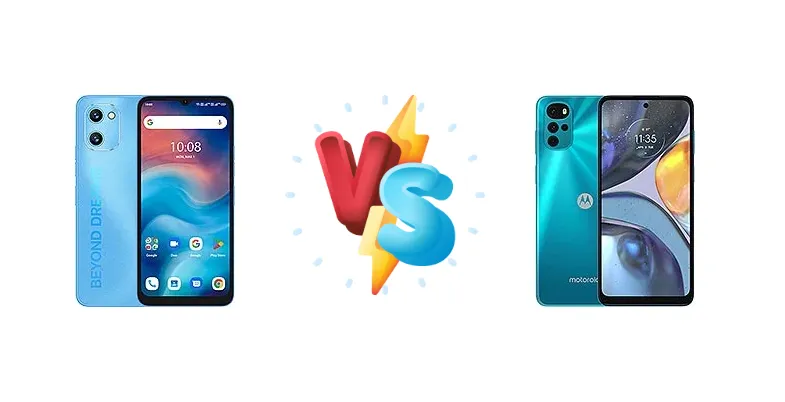
The Umidigi G1 and Motorola Moto G22 represent distinct approaches to the ultra-budget smartphone market. The G1, while older, offers a baseline level of functionality, while the Moto G22 aims to deliver a more modern experience with a newer chipset and faster charging. This comparison dissects their key differences to determine which phone provides the best value for your money.
🏆 Quick Verdict
For most users, the Motorola Moto G22 is the superior choice. Its Helio G37 chipset, built on a more efficient 12nm process, provides a noticeable performance boost over the Umidigi G1’s older 28nm MT6739. While the G1 might be cheaper, the G22’s improved processing power and faster charging justify the price difference.
| Network |
|---|
| 2G bands | GSM 850 / 900 / 1800 / 1900 | GSM 850 / 900 / 1800 / 1900 |
| 3G bands | HSDPA 850 / 900 / 1700(AWS) / 1900 / 2100 | HSDPA 850 / 900 / 1900 / 2100 |
| 4G bands | 1, 2, 3, 4, 5, 7, 8, 12, 17, 20, 28, 38, 40, 41 | 1, 3, 5, 7, 8, 20, 38, 40, 41 |
| Speed | HSPA, LTE | HSPA 42.2/5.76 Mbps, LTE Cat4 150/50 Mbps |
| Technology | GSM / HSPA / LTE | GSM / HSPA / LTE |
| Launch |
|---|
| Announced | 2022 | 2022, March 04 |
| Status | Available. Released 2022 | Available. Released 2022, March 04 |
| Body |
|---|
| Build | - | Glass front, plastic frame, plastic back |
| Dimensions | 163.9 x 75.7 x 8.8 mm (6.45 x 2.98 x 0.35 in) | 164 x 75 x 8.5 mm (6.46 x 2.95 x 0.33 in) |
| SIM | Nano-SIM + Nano-SIM | · Nano-SIM· Nano-SIM + Nano-SIM |
| Weight | 195 g (6.88 oz) | 185 g (6.53 oz) |
| | - | Water-repellent design |
| Display |
|---|
| Resolution | 720 x 1600 pixels, 20:9 ratio (~269 ppi density) | 720 x 1600 pixels, 20:9 ratio (~268 ppi density) |
| Size | 6.52 inches, 102.6 cm2 (~82.7% screen-to-body ratio) | 6.5 inches, 103.5 cm2 (~84.2% screen-to-body ratio) |
| Type | IPS LCD | IPS LCD, 90Hz |
| Platform |
|---|
| CPU | Quad-core 1.5 GHz Cortex-A53 | Octa-core (4x2.3 GHz Cortex-A53 & 4x1.8 GHz Cortex-A53) |
| Chipset | Mediatek MT6739 (28 nm) | Mediatek MT6765V/CB Helio G37 (12 nm) |
| GPU | PowerVR GE8100 | PowerVR GE8320 |
| OS | Android 13 | Android 12 |
| Memory |
|---|
| Card slot | microSDXC (uses shared SIM slot) | microSDXC (dedicated slot) |
| Internal | 32GB 3GB RAM | 64GB 4GB RAM, 128GB 4GB RAM |
| Main Camera |
|---|
| Dual | 13 MP, f/2.2, (wide), AF
Auxiliary lens | - |
| Features | Dual-LED flash | LED flash, HDR, panorama |
| Quad | - | 50 MP, f/1.8, (wide), 0.64µm, PDAF
8 MP, f/2.2, 118˚ (ultrawide), 1/4.0", 1.12µm
2 MP (macro)
Auxiliary lens |
| Video | 1080p@30fps | 1080p@30fps |
| Selfie camera |
|---|
| Features | - | HDR |
| Single | 5 MP, f/2.2, (wide) | 16 MP, f/2.5, (wide), 1.0µm |
| Video | 720p@30fps | 1080p@30fps |
| Sound |
|---|
| 3.5mm jack | - | Yes |
| 35mm jack | Yes | Yes |
| Loudspeaker | Yes | Yes |
| Comms |
|---|
| Bluetooth | 4.2, A2DP | 5.0, A2DP, LE |
| NFC | No | Yes (market/region dependent) |
| Positioning | GPS, GALILEO, GLONASS, BDS | GPS, GLONASS, GALILEO |
| Radio | No | Unspecified |
| USB | USB Type-C, OTG | USB Type-C 2.0 |
| WLAN | Wi-Fi 802.11 b/g/n/ac, dual-band, Wi-Fi Direct | Wi-Fi 802.11 a/b/g/n/ac, dual-band, Wi-Fi Direct |
| Features |
|---|
| Sensors | Accelerometer, proximity, compass | Fingerprint (side-mounted), accelerometer, gyro, proximity, compass |
| Battery |
|---|
| Charging | 10W wired | 20W wired (India)
15W wired (Global) |
| Type | 5150 mAh | Li-Po 5000 mAh |
| Misc |
|---|
| Colors | Sunglow Gold, Galaxy Blue, Starry Black | Pearl White, Iceberg Blue, Cosmic Black, Mint Green |
| Models | - | XT2231-1, XT2231-2, XT2231-5 |
| Price | - | About 120 EUR |
Umidigi G1
- Potentially lower price point
- Simple and straightforward user experience
- Functional for basic tasks
- Outdated and inefficient chipset
- Slow charging speed
- Limited performance for modern apps
Motorola Moto G22
- More powerful and efficient Helio G37 chipset
- Faster charging (15W/20W)
- Improved multitasking and app performance
- May be slightly more expensive
- Software updates may be limited
- Camera performance likely similar to G1
Display Comparison
Neither device boasts a standout display. Specifics regarding panel type (IPS, TFT) and resolution are missing, but both likely target a 720p+ resolution common in this price bracket. The key difference lies in the processing power driving the display; the G22’s more capable chipset can likely handle smoother animations and transitions. Bezels are expected to be substantial on both, reflecting their budget positioning.
Camera Comparison
Camera performance is likely to be similar in real-world usage, given the focus on budget components. Both phones likely feature a primary camera alongside supporting sensors of limited utility. Without specific sensor details, it’s difficult to make a definitive judgment. However, the G22’s more powerful ISP (Image Signal Processor) within the Helio G37 chipset could offer slightly better image processing, resulting in improved dynamic range and noise reduction. Expect both to perform adequately in good lighting conditions but struggle in low light.
Performance
The Motorola Moto G22’s Mediatek Helio G37 is the clear winner here. Built on a 12nm process, it offers significantly improved power efficiency compared to the Umidigi G1’s 28nm Mediatek MT6739. The G37’s octa-core configuration (4x2.3 GHz Cortex-A53 & 4x1.8 GHz Cortex-A53) provides a substantial uplift in multi-core performance over the G1’s quad-core 1.5 GHz Cortex-A53. This translates to faster app loading times, smoother multitasking, and a more responsive user experience. The G1 will struggle with demanding applications, while the G22 offers a more usable experience.
Battery Life
While battery capacity isn’t specified, both phones likely house batteries in the 4000-5000 mAh range. The critical difference is charging speed. The Moto G22 supports 20W wired charging (in India) or 15W globally, significantly faster than the Umidigi G1’s 10W charging. This means the G22 can replenish its battery much quicker, reducing downtime. The efficiency gains of the Helio G37 may also contribute to slightly better battery life during typical usage.
Buying Guide
Buy the Umidigi G1 if you absolutely need the lowest possible price and are only planning to use the phone for very basic tasks like calls, texts, and light web browsing. Buy the Motorola Moto G22 if you prioritize smoother performance for social media, streaming, and casual gaming, and appreciate the convenience of faster charging, even if it's region-dependent.
Frequently Asked Questions
❓ Does the Motorola Moto G22's Helio G37 chipset handle popular games like PUBG Mobile?
The Helio G37 is capable of running PUBG Mobile, but expect to play at lower graphics settings (balanced or low) to maintain a stable frame rate. It's not a gaming powerhouse, but it offers a playable experience, unlike the Umidigi G1 which would likely struggle significantly.
❓ Is the 15W/20W charging on the Moto G22 a significant improvement over the Umidigi G1's 10W charging?
Yes, it is. 15W/20W charging will noticeably reduce the time it takes to fully charge the Moto G22. While a precise 0-100% time isn't available, it will be considerably faster than the Umidigi G1, offering more convenience for users who rely on their phone throughout the day.
❓ How does the older 28nm process of the MT6739 in the Umidigi G1 affect battery life?
The 28nm process is less power-efficient than the 12nm process used in the Helio G37. This means the MT6739 consumes more power for the same tasks, resulting in shorter battery life on the Umidigi G1, even if both phones have similar battery capacities.