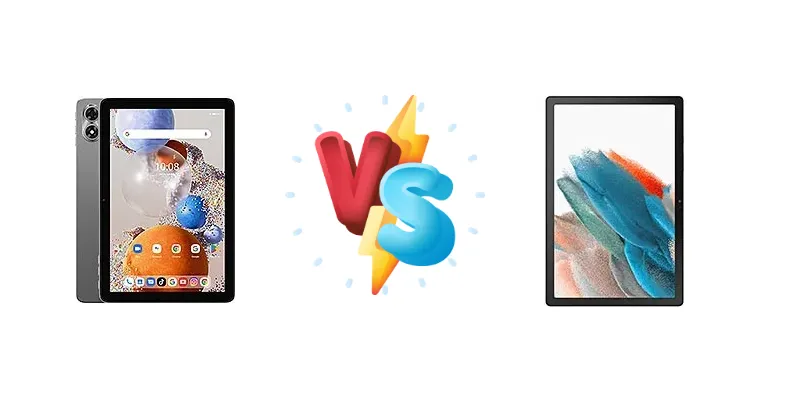
The budget tablet market is fiercely competitive, and the Umidigi G1 Tab and Samsung Galaxy Tab A8 10.5 (2021) represent compelling options for users seeking affordable Android experiences. This comparison dives deep into their core specifications, focusing on how the chipset choices and charging capabilities impact real-world performance and usability.
🏆 Quick Verdict
For most users, the Samsung Galaxy Tab A8 10.5 (2021) is the better choice. Its Unisoc Tiger T618 chipset, featuring an octa-core configuration, delivers significantly improved multi-tasking and application launch speeds compared to the Umidigi G1 Tab’s quad-core RK3562, justifying the slight price premium.
| Network |
|---|
| 2G bands | N/A | GSM 850 / 900 / 1800 / 1900 |
| 3G bands | - | HSDPA 850 / 900 / 1700(AWS) / 1900 / 2100 |
| 4G bands | N/A | 1, 2, 3, 4, 5, 7, 8, 12, 17, 20, 28, 38, 40, 41, 66 |
| EDGE | N/A | - |
| GPRS | N/A | - |
| Speed | - | HSPA, LTE - cellular model only |
| Technology | No cellular connectivity | GSM / HSPA / LTE |
| Launch |
|---|
| Announced | 2023 | 2021, December 15 |
| Status | Available. Released 2023 | Available. Released 2022, January 17 |
| Body |
|---|
| Dimensions | 244.8 x 162.2 x 9.3 mm (9.64 x 6.39 x 0.37 in) | 246.8 x 161.9 x 6.9 mm (9.72 x 6.37 x 0.27 in) |
| SIM | No | Nano-SIM (cellular model only) |
| Weight | 576 g (1.27 lb) | 508 g (1.12 lb) |
| Display |
|---|
| Resolution | 800 x 1280 pixels, 16:10 ratio (~149 ppi density) | 1200 x 1920 pixels, 16:10 ratio (~216 ppi density) |
| Size | 10.1 inches, 295.8 cm2 (~74.5% screen-to-body ratio) | 10.5 inches, 319.7 cm2 (~80.0% screen-to-body ratio) |
| Type | IPS LCD | TFT LCD |
| Platform |
|---|
| CPU | Quad-core 2.0 GHz | Octa-core (2x2.0 GHz Cortex-A75 & 6x2.0 GHz Cortex-A55) |
| Chipset | RK3562 (22 nm) | Unisoc Tiger T618 (12 nm) |
| GPU | - | Mali G52 MP2 |
| OS | Android 13 | Android 11, upgradable to Android 14, One UI 6 |
| Memory |
|---|
| Card slot | microSDXC (dedicated slot) | microSDXC (dedicated slot) |
| Internal | 64GB 4GB RAM | 32GB 2GB RAM, 32GB 3GB RAM, 64GB 2GB RAM, 64GB 3GB RAM, 64GB 4GB RAM, 128GB 3GB RAM, 128GB 4GB RAM |
| Main Camera |
|---|
| Features | LED flash | - |
| Single | 8 MP, f/2.2, (wide) | 8 MP, AF |
| Video | 720p@30fps | 1080p@30fps |
| Selfie camera |
|---|
| Single | 8 MP, f/2.2, (wide) | 5 MP |
| Video | 720p@30fps | 1080p@30fps |
| Sound |
|---|
| 3.5mm jack | - | Yes |
| 35mm jack | Yes | Yes |
| Loudspeaker | Yes, with stereo speakers | Yes, with stereo speakers (4 speakers) |
| Comms |
|---|
| Bluetooth | 5.0, A2DP, LE | 5.0, A2DP, LE |
| NFC | No | No |
| Positioning | No | GPS, GLONASS, BDS, GALILEO, QZSS - cellular model only |
| Radio | No | No |
| USB | USB Type-C | USB Type-C 2.0 |
| WLAN | Wi-Fi 802.11 a/b/g/n/ac/6, dual-band | Wi-Fi 802.11 a/b/g/n/ac, dual-band, Wi-Fi Direct |
| Features |
|---|
| Sensors | Accelerometer | Accelerometer, gyro, proximity, compass |
| Battery |
|---|
| Charging | 10W wired | 15W wired |
| Type | 6000 mAh | Li-Po 7040 mAh |
| Misc |
|---|
| Colors | Space Grey | Gray, Silver, Pink Gold |
| Models | - | SM-X200, SM-X205 |
| Price | - | About 230 EUR |
| SAR EU | - | 0.92 W/kg (body) |
Umidigi G1 Tab
- Lower price point makes it highly accessible.
- Adequate for basic tasks like reading and web browsing.
- Potentially longer battery life if equipped with a larger capacity battery (unconfirmed).
- RK3562 chipset struggles with multitasking and demanding apps.
- Slower 10W charging.
- Likely lower build quality compared to Samsung.
Samsung Galaxy Tab A8 10.5 (2021)
- Octa-core Unisoc T618 provides significantly better performance.
- Faster 15W charging reduces downtime.
- Samsung brand reputation for reliability and software support.
- Slightly higher price compared to the Umidigi G1 Tab.
- May still exhibit some lag with very demanding applications.
- Build quality, while good, is still plastic-based.
Display Comparison
Neither device boasts a particularly impressive display. Both are likely to utilize IPS LCD panels, common in this price bracket. However, display specifications beyond panel type are unavailable. The Samsung Tab A8 benefits from Samsung’s display tuning, which generally provides more accurate color reproduction. Bezels are expected to be substantial on both, prioritizing cost reduction over a premium aesthetic. Without specific brightness or resolution data, it’s difficult to definitively declare a winner, but Samsung’s brand reputation suggests a slightly more refined visual experience.
Camera Comparison
Camera performance is unlikely to be a deciding factor for either tablet. Both are positioned as budget devices, and camera quality typically reflects that. Specific camera sensor details are unavailable, but it’s safe to assume both will feature modest sensors. The focus should be on video calling and occasional snapshots, not photography. The absence of Optical Image Stabilization (OIS) on either device further reinforces this point. Any differences in image quality will likely be attributable to software processing rather than hardware superiority.
Performance
The core difference lies in the chipsets. The Samsung Galaxy Tab A8’s Unisoc Tiger T618 is an octa-core processor built on a 12nm process, featuring two Cortex-A75 performance cores and six Cortex-A55 efficiency cores. This architecture provides a substantial advantage in multi-threaded workloads compared to the Umidigi G1 Tab’s RK3562, a quad-core processor fabricated on a larger 22nm node. The 12nm process of the Unisoc chip also translates to better power efficiency. Users who frequently switch between apps, play casual games, or engage in light video editing will notice a significant performance boost with the Tab A8. The RK3562 in the Umidigi G1 Tab is adequate for basic tasks, but will struggle with more demanding applications.
Battery Life
Battery capacity is not specified for either device. However, the Samsung Galaxy Tab A8 10.5 (2021) supports 15W wired charging, while the Umidigi G1 Tab is limited to 10W. This faster charging speed on the Samsung tablet translates to quicker top-ups, reducing downtime. While a larger battery capacity on the Umidigi G1 Tab could offset the slower charging, the more efficient Unisoc T618 in the Tab A8 likely results in comparable or even better real-world battery life despite potentially having a similar capacity.
Buying Guide
Buy the Umidigi G1 Tab if you prioritize absolute affordability and primarily need a tablet for basic tasks like reading ebooks, light web browsing, and occasional video playback. Buy the Samsung Galaxy Tab A8 10.5 (2021) if you value smoother performance for multitasking, streaming, and running more demanding applications, and appreciate the Samsung ecosystem and brand reliability.
Frequently Asked Questions
❓ Will the Unisoc T618 in the Samsung Tab A8 overheat during extended gaming sessions?
The Unisoc T618 is a relatively efficient chipset. While it may get warm during prolonged gaming, it's unlikely to experience significant thermal throttling due to its 12nm fabrication process and the tablet's form factor providing some passive cooling. However, demanding games at maximum settings may still lead to some performance reduction over time.
❓ Is the RK3562 chipset in the Umidigi G1 Tab sufficient for running multiple apps simultaneously?
The RK3562's quad-core architecture and 22nm process will struggle with heavy multitasking. While it can handle a few apps open in the background, switching between them or running resource-intensive applications concurrently will likely result in noticeable lag and slowdowns. It's best suited for single-app usage.
❓ Does the Samsung Galaxy Tab A8 support expandable storage via microSD card?
Yes, the Samsung Galaxy Tab A8 10.5 (2021) does support microSD card expansion up to 1TB, providing flexibility for users who need to store a large amount of media or files. This is a significant advantage over tablets that lack expandable storage options.
❓ What type of USB port do both tablets use?
Both tablets are expected to utilize a USB-C port for charging and data transfer. This is the current standard for most Android devices, offering faster data transfer speeds and reversible connectivity compared to older USB standards.