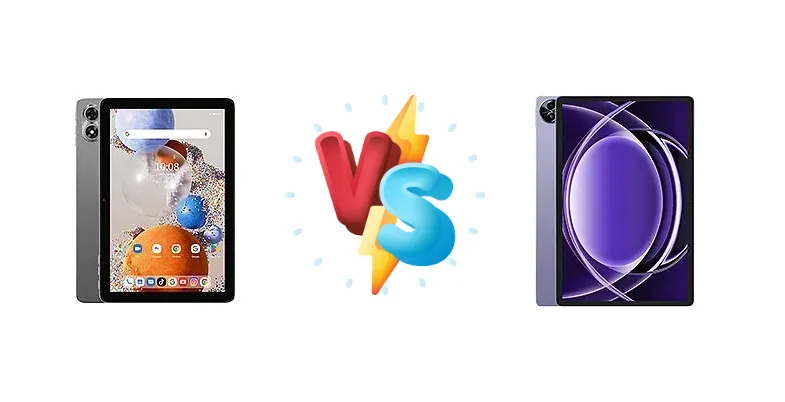
The budget tablet market is heating up, with options like the Umidigi G1 Tab and Realme Pad 2 Lite vying for your attention. Both aim to deliver a functional tablet experience without breaking the bank, but they take distinctly different approaches to achieving that goal, primarily through their core processing power and charging capabilities. This comparison will dissect the key differences to help you determine which tablet best suits your needs.
🏆 Quick Verdict
For the average user prioritizing responsiveness and future-proofing, the Realme Pad 2 Lite is the clear winner. Its Mediatek Helio G99 chipset, built on a more efficient 6nm process, offers significantly better performance than the Umidigi G1 Tab’s RK3562. While the Umidigi offers a lower price point, the performance gap justifies the slight premium for the Realme.
| Network |
|---|
| 2G bands | N/A | GSM 850 / 900 / 1800 / 1900 |
| 3G bands | - | HSDPA 850 / 900 / 2100 |
| 4G bands | N/A | 1, 3, 5, 7, 8, 20, 28, 38, 40, 41 |
| EDGE | N/A | - |
| GPRS | N/A | - |
| Speed | - | HSPA, LTE |
| Technology | No cellular connectivity | GSM / HSPA / LTE |
| Launch |
|---|
| Announced | 2023 | 2024, September 13 |
| Status | Available. Released 2023 | Available. Released 2024, September 26 |
| Body |
|---|
| Dimensions | 244.8 x 162.2 x 9.3 mm (9.64 x 6.39 x 0.37 in) | 258 x 169.5 x 8.3 mm (10.16 x 6.67 x 0.33 in) |
| SIM | No | No |
| Weight | 576 g (1.27 lb) | 525 g (1.16 lb) |
| Display |
|---|
| Resolution | 800 x 1280 pixels, 16:10 ratio (~149 ppi density) | 1200 x 1920 pixels, 16:10 ratio (~207 ppi density) |
| Size | 10.1 inches, 295.8 cm2 (~74.5% screen-to-body ratio) | 10.95 inches, 347.7 cm2 (~79.5% screen-to-body ratio) |
| Type | IPS LCD | IPS LCD, 1B colors, 90Hz, 450 nits (peak) |
| Platform |
|---|
| CPU | Quad-core 2.0 GHz | Octa-core (2x2.2 GHz Cortex-A76 & 6x2.0 GHz Cortex-A55) |
| Chipset | RK3562 (22 nm) | Mediatek Helio G99 (6 nm) |
| GPU | - | Mali-G57 MC2 |
| OS | Android 13 | Android 14, Realme UI 5.0 for Pad |
| Memory |
|---|
| Card slot | microSDXC (dedicated slot) | Unspecified |
| Internal | 64GB 4GB RAM | 128GB 4GB RAM, 128GB 8GB RAM |
| Main Camera |
|---|
| Features | LED flash | Panorama |
| Single | 8 MP, f/2.2, (wide) | 8 MP, f/2.0 |
| Video | 720p@30fps | 1080p@30fps |
| Selfie camera |
|---|
| Features | - | Panorama |
| Single | 8 MP, f/2.2, (wide) | 5 MP, f/2.2 |
| Video | 720p@30fps | 1080p@30fps |
| Sound |
|---|
| 35mm jack | Yes | No |
| Loudspeaker | Yes, with stereo speakers | Yes, with stereo speakers (4 speakers) |
| Comms |
|---|
| Bluetooth | 5.0, A2DP, LE | 5.2, A2DP, LE |
| NFC | No | No |
| Positioning | No | GPS, GALILEO, GLONASS, BDS |
| Radio | No | No |
| USB | USB Type-C | USB Type-C |
| WLAN | Wi-Fi 802.11 a/b/g/n/ac/6, dual-band | Wi-Fi 802.11 a/b/g/n/ac, dual-band |
| Features |
|---|
| Sensors | Accelerometer | Accelerometer |
| Battery |
|---|
| Charging | 10W wired | 15W wired |
| Type | 6000 mAh | 8300 mAh |
| Misc |
|---|
| Colors | Space Grey | Nebula Purple, Space Grey |
| Models | - | RMP2402 |
| Price | - | About 160 EUR |
Umidigi G1 Tab
- Lower price point makes it accessible.
- Functional for basic tasks like reading and browsing.
- Potentially longer battery life due to less powerful processor (though less efficient process)
- Significantly slower performance compared to the Realme Pad 2 Lite.
- Less efficient processor leading to potential heat issues.
- Slower charging speed.
Realme Pad 2 Lite
- Faster and more responsive performance thanks to the Helio G99.
- More efficient 6nm process for better battery life and thermal management.
- Faster 15W charging.
- Better long-term value due to superior processing power.
- Slightly higher price point.
- May not offer a dramatically better display experience.
Display Comparison
Neither device’s display specifications are provided, so a direct comparison is limited. However, given the price points, we can assume both utilize IPS LCD panels. The Realme Pad 2 Lite, benefiting from a more modern chipset, may have access to more advanced display drivers and potentially better color calibration. Bezels are likely comparable, aiming for maximizing screen real estate within the budget constraints. Without specific brightness or color gamut data, it’s difficult to definitively declare a winner, but Realme’s overall focus on user experience suggests a potentially more refined display experience.
Camera Comparison
Given the budget nature of both tablets, camera performance is unlikely to be a key differentiator. It’s highly probable both devices feature basic camera setups geared towards video calls rather than photography. Without specific sensor details, it’s safe to assume image quality will be adequate for casual use but not exceptional. The absence of information regarding OIS or advanced image processing suggests a focus on cost reduction over camera capabilities.
Performance
The performance disparity is the most significant difference between these tablets. The Realme Pad 2 Lite’s Mediatek Helio G99, fabricated on a 6nm process, is a substantial upgrade over the Umidigi G1 Tab’s RK3562 (22nm). The Helio G99’s octa-core configuration (2x2.2 GHz Cortex-A76 & 6x2.0 GHz Cortex-A55) provides a significant advantage in both single-core and multi-core performance compared to the RK3562’s quad-core 2.0 GHz setup. This translates to faster app loading times, smoother multitasking, and a more responsive user interface. The 6nm process also contributes to better thermal efficiency, meaning the Realme Pad 2 Lite is less likely to throttle under sustained load. This is crucial for gaming or prolonged video editing.
Battery Life
While battery capacity isn’t specified, the Realme Pad 2 Lite’s 15W wired charging is a clear advantage over the Umidigi G1 Tab’s 10W charging. Faster charging reduces downtime and allows for quicker top-ups, which is particularly beneficial for a portable device like a tablet. Even with a similar battery capacity, the more efficient Helio G99 chipset in the Realme Pad 2 Lite will likely result in longer battery life during typical usage scenarios. The 6nm process inherently consumes less power than the 22nm process of the RK3562.
Buying Guide
Buy the Umidigi G1 Tab if you need a basic tablet for light tasks like reading ebooks, browsing the web, and occasional video playback, and your budget is extremely tight. It’s a functional device for minimal demands. Buy the Realme Pad 2 Lite if you prefer a smoother, more responsive experience for multitasking, streaming, and even light gaming. The faster processor and more efficient architecture make it a better long-term investment, especially if you plan to use the tablet frequently.
Frequently Asked Questions
❓ Will the Helio G99 in the Realme Pad 2 Lite overheat during extended gaming sessions?
The Mediatek Helio G99 is designed with thermal efficiency in mind, utilizing a 6nm process. While it will generate heat during gaming, it's less prone to significant throttling compared to the RK3562 in the Umidigi G1 Tab, which is built on a less efficient 22nm process. Realme likely incorporates thermal management solutions to further mitigate heat buildup.
❓ Is the performance difference between the RK3562 and Helio G99 noticeable for everyday tasks like browsing and video streaming?
Yes, the difference is quite noticeable. The Helio G99’s octa-core architecture and faster clock speeds result in significantly smoother app loading, quicker web page rendering, and more fluid video playback. The Umidigi G1 Tab may exhibit occasional lag or stuttering during these tasks, especially with multiple apps open.
❓ Does the Realme Pad 2 Lite support fast charging protocols beyond 15W?
While the Realme Pad 2 Lite advertises 15W charging, it may support Power Delivery (PD) protocols, allowing for potentially faster charging with compatible chargers. However, the maximum charging speed will still be limited by the device's internal charging circuitry.