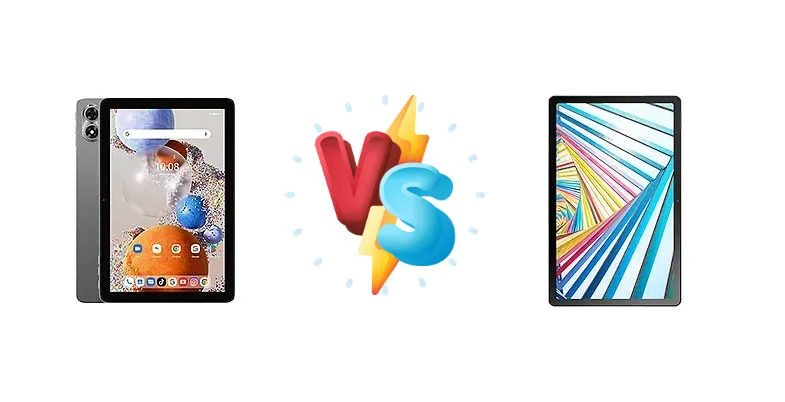
The budget tablet market is fiercely competitive, and the Umidigi G1 Tab and Lenovo Tab M10 Plus (3rd Gen) represent compelling options for users seeking affordable Android experiences. This comparison dives deep into their specifications, focusing on performance differences stemming from their distinct chipsets and the implications for everyday use.
🏆 Quick Verdict
For most users, the Lenovo Tab M10 Plus (3rd Gen) offers a superior experience thanks to its more powerful Snapdragon 680 chipset and faster 20W charging. While the Umidigi G1 Tab is more affordable, the performance gap justifies the price difference for those prioritizing responsiveness and longevity.
| Network |
|---|
| 2G bands | N/A | GSM 850 / 900 / 1800 / 1900 |
| 3G bands | - | HSDPA 800 / 850 / 900 / 1900 / 2100 |
| 4G bands | N/A | 1, 2, 3, 4, 5, 7, 8, 19, 20, 26, 28, 28, 38, 40, 41 |
| EDGE | N/A | - |
| GPRS | N/A | - |
| Speed | - | HSPA 42.2/5.76 Mbps, LTE Cat13 390/75 Mbps - cellular model only |
| Technology | No cellular connectivity | GSM / HSPA / LTE |
| Launch |
|---|
| Announced | 2023 | 2022, May |
| Status | Available. Released 2023 | Available. Released 2022, May |
| Body |
|---|
| Dimensions | 244.8 x 162.2 x 9.3 mm (9.64 x 6.39 x 0.37 in) | 251.2 x 158.8 x 7.5 mm (9.89 x 6.25 x 0.30 in) |
| SIM | No | Nano-SIM (cellular model only) |
| Weight | 576 g (1.27 lb) | 465 g (1.03 lb) |
| | - | Stylus support |
| Display |
|---|
| Resolution | 800 x 1280 pixels, 16:10 ratio (~149 ppi density) | 1200 x 2000 pixels, 5:3 ratio (~220 ppi density) |
| Size | 10.1 inches, 295.8 cm2 (~74.5% screen-to-body ratio) | 10.61 inches, 320.4 cm2 (~80.3% screen-to-body ratio) |
| Type | IPS LCD | IPS LCD, 400 nits (typ) |
| Platform |
|---|
| CPU | Quad-core 2.0 GHz | Octa-core (4x2.4 GHz Kryo 265 Gold & 4x1.9 GHz Kryo 265 Silver) - LTE model Octa-core (2x2.0 GHz Cortex-A75 & 6x1.8 GHz Cortex-A55) - Wi-Fi only model |
| Chipset | RK3562 (22 nm) | Qualcomm SM6225 Snapdragon 680 4G (6 nm) - LTE model Mediatek MT6769V/CU Helio G80 (12 nm) - Wi-Fi only model |
| GPU | - | Adreno 610 - LTE model Mali-G52 MC2 - Wi-Fi only model |
| OS | Android 13 | Android 12 |
| Memory |
|---|
| Card slot | microSDXC (dedicated slot) | microSDXC (dedicated slot) |
| Internal | 64GB 4GB RAM | 32GB 3GB RAM, 64GB 4GB RAM, 128GB 4GB RAM, 128GB 6GB RAM |
| | - | eMCP/uMCP |
| Main Camera |
|---|
| Features | LED flash | - |
| Single | 8 MP, f/2.2, (wide) | 8 MP, AF |
| Video | 720p@30fps | 1080p |
| Selfie camera |
|---|
| Single | 8 MP, f/2.2, (wide) | 8 MP |
| Video | 720p@30fps | - |
| Sound |
|---|
| 3.5mm jack | - | Yes |
| 35mm jack | Yes | Yes |
| Loudspeaker | Yes, with stereo speakers | Yes, with stereo speakers (4 speakers) |
| Comms |
|---|
| Bluetooth | 5.0, A2DP, LE | 5.0, A2DP, LE |
| NFC | No | No |
| Positioning | No | GPS, GLONASS, BDS - cellular model only |
| Radio | No | FM Radio |
| USB | USB Type-C | USB Type-C 2.0 |
| WLAN | Wi-Fi 802.11 a/b/g/n/ac/6, dual-band | Wi-Fi 802.11 a/b/g/n/ac, dual-band, Wi-Fi Direct |
| Features |
|---|
| Sensors | Accelerometer | Accelerometer, proximity, gyro |
| Battery |
|---|
| Charging | 10W wired | 20W wired |
| Type | 6000 mAh | Li-Po 7700 mAh |
| Misc |
|---|
| Colors | Space Grey | Storm Grey, Frost Blue |
| Price | - | About 260 EUR |
Umidigi G1 Tab
- Lower price point makes it highly accessible.
- Sufficient for basic tasks like reading and web browsing.
- Compact and lightweight design for portability.
- RK3562 chipset offers limited performance.
- Slow 10W charging.
- Likely lower build quality compared to Lenovo.
Lenovo Tab M10 Plus (3rd Gen)
- More powerful Snapdragon 680 (LTE model) or Helio G80 (Wi-Fi model) chipset.
- Faster 20W charging.
- Better overall performance for multitasking and demanding apps.
- Higher price compared to the Umidigi G1 Tab.
- May still struggle with graphically intensive games.
- Software updates may be less frequent than higher-end tablets.
Display Comparison
Neither device boasts a particularly standout display. Specifics like panel type (IPS is assumed for both) and resolution are missing, but the focus here is on performance. The lack of high refresh rates on either tablet suggests they are geared towards content consumption rather than fast-paced gaming. Bezels are likely comparable given the price points, and color accuracy is expected to be standard for this segment.
Camera Comparison
Camera quality is unlikely to be a deciding factor for either tablet. Details on sensor sizes and apertures are absent, but given the price bracket, expectations should be tempered. Both tablets likely feature basic camera setups suitable for casual snapshots and video calls. Focusing on the chipset’s image signal processor (ISP) capabilities, the Snapdragon 680 will likely offer slightly better image processing and noise reduction compared to the RK3562.
Performance
The core difference lies in the chipsets. The Lenovo Tab M10 Plus (3rd Gen) offers a significant advantage with the Qualcomm Snapdragon 680 (6nm) in the LTE model, featuring an octa-core CPU clocked up to 2.4 GHz. This contrasts sharply with the Umidigi G1 Tab’s RK3562 (22nm) quad-core processor running at 2.0 GHz. The 6nm process node of the Snapdragon 680 translates to better power efficiency and thermal performance, meaning sustained performance will be higher. The Wi-Fi only model of the Lenovo Tab M10 Plus (3rd Gen) uses the Mediatek Helio G80 (12nm), which is still a step up from the RK3562, though less efficient than the Snapdragon. The Snapdragon’s Kryo cores offer a more sophisticated architecture than the RK3562’s, resulting in faster single-core and multi-core performance.
Battery Life
While battery capacity isn't specified, the Lenovo Tab M10 Plus (3rd Gen) benefits from 20W wired charging, a significant improvement over the Umidigi G1 Tab’s 10W charging. This faster charging speed will reduce downtime and provide a more convenient user experience. Even with a similar battery capacity, the Snapdragon 680’s superior power efficiency will likely result in longer battery life during typical usage scenarios.
Buying Guide
Buy the Umidigi G1 Tab if you need a basic tablet for light tasks like reading ebooks, browsing the web, and occasional video playback, and your budget is extremely limited. Buy the Lenovo Tab M10 Plus (3rd Gen) if you prioritize smoother multitasking, faster app loading times, and the ability to handle more demanding applications, especially if you opt for the LTE model for on-the-go connectivity.
Frequently Asked Questions
❓ Will the Umidigi G1 Tab struggle with video streaming services like Netflix or YouTube?
While the Umidigi G1 Tab can handle video streaming, the RK3562 chipset may result in occasional buffering or lower video quality settings, especially with higher resolutions. The Lenovo Tab M10 Plus (3rd Gen) with its Snapdragon 680 will provide a smoother streaming experience.
❓ Is the LTE connectivity on the Lenovo Tab M10 Plus (3rd Gen) worth the extra cost?
If you frequently travel or need internet access in areas without Wi-Fi, the LTE connectivity is a valuable addition. It allows you to stay connected for work, entertainment, or communication without relying on Wi-Fi hotspots. The Wi-Fi only model is sufficient for home or office use.
❓ Can either of these tablets handle light gaming?
Both tablets can handle light gaming, but don't expect high frame rates or detailed graphics. The Lenovo Tab M10 Plus (3rd Gen) with the Snapdragon 680 or Helio G80 will offer a noticeably better gaming experience than the Umidigi G1 Tab with the RK3562.
❓ How does the software experience differ between these two tablets?
Both tablets run Android, but the software experience can vary. Lenovo typically offers a cleaner, more stock-Android-like experience, while Umidigi may include more pre-installed apps and customizations. Software update support is generally better from established brands like Lenovo.