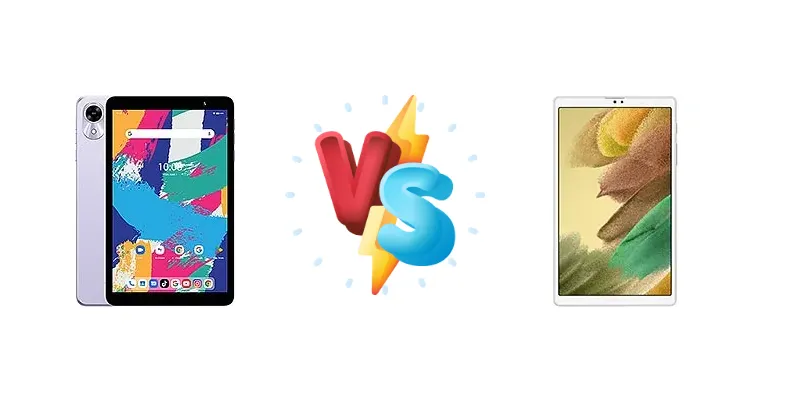
The sub-$200 tablet market is fiercely competitive, offering options for casual users, students, and anyone needing a secondary display. The Umidigi G1 Tab Mini and Samsung Galaxy Tab A7 Lite represent two compelling choices, but they take different approaches to achieving affordability. This comparison dives deep into their specifications to determine which tablet delivers the best experience for your money.
🏆 Quick Verdict
For most users, the Samsung Galaxy Tab A7 Lite is the better choice. While the Umidigi G1 Tab Mini offers a compelling price, the A7 Lite’s more efficient Helio P22T chipset and octa-core CPU provide a noticeably smoother user experience, especially when multitasking. The 15W charging also offers a slight convenience advantage.
| Network |
|---|
| 2G bands | N/A | GSM 850 / 900 / 1800 / 1900 |
| 3G bands | - | HSDPA 850 / 900 / 1700(AWS) / 1900 / 2100 |
| 4G bands | N/A | 1, 2, 3, 4, 5, 7, 8, 12, 17, 20, 28, 38, 40, 66 |
| EDGE | N/A | - |
| GPRS | N/A | - |
| Speed | - | HSPA, LTE - cellular model only |
| Technology | No cellular connectivity | GSM / HSPA / LTE |
| Launch |
|---|
| Announced | 2024 | 2021, May 27 |
| Status | Available. Released 2024 | Available. Released 2021, June 18 |
| Body |
|---|
| Build | - | Glass front, aluminum back, aluminum frame, plastic ends |
| Dimensions | 201.6 x 124.5 x 8.9 mm (7.94 x 4.90 x 0.35 in) | 212.5 x 124.7 x 8 mm (8.37 x 4.91 x 0.31 in) |
| SIM | No | Nano-SIM (cellular model only) |
| Weight | 368 g (12.98 oz) | 366 g (Wi-Fi), 371 g (LTE) (12.91 oz) |
| Display |
|---|
| Resolution | 800 x 1280 pixels, 16:10 ratio (~189 ppi density) | 800 x 1340 pixels, 5:3 ratio (~179 ppi density) |
| Size | 8.0 inches, 185.6 cm2 (~73.9% screen-to-body ratio) | 8.7 inches, 214.9 cm2 (~81.1% screen-to-body ratio) |
| Type | IPS LCD | TFT LCD |
| Platform |
|---|
| CPU | Quad-core 2.0 GHz | Octa-core (4x2.3 GHz Cortex-A53 & 4x1.8 GHz Cortex-A53) |
| Chipset | RK3562 (22 nm) | Mediatek MT8768T Helio P22T (12 nm) |
| GPU | - | PowerVR GE8320 |
| OS | Android 14 | Android 11, upgradable to Android 14, One UI 6.1 |
| Memory |
|---|
| Card slot | microSDXC (dedicated slot) | microSDXC (dedicated slot) |
| Internal | 32GB 3GB RAM | 32GB 2GB RAM, 32GB 3GB RAM, 64GB 4GB RAM |
| | - | eMMC 5.1 |
| Main Camera |
|---|
| Features | LED flash | - |
| Single | 5 MP, f/2.2, (wide) | 8 MP, AF |
| Video | 720p@30fps | 1080p@30fps |
| Selfie camera |
|---|
| Single | 5 MP, f/2.0, (wide) | 2 MP |
| Video | 720p@30fps | - |
| Sound |
|---|
| 3.5mm jack | - | Yes |
| 35mm jack | Yes | Yes |
| Loudspeaker | Yes, with stereo speakers (4 speakers) | Yes, with stereo speakers |
| Comms |
|---|
| Bluetooth | 5.0, A2DP, LE | 5.0, A2DP, LE |
| NFC | No | No |
| Positioning | No | GPS, GLONASS, BDS, GALILEO - cellular model only |
| Radio | No | No |
| USB | USB Type-C | USB Type-C 2.0 |
| WLAN | Wi-Fi 802.11 a/b/g/n/ac/6, dual-band | Wi-Fi 802.11 a/b/g/n/ac, dual-band, Wi-Fi Direct |
| Features |
|---|
| Sensors | Accelerometer | Accelerometer, compass |
| Battery |
|---|
| Charging | 10W wired | 15W wired |
| Type | 5000 mAh | Li-Po 5100 mAh |
| Misc |
|---|
| Colors | Glacier Blue, Lake Green, Nebula Purple, Space Grey | Gray, Silver |
| Models | - | SM-T225, SM-T220, SM-T225N, SM-T227U |
| Price | - | About 140 EUR |
| SAR | - | 0.68 W/kg (body) |
| SAR EU | - | 0.64 W/kg (head) 0.99 W/kg (body) |
Umidigi G1 Tab Mini
- Lowest possible price point
- Functional for basic tasks
- Compact and portable
- Less powerful processor
- Less efficient chipset
- Slower charging
Samsung Galaxy Tab A7 Lite
- More powerful octa-core processor
- More efficient chipset
- Faster 15W charging
- Slightly higher price
- Still limited in gaming performance
- Basic camera capabilities
Display Comparison
Neither device boasts a particularly impressive display. Details regarding panel type (IPS, TFT) and resolution are missing for the Umidigi G1 Tab Mini, suggesting a basic implementation. The Samsung Galaxy Tab A7 Lite also lacks detailed display specs, but Samsung’s history indicates a reasonably color-accurate IPS panel. The key difference lies in processing power impacting UI smoothness, not display quality itself. Both are likely to be adequate for media consumption but won’t excel in color accuracy or brightness.
Camera Comparison
Both tablets are unlikely to impress in the camera department. Details are scarce, but given the price point, expect basic sensors. Focusing on camera quality in this segment is a misallocation of expectations; these tablets are not designed for photography. Any differences in image quality will likely be minimal and overshadowed by the limitations of the sensors themselves.
Performance
The performance gap is the most significant differentiator. The Samsung Galaxy Tab A7 Lite’s MediaTek Helio P22T is built on a more efficient 12nm process compared to the Umidigi G1 Tab Mini’s RK3562 (22nm). More importantly, the A7 Lite features an octa-core CPU (4x2.3 GHz Cortex-A53 & 4x1.8 GHz Cortex-A53) versus the G1 Tab Mini’s quad-core 2.0 GHz processor. This translates to significantly better multitasking and responsiveness on the Samsung device. While neither is a gaming powerhouse, the A7 Lite will handle less demanding games with fewer stutters. The larger core count and smaller node size of the Helio P22T provide a clear advantage in sustained performance.
Battery Life
Battery capacity is not specified for either device, making a direct comparison difficult. However, the Samsung Galaxy Tab A7 Lite’s 15W wired charging offers a slight advantage over the Umidigi G1 Tab Mini’s 10W charging. While charging speed isn’t everything, the faster rate will reduce downtime, especially for users who rely on the tablet throughout the day. The more efficient Helio P22T chipset in the A7 Lite may also contribute to slightly better battery life during typical usage.
Buying Guide
Buy the Umidigi G1 Tab Mini if you prioritize absolute lowest cost and primarily need a tablet for static tasks like reading ebooks or displaying information. Its RK3562 chipset is sufficient for these basic functions. Buy the Samsung Galaxy Tab A7 Lite if you value a more responsive user interface, smoother multitasking, and a slightly faster charging experience. It’s a better all-rounder for everyday use and light gaming.
Frequently Asked Questions
❓ Will the RK3562 chipset in the Umidigi G1 Tab Mini struggle with multiple apps open simultaneously?
Yes, the quad-core RK3562 chipset is likely to exhibit noticeable slowdowns when multitasking with several apps. Its processing power is geared towards single-task performance, making it less efficient at handling concurrent operations compared to the octa-core Helio P22T in the Samsung Galaxy Tab A7 Lite.
❓ Is the 10W charging on the Umidigi G1 Tab Mini significantly slower than the 15W charging on the Samsung Galaxy Tab A7 Lite?
While the difference may not seem drastic, 10W charging will take considerably longer to fully charge the Umidigi G1 Tab Mini. Expect a longer wait time to go from 0% to 100%, potentially adding an hour or more to the charging cycle compared to the Samsung device.
❓ Can either of these tablets handle popular mobile games like PUBG or Call of Duty?
Both tablets will struggle with demanding games like PUBG or Call of Duty. While the Samsung Galaxy Tab A7 Lite’s Helio P22T offers slightly better performance, you’ll likely need to play at the lowest graphics settings and accept occasional frame drops. These tablets are better suited for casual gaming or less graphically intensive titles.