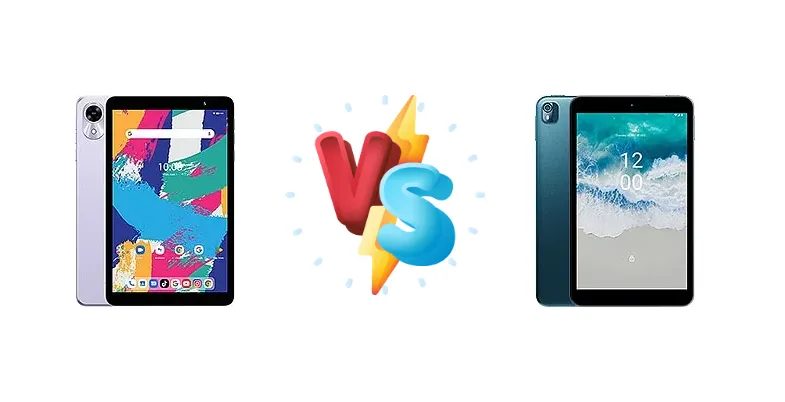
The sub-$150 Android tablet market is fiercely competitive. The Umidigi G1 Tab Mini and Nokia T10 both aim to deliver a functional tablet experience without breaking the bank, but they take different approaches to achieving this. The key differentiator lies in their chipsets: the Umidigi utilizes a Rockchip RK3562, while the Nokia opts for a Unisoc T606. This comparison will dissect these differences and determine which tablet best suits your needs.
🏆 Quick Verdict
For most users, the Nokia T10 emerges as the better choice. Its octa-core Unisoc T606 chipset, built on a more efficient 12nm process, provides a noticeable performance advantage over the Umidigi G1 Tab Mini’s quad-core RK3562. While both offer similar 10W charging, the Nokia’s superior processing power translates to a smoother user experience, especially for multitasking and demanding applications.
| Network |
|---|
| 2G bands | N/A | GSM 850 / 900 / 1800 / 1900 |
| 3G bands | - | HSDPA 850 / 900 / 2100 |
| 4G bands | N/A | 1, 3, 5, 7, 8, 20, 28, 38, 40, 41 |
| EDGE | N/A | - |
| GPRS | N/A | - |
| Speed | - | HSPA 42.2/5.76 Mbps, LTE Cat4 150/50 Mbps |
| Technology | No cellular connectivity | GSM / HSPA / LTE |
| Launch |
|---|
| Announced | 2024 | 2022, July 12 |
| Status | Available. Released 2024 | Available. Released 2022, August 20 |
| Body |
|---|
| Build | - | Glass front, plastic back, plastic frame |
| Dimensions | 201.6 x 124.5 x 8.9 mm (7.94 x 4.90 x 0.35 in) | 208 x 123.2 x 9 mm (8.19 x 4.85 x 0.35 in) |
| SIM | No | Nano-SIM |
| Weight | 368 g (12.98 oz) | 375 g (13.23 oz) |
| | - | Splash resistant |
| Display |
|---|
| Resolution | 800 x 1280 pixels, 16:10 ratio (~189 ppi density) | 800 x 1280 pixels, 16:10 ratio (~189 ppi density) |
| Size | 8.0 inches, 185.6 cm2 (~73.9% screen-to-body ratio) | 8.0 inches, 185.6 cm2 (~72.4% screen-to-body ratio) |
| Type | IPS LCD | IPS LCD, 360 nits (typ), 450 nits (peak) |
| Platform |
|---|
| CPU | Quad-core 2.0 GHz | Octa-core (2x1.6 GHz Cortex-A75 & 6x1.6 GHz Cortex-A55) |
| Chipset | RK3562 (22 nm) | Unisoc T606 (12 nm) |
| GPU | - | Mali-G57 MP1 |
| OS | Android 14 | Android 12, upgradable to Android 13 |
| Memory |
|---|
| Card slot | microSDXC (dedicated slot) | microSDXC |
| Internal | 32GB 3GB RAM | 32GB 3GB RAM, 64GB 4GB RAM |
| Main Camera |
|---|
| Features | LED flash | LED flash |
| Single | 5 MP, f/2.2, (wide) | 8 MP, 1/4.0", 1.12µm, AF |
| Video | 720p@30fps | 1080p |
| Selfie camera |
|---|
| Single | 5 MP, f/2.0, (wide) | 2 MP, 1/5.0", 1.65µm |
| Video | 720p@30fps | 720p |
| Sound |
|---|
| 3.5mm jack | - | Yes |
| 35mm jack | Yes | Yes |
| Loudspeaker | Yes, with stereo speakers (4 speakers) | Yes, with stereo speakers |
| Comms |
|---|
| Bluetooth | 5.0, A2DP, LE | 5.0, A2DP, LE |
| NFC | No | No |
| Positioning | No | GPS, GLONASS, GALILEO |
| Radio | No | No |
| USB | USB Type-C | USB Type-C 2.0, OTG |
| WLAN | Wi-Fi 802.11 a/b/g/n/ac/6, dual-band | Wi-Fi 802.11 a/b/g/n/ac, dual-band |
| Features |
|---|
| Sensors | Accelerometer | Accelerometer, proximity |
| Battery |
|---|
| Charging | 10W wired | 10W wired |
| Type | 5000 mAh | Li-Po 5250 mAh |
| Misc |
|---|
| Colors | Glacier Blue, Lake Green, Nebula Purple, Space Grey | Ocean Blue |
| Models | - | TA-1503, TA-1472, TA-1462, TA-1457 |
| Price | - | About 160 EUR |
| SAR | - | 1.19 W/kg (body) |
| SAR EU | - | 0.27 W/kg (head) 1.57 W/kg (body) |
Umidigi G1 Tab Mini
- More compact and portable due to its 'Mini' size.
- Potentially lower price point.
- Simple and straightforward user experience for basic tasks.
- Significantly weaker processor performance.
- Less efficient chipset (RK3562) leading to potentially shorter battery life.
- Likely to struggle with multitasking and demanding apps.
Nokia T10
- More powerful and efficient octa-core Unisoc T606 chipset.
- Smoother multitasking and app performance.
- Better overall user experience for everyday tasks.
- Slightly larger and less portable than the Umidigi G1 Tab Mini.
- May be marginally more expensive.
- 10W charging is relatively slow.
Display Comparison
Neither device boasts a standout display. Both are likely to feature IPS LCD panels, common in this price bracket. However, the lack of specific display specs (resolution, brightness) makes a direct comparison difficult. The Umidigi’s ‘Mini’ designation suggests a smaller screen size, potentially impacting usability for tasks like web browsing. Without knowing the peak brightness of either panel, it’s hard to assess outdoor visibility, but we can assume both will struggle in direct sunlight. Color accuracy is also likely to be standard for this segment.
Camera Comparison
Camera performance is unlikely to be a deciding factor for either tablet. Both are positioned as budget devices, and camera quality typically takes a backseat. Without specific sensor details, it’s safe to assume both will feature basic cameras suitable for casual snapshots. The absence of Optical Image Stabilization (OIS) on either device suggests image quality will suffer in low-light conditions. Focusing on the chipset difference is far more relevant than speculating on camera capabilities.
Performance
The core difference lies in the chipsets. The Nokia T10’s Unisoc T606, fabricated on a 12nm process, features an octa-core configuration with a mix of Cortex-A75 and A55 cores. This architecture provides a significant advantage over the Umidigi G1 Tab Mini’s RK3562, a quad-core processor built on a larger 22nm node. The 12nm process inherently offers better power efficiency, potentially leading to longer battery life under load. The Cortex-A75 cores in the T10 provide a performance boost for more demanding tasks, while the A55 cores handle background processes efficiently. This translates to snappier app launches and smoother multitasking on the Nokia. The RK3562, while adequate for basic tasks, will likely exhibit more lag and struggle with resource-intensive applications.
Battery Life
Both tablets feature 10W wired charging, indicating similar charging speeds. The actual battery capacity isn’t specified, but the Unisoc T606’s superior power efficiency in the Nokia T10 could translate to longer real-world battery life, despite potentially having a similar capacity to the Umidigi. The 22nm RK3562 in the Umidigi will consume more power, potentially requiring more frequent charging, especially during intensive use. A full 0-100% charge on both devices will likely take around 3-4 hours.
Buying Guide
Buy the Umidigi G1 Tab Mini if you prioritize extreme portability and a minimal footprint for basic tasks like e-reading or simple video playback. Its smaller size makes it ideal for travel. Buy the Nokia T10 if you value a more responsive and versatile tablet experience, capable of handling more demanding apps, light gaming, and smoother multitasking. The Nokia T10 is the better all-rounder for everyday use.
Frequently Asked Questions
❓ Will the Unisoc T606 in the Nokia T10 handle light gaming like Asphalt 8 or Subway Surfers?
Yes, the Unisoc T606 is capable of running less demanding games like Asphalt 8 and Subway Surfers at playable frame rates with reduced graphics settings. While it won’t deliver a high-end gaming experience, it’s a significant step up from the RK3562 in the Umidigi G1 Tab Mini, which may struggle with even these titles.
❓ Is the RK3562 chipset in the Umidigi G1 Tab Mini sufficient for video streaming services like Netflix and YouTube?
The RK3562 can handle video streaming from services like Netflix and YouTube, but you might experience occasional buffering or lag, especially with higher resolutions (1080p or above). The Nokia T10’s Unisoc T606 will provide a smoother and more reliable streaming experience.
❓ How does the 12nm process of the Unisoc T606 impact real-world battery life compared to the 22nm RK3562?
The 12nm process is more efficient than the 22nm process. This means the Unisoc T606 consumes less power for the same level of performance. In practical terms, you can expect the Nokia T10 to offer longer battery life during typical usage scenarios, such as web browsing, video playback, and light multitasking, compared to the Umidigi G1 Tab Mini.