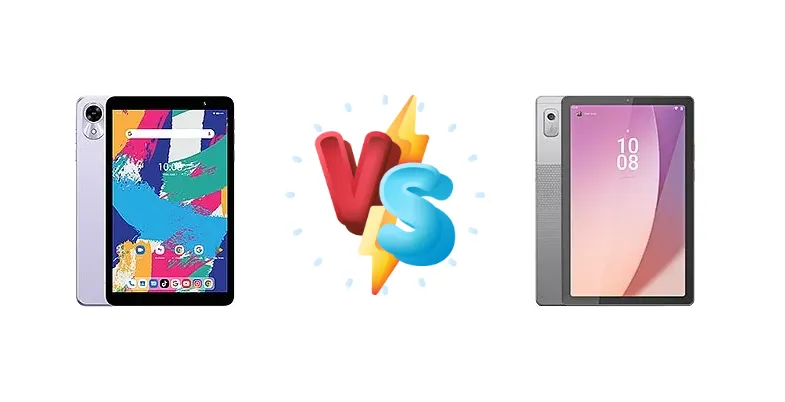
The sub-$150 tablet market is fiercely competitive, and the Umidigi G1 Tab Mini and Lenovo Tab M9 represent two compelling options. While both aim to deliver affordable Android experiences, they take different approaches to achieving that goal, primarily through their choice of system-on-chip. This comparison dives deep into the hardware differences to determine which tablet offers the best value for your money.
🏆 Quick Verdict
For most users, the Lenovo Tab M9 emerges as the better choice. Its Mediatek Helio G80 chipset, built on a more efficient 12nm process, provides a significant performance advantage over the Umidigi G1 Tab Mini’s RK3562, making it more suitable for multitasking, gaming, and demanding applications. While both charge at the same 10W rate, the M9’s superior processing power justifies the slight price difference.
| Network |
|---|
| 2G bands | N/A | GSM 850 / 900 / 1800 / 1900 |
| 3G bands | - | HSDPA 850 / 900 / 1700(AWS) / 1900 / 2100 |
| 4G bands | N/A | 1, 2, 3, 4, 5, 7, 8, 18, 19, 20, 26, 28, 38, 40, 41, 66 |
| EDGE | N/A | - |
| GPRS | N/A | - |
| Speed | - | HSPA, LTE - cellular model only |
| Technology | No cellular connectivity | GSM / HSPA / LTE |
| Launch |
|---|
| Announced | 2024 | 2022, December 20 |
| Status | Available. Released 2024 | Available. Released 2023, March 14 |
| Body |
|---|
| Dimensions | 201.6 x 124.5 x 8.9 mm (7.94 x 4.90 x 0.35 in) | 215.4 x 136.8 x 8 mm (8.48 x 5.39 x 0.31 in) |
| SIM | No | Nano-SIM (cellular model only) |
| Weight | 368 g (12.98 oz) | 344 g (12.13 oz) |
| Display |
|---|
| Resolution | 800 x 1280 pixels, 16:10 ratio (~189 ppi density) | 800 x 1340 pixels, 5:3 ratio (~173 ppi density) |
| Size | 8.0 inches, 185.6 cm2 (~73.9% screen-to-body ratio) | 9.0 inches, 230.0 cm2 (~78.1% screen-to-body ratio) |
| Type | IPS LCD | IPS LCD, 400 nits (typ) |
| Platform |
|---|
| CPU | Quad-core 2.0 GHz | Octa-core (2x2.0 GHz Cortex-A75 & 6x1.8 GHz Cortex-A55) |
| Chipset | RK3562 (22 nm) | Mediatek MT6769V/CU Helio G80 (12 nm) |
| GPU | - | Mali-G52 MC2 |
| OS | Android 14 | Android 12 |
| Memory |
|---|
| Card slot | microSDXC (dedicated slot) | microSDXC (dedicated slot) |
| Internal | 32GB 3GB RAM | 32GB 3GB RAM, 64GB 4GB RAM, 128GB 4GB RAM |
| | - | eMMC 5.1 |
| Main Camera |
|---|
| Features | LED flash | - |
| Single | 5 MP, f/2.2, (wide) | 8 MP, AF |
| Video | 720p@30fps | 1080p |
| Selfie camera |
|---|
| Single | 5 MP, f/2.0, (wide) | 2 MP |
| Video | 720p@30fps | 720p |
| Sound |
|---|
| 3.5mm jack | - | Yes |
| 35mm jack | Yes | Yes |
| Loudspeaker | Yes, with stereo speakers (4 speakers) | Yes, with dual speakers |
| Comms |
|---|
| Bluetooth | 5.0, A2DP, LE | 5.1, A2DP, LE |
| NFC | No | No |
| Positioning | No | GPS, GLONASS, GALILEO - cellular model only |
| Radio | No | Unspecified |
| USB | USB Type-C | USB Type-C 2.0 |
| WLAN | Wi-Fi 802.11 a/b/g/n/ac/6, dual-band | Wi-Fi 802.11 a/b/g/n/ac, dual-band, Wi-Fi Direct |
| Features |
|---|
| Sensors | Accelerometer | Accelerometer, proximity |
| Battery |
|---|
| Charging | 10W wired | 10W wired |
| Type | 5000 mAh | Li-Po 5100 mAh |
| Misc |
|---|
| Colors | Glacier Blue, Lake Green, Nebula Purple, Space Grey | Arctic Grey, Frost Blue |
| Models | - | TB310FU |
| Price | - | About 180 EUR |
Umidigi G1 Tab Mini
- Highly portable due to its compact size.
- Potentially lower price point.
- Sufficient for basic tasks like reading and web browsing.
- RK3562 chipset is significantly less powerful than the Helio G80.
- 22nm process node leads to lower power efficiency.
- Likely to struggle with multitasking and demanding applications.
Lenovo Tab M9
- Helio G80 chipset offers significantly better performance.
- 12nm process node provides improved power efficiency.
- More responsive user experience for everyday tasks.
- May be slightly more expensive than the Umidigi G1 Tab Mini.
- 10W charging is relatively slow.
- Camera performance is likely to be basic.
Display Comparison
Neither Umidigi nor Lenovo provide detailed display specifications beyond screen size. However, the choice of chipset indirectly impacts the display experience. The more powerful GPU in the Helio G80 of the Lenovo Tab M9 will allow for smoother rendering of UI elements and video playback. While both likely utilize IPS LCD panels, the M9’s processing power suggests a higher likelihood of supporting higher resolutions or refresh rates, though this isn't confirmed. Bezels are expected to be similar on both devices, given their price point.
Camera Comparison
Given the price bracket, camera performance isn’t a primary focus. Detailed camera specs are unavailable for either device. It’s safe to assume both tablets feature basic camera setups suitable for casual snapshots and video calls. The absence of detailed information suggests neither device will excel in image quality, and users shouldn’t expect features like optical image stabilization (OIS) or advanced image processing. Any included macro cameras are likely to be low resolution and of limited utility.
Performance
The core difference lies in the chipsets. The Lenovo Tab M9’s Mediatek Helio G80 (12nm) is an octa-core processor featuring two Cortex-A75 cores clocked at 2.0 GHz and six Cortex-A55 cores at 1.8 GHz. This configuration provides a substantial performance boost over the Umidigi G1 Tab Mini’s RK3562 (22nm) quad-core 2.0 GHz processor. The 12nm fabrication process of the Helio G80 also translates to better power efficiency and potentially less thermal throttling during sustained workloads. The architectural advantage of the A75 cores in the M9 will be noticeable in app launch times and overall system responsiveness. The RK3562, while adequate for basic tasks, will struggle with more demanding applications.
Battery Life
Both tablets feature 10W wired charging, indicating similar charging speeds. While battery capacity isn’t specified, the more efficient Helio G80 in the Lenovo Tab M9 will likely result in longer battery life despite potentially having a similar capacity to the Umidigi G1 Tab Mini. The 12nm process node contributes to reduced power consumption, allowing the M9 to operate for a longer duration on a single charge, especially during video playback or gaming.
Buying Guide
Buy the Umidigi G1 Tab Mini if you prioritize extreme portability and a minimal footprint for basic tasks like e-reading and light web browsing. It’s a good option for those who need a secondary display for simple content consumption. Buy the Lenovo Tab M9 if you value performance and responsiveness for everyday tasks, streaming video, and casual gaming. The M9 is the better all-rounder for users who want a tablet that can handle a wider range of applications without significant slowdown.
Frequently Asked Questions
❓ Will the Helio G80 in the Lenovo Tab M9 overheat during extended gaming sessions?
While the Helio G80 is a capable processor, its thermal performance in the Tab M9 will depend on the tablet's cooling solution. However, the 12nm process node is more efficient than the RK3562’s 22nm node, meaning it’s less prone to overheating and should maintain performance for longer periods. Expect some throttling during very demanding games, but it should be less severe than on the Umidigi.
❓ Is the RK3562 chipset in the Umidigi G1 Tab Mini sufficient for streaming video from services like Netflix and YouTube?
The RK3562 can handle basic video streaming from services like Netflix and YouTube, but you may experience occasional stuttering or buffering, especially with higher resolutions (1080p or above). The limited processing power and GPU capabilities of the RK3562 mean it’s not ideally suited for demanding streaming tasks. The Lenovo Tab M9’s Helio G80 will provide a much smoother streaming experience.
❓ Can either tablet be used for light photo editing?
Light photo editing, such as cropping and applying basic filters, is possible on both tablets. However, the Lenovo Tab M9 with its Helio G80 will handle these tasks significantly faster and more smoothly. The Umidigi G1 Tab Mini’s RK3562 may struggle with larger image files or more complex edits.
❓ What type of storage does each tablet use, and is it expandable?
Specific storage details (eMMC vs. UFS) are not provided. However, given the price point, both tablets likely utilize eMMC storage. Expandability via microSD card is common in this segment, and it's reasonable to assume both tablets offer a microSD card slot, though the maximum supported capacity may vary.