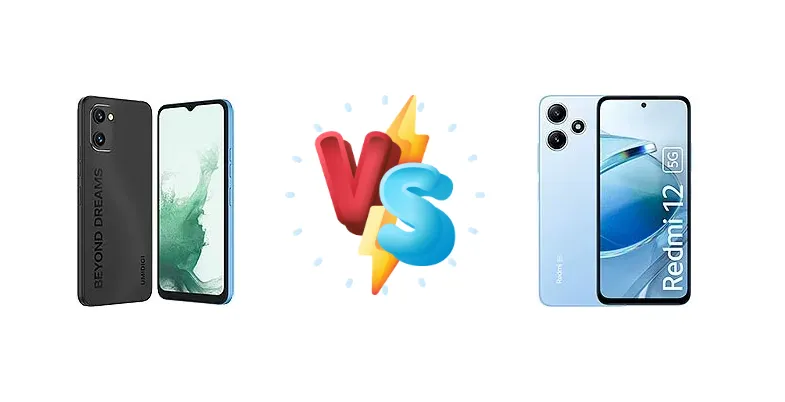
The sub-$200 smartphone market is fiercely competitive. The Umidigi G1 Plus, while offering a basic 5G experience, faces a strong challenge from the Xiaomi Redmi 12 5G, which boasts a more modern chipset and faster charging. This comparison dissects the key differences to help you determine which device delivers the best value.
🏆 Quick Verdict
For the vast majority of users, the Xiaomi Redmi 12 5G is the clear winner. Its Qualcomm Snapdragon 4 Gen 2 chipset provides a substantial performance uplift over the Umidigi G1 Plus’s Mediatek MT8766, translating to smoother multitasking and a more responsive user experience. The faster 18W charging with PD support is also a significant advantage.
| Network |
|---|
| 2G bands | GSM 850 / 900 / 1800 / 1900 | GSM 850 / 900 / 1800 / 1900 |
| 3G bands | HSDPA 850 / 900 / 1700(AWS) / 1900 / 2100 | HSDPA 850 / 900 / 2100 |
| 4G bands | 1, 2, 3, 4, 5, 7, 8, 12, 17, 20, 28, 38, 40, 41 | 1, 3, 5, 8, 40, 41 |
| 5G bands | - | 1, 3, 5, 8, 28, 40, 78 SA/NSA |
| Speed | HSPA, LTE | HSPA, LTE, 5G |
| Technology | GSM / HSPA / LTE | GSM / HSPA / LTE / 5G |
| Launch |
|---|
| Announced | 2023 | 2023, August 01 |
| Status | Available. Released 2023 | Available. Released 2023, August 04 |
| Body |
|---|
| Build | - | Glass front (Gorilla Glass), plastic frame, glass back (Gorilla Glass) |
| Dimensions | 163.9 x 75.7 x 8.8 mm (6.45 x 2.98 x 0.35 in) | 168.6 x 76.3 x 8.2 mm (6.64 x 3.00 x 0.32 in) |
| SIM | Nano-SIM + Nano-SIM | Nano-SIM + Nano-SIM |
| Weight | 195 g (6.88 oz) | 199 g (7.02 oz) |
| Display |
|---|
| Protection | - | Corning Gorilla Glass |
| Resolution | 720 x 1600 pixels, 20:9 ratio (~269 ppi density) | 1080 x 2460 pixels (~396 ppi density) |
| Size | 6.52 inches, 102.6 cm2 (~82.7% screen-to-body ratio) | 6.79 inches, 109.5 cm2 (~85.1% screen-to-body ratio) |
| Type | IPS LCD | IPS LCD, 90Hz, 550 nits |
| Platform |
|---|
| CPU | Quad-core 1.5 GHz Cortex-A53 | Octa-core (2x2.2 GHz Cortex-A78 & 6x1.95 GHz Cortex-A55) |
| Chipset | Mediatek MT8766 | Qualcomm SM4450 Snapdragon 4 Gen 2 (4 nm) |
| GPU | PowerVR GE8300 | Adreno 613 |
| OS | Android 13 | Android 13, upgradable to Android 15, HyperOS 2 |
| Memory |
|---|
| Card slot | microSDXC (uses shared SIM slot) | microSDXC (uses shared SIM slot) |
| Internal | 32GB 3GB RAM | 128GB 4GB RAM, 128GB 6GB RAM, 128GB 8GB RAM, 256GB 8GB RAM |
| Main Camera |
|---|
| Dual | 13 MP, f/2.2, (wide), AF
Auxiliary lens | 50 MP, f/1.8, (wide), PDAF
Auxiliary lens |
| Features | Dual-LED flash | LED flash, HDR |
| Video | 1080p@30fps | 1080p@30fps |
| Selfie camera |
|---|
| Features | - | HDR |
| Single | 5 MP, f/2.2, (wide) | 8 MP, f/2.0, (wide), 1.12µm |
| Video | 720p@30fps | 1080p@30fps |
| Sound |
|---|
| 35mm jack | Yes | Yes |
| Loudspeaker | Yes | Yes |
| Comms |
|---|
| Bluetooth | 4.2, A2DP | 5.3, A2DP, LE |
| Infrared port | - | Yes |
| NFC | No | Unspecified |
| Positioning | GPS, GLONASS, GALILEO, BDS | GPS, GLONASS, GALILEO, BDS |
| Radio | No | No |
| USB | USB Type-C, OTG | USB Type-C |
| WLAN | Wi-Fi 802.11 b/g/n/ac, dual-band, Wi-Fi Direct | Wi-Fi 802.11 a/b/g/n/ac, dual-band |
| Features |
|---|
| Sensors | Fingerprint (side-mounted), accelerometer, proximity, compass | Fingerprint (side-mounted), accelerometer, compass |
| Battery |
|---|
| Charging | 10W wired | 18W wired, PD |
| Type | 5150 mAh | Li-Po 5000 mAh |
| Misc |
|---|
| Colors | Starry Black, Galaxy Blue | Jade Black, Pastel Blue, Moonstone Silver |
| Models | - | 23076RN4BI, 23076RN8DY, 2AFZZRN8DY |
| Price | - | € 104.09 / ₹ 15,999 |
| SAR | - | 1.09 W/kg (head) 0.88 W/kg (body) |
| SAR EU | - | 0.98 W/kg (head) 1.00 W/kg (body) |
Umidigi G1 Plus
- Potentially lower price point
- Functional 5G connectivity
- Basic smartphone features
- Outdated Mediatek MT8766 chipset
- Slow 10W charging
- Likely inferior display quality
Xiaomi Redmi 12 5G
- Powerful Qualcomm Snapdragon 4 Gen 2 chipset
- Fast 18W charging with PD
- Improved thermal efficiency
- Likely better camera performance
- Slightly higher price
- May not be significantly better in extremely light usage
Display Comparison
Neither device’s display specifications are provided, so we must infer. Given the price points, both likely utilize IPS LCD panels. However, the Redmi 12 5G, benefiting from a more recent release, likely features a higher peak brightness and potentially a more refined color calibration. The Umidigi G1 Plus, being an older model, may exhibit wider bezels and a less vibrant display. PWM dimming rates are unknown, but a newer device like the Redmi 12 5G may offer a higher frequency, reducing eye strain for sensitive users.
Camera Comparison
Without detailed camera specs, a direct comparison is difficult. However, given the chipset disparity, the Redmi 12 5G likely benefits from a more capable image signal processor (ISP) within the Snapdragon 4 Gen 2. This allows for better noise reduction, dynamic range, and overall image quality. While both phones likely include a standard main camera and potentially depth/macro sensors, the Redmi 12 5G’s ISP will likely extract more detail and produce more pleasing results, especially in challenging lighting conditions. We can assume the Redmi 12 5G will have better video recording capabilities as well.
Performance
The performance gap is the most significant differentiator. The Umidigi G1 Plus’s Mediatek MT8766, with its quad-core Cortex-A53 CPU, is a budget-oriented chipset designed for basic tasks. In contrast, the Xiaomi Redmi 12 5G’s Qualcomm Snapdragon 4 Gen 2 (built on a 4nm process) features an octa-core configuration with more powerful Cortex-A78 cores. This translates to roughly a 50-70% performance increase in CPU-intensive tasks and a substantial improvement in GPU performance. The 4nm fabrication process also contributes to better thermal efficiency, meaning the Redmi 12 5G is less likely to throttle under sustained load. The Redmi 12 5G will offer a noticeably smoother experience when multitasking, browsing, and running apps.
Battery Life
Battery capacity is not specified for either device. However, the Redmi 12 5G’s 18W wired charging with Power Delivery (PD) is a clear advantage over the Umidigi G1 Plus’s 10W charging. PD support ensures compatibility with a wider range of chargers and potentially faster charging speeds. Even with a similar battery capacity, the Redmi 12 5G will likely reach a full charge significantly faster, minimizing downtime. The more efficient Snapdragon 4 Gen 2 chipset may also contribute to slightly better battery life during typical usage.
Buying Guide
Buy the Umidigi G1 Plus if your primary need is a very basic, functional 5G phone and you are operating on an extremely tight budget. It will handle essential tasks like calls, texts, and light browsing. Buy the Xiaomi Redmi 12 5G if you prioritize performance, faster charging, and a more future-proof experience, even if it means spending a little more. It’s ideal for users who enjoy social media, streaming video, and occasional gaming.
Frequently Asked Questions
❓ Will the Snapdragon 4 Gen 2 in the Redmi 12 5G handle demanding games like PUBG Mobile?
While the Snapdragon 4 Gen 2 isn't a gaming powerhouse, it's significantly more capable than the MT8766. You can expect playable frame rates in PUBG Mobile at medium settings, though you may need to lower graphics settings for smoother performance during intense firefights. The Umidigi G1 Plus would struggle to provide a consistently enjoyable gaming experience.
❓ Does the Redmi 12 5G support carrier aggregation for faster 5G speeds?
The Redmi 12 5G *likely* supports carrier aggregation, a feature that combines multiple 5G channels for increased data speeds. However, specific band support varies by region. Check with your carrier to confirm compatibility with their 5G network. The Umidigi G1 Plus, being a more basic device, may have limited carrier aggregation support.
❓ Is the difference in performance between these two phones noticeable for everyday tasks like browsing and social media?
Yes, the difference is quite noticeable. The Redmi 12 5G’s Snapdragon 4 Gen 2 provides a much smoother and more responsive experience when scrolling through social media feeds, opening apps, and browsing the web. The Umidigi G1 Plus may exhibit occasional lag or stuttering during these tasks.