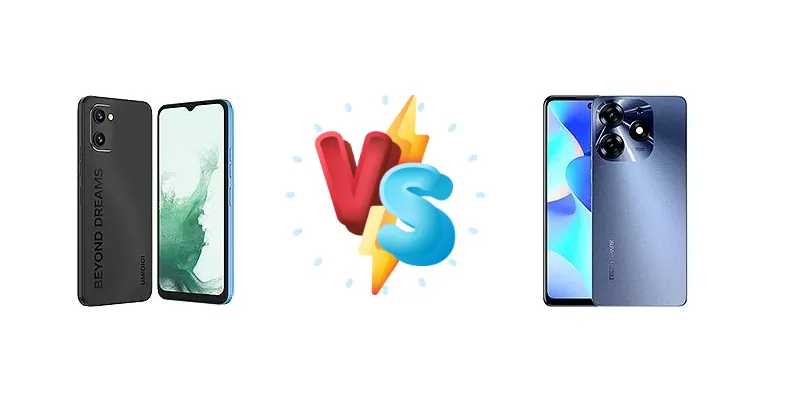
The sub-$150 smartphone market is fiercely competitive. The Umidigi G1 Plus and Tecno Spark 10 Pro both aim to deliver essential features at an accessible price point, but they take different approaches. The G1 Plus prioritizes a basic, functional experience, while the Spark 10 Pro attempts to offer a more polished experience with a more powerful chipset and brighter display.
🏆 Quick Verdict
For most users, the Tecno Spark 10 Pro is the better choice. Its Helio G88 chipset provides significantly improved performance over the Umidigi G1 Plus’s MT8766, making it more responsive for everyday tasks and light gaming. The 18W charging is also a welcome upgrade, despite both phones sharing the same 131-hour endurance rating.
| Network |
|---|
| 2G bands | GSM 850 / 900 / 1800 / 1900 | GSM 850 / 900 / 1800 / 1900 |
| 3G bands | HSDPA 850 / 900 / 1700(AWS) / 1900 / 2100 | HSDPA 850 / 900 / 2100 |
| 4G bands | 1, 2, 3, 4, 5, 7, 8, 12, 17, 20, 28, 38, 40, 41 | LTE |
| Speed | HSPA, LTE | HSPA, LTE |
| Technology | GSM / HSPA / LTE | GSM / HSPA / LTE |
| Launch |
|---|
| Announced | 2023 | 2023, March 06 |
| Status | Available. Released 2023 | Available. Released 2023, March 22 |
| Body |
|---|
| Build | - | Glass front, plastic frame, glass back |
| Dimensions | 163.9 x 75.7 x 8.8 mm (6.45 x 2.98 x 0.35 in) | 168.4 x 76.2 x 8.4 mm (6.63 x 3.00 x 0.33 in) |
| SIM | Nano-SIM + Nano-SIM | Nano-SIM + Nano-SIM |
| Weight | 195 g (6.88 oz) | 208 g (7.34 oz) |
| Display |
|---|
| Resolution | 720 x 1600 pixels, 20:9 ratio (~269 ppi density) | 1080 x 2460 pixels (~396 ppi density) |
| Size | 6.52 inches, 102.6 cm2 (~82.7% screen-to-body ratio) | 6.8 inches, 109.3 cm2 (~85.1% screen-to-body ratio) |
| Type | IPS LCD | IPS LCD, 90Hz |
| Platform |
|---|
| CPU | Quad-core 1.5 GHz Cortex-A53 | Octa-core (2x2.0 GHz Cortex-A75 & 6x1.8 GHz Cortex-A55) |
| Chipset | Mediatek MT8766 | Mediatek MT6769H Helio G88 (12 nm) |
| GPU | PowerVR GE8300 | Mali-G52 MC2 |
| OS | Android 13 | Android 13, HIOS 12.6 |
| Memory |
|---|
| Card slot | microSDXC (uses shared SIM slot) | microSDXC (dedicated slot) |
| Internal | 32GB 3GB RAM | 128GB 4GB RAM, 128GB 8GB RAM, 256GB 8GB RAM |
| Main Camera |
|---|
| Dual | 13 MP, f/2.2, (wide), AF
Auxiliary lens | 50 MP, f/1.6, (wide), PDAF
0.08 MP, (depth) |
| Features | Dual-LED flash | Dual-LED flash, HDR, panorama |
| Single | - | 50 MP, f/1.6, (wide), PDAF
Auxiliary lens |
| Triple | - | 50 MP, f/1.6, (wide), PDAF
other unspecified cameras |
| Video | 1080p@30fps | 1440p@30fps, 1080p@30fps |
| Selfie camera |
|---|
| Features | - | Dual-LED flash |
| Single | 5 MP, f/2.2, (wide) | 32 MP, (wide) |
| Video | 720p@30fps | 1440p@30fps, 1080p@30fps |
| Sound |
|---|
| 3.5mm jack | - | Yes |
| 35mm jack | Yes | Yes |
| Loudspeaker | Yes | Yes |
| Comms |
|---|
| Bluetooth | 4.2, A2DP | 5.3, A2DP, LE |
| NFC | No | Yes |
| Positioning | GPS, GLONASS, GALILEO, BDS | GPS |
| Radio | No | FM radio |
| USB | USB Type-C, OTG | USB Type-C 2.0, OTG |
| WLAN | Wi-Fi 802.11 b/g/n/ac, dual-band, Wi-Fi Direct | Wi-Fi 802.11 b/g/n |
| Features |
|---|
| Sensors | Fingerprint (side-mounted), accelerometer, proximity, compass | Fingerprint (side-mounted), accelerometer, proximity, compass |
| Battery |
|---|
| Charging | 10W wired | 18W wired |
| Type | 5150 mAh | 5000 mAh |
| Misc |
|---|
| Colors | Starry Black, Galaxy Blue | Starry Black, Pearl White |
| Models | - | KI7 |
| Price | - | £ 245.74 |
| Tests |
|---|
| Battery life | - |
Endurance rating 131h
|
| Camera | - |
Photo / Video |
| Display | - |
Contrast ratio: 1991:1 (nominal) |
| Loudspeaker | - |
-29.2 LUFS (Average)
|
| Performance | - |
AnTuTu: 249938 (v9)
GeekBench: 1358 (v5.1), 1376 (v6)
GFXBench: 8.1fps (ES 3.1 onscreen) |
Umidigi G1 Plus
- Lowest possible price point
- Functional for basic tasks
- Acceptable battery endurance
- Very slow processor
- Limited performance for multitasking
- Slow charging speed (10W)
Tecno Spark 10 Pro
- Significantly faster processor
- Brighter display for better visibility
- Faster 18W charging
- Slightly higher price
- Camera performance likely similar to Umidigi
- May still struggle with demanding games
Display Comparison
The Tecno Spark 10 Pro boasts a significantly brighter display, reaching a measured 521 nits compared to the Umidigi G1 Plus’s unspecified brightness. Both share a 1991:1 contrast ratio, suggesting similar color depth and black levels. However, the higher peak brightness of the Spark 10 Pro translates to better visibility outdoors and in brightly lit environments. While both displays share the same contrast ratio, the real-world viewing experience will be noticeably better on the Tecno due to its superior brightness.
Camera Comparison
Both phones list 'Photo / Video' capabilities, but lack specific details. Without sensor size or aperture information, a direct comparison is difficult. However, given the price points, it’s safe to assume both cameras will perform adequately in good lighting conditions but struggle in low light. The absence of details suggests neither phone is a standout performer in the camera department, and users shouldn't expect flagship-level image quality. Focusing on the chipset, the G88's ISP (Image Signal Processor) is more advanced, potentially leading to slightly better image processing on the Tecno.
Performance
The performance gap between these two devices is substantial. The Umidigi G1 Plus utilizes the Mediatek MT8766 with a quad-core Cortex-A53 CPU clocked at 1.5 GHz. This is a relatively old and low-power chipset. In contrast, the Tecno Spark 10 Pro features the Mediatek Helio G88, an octa-core processor with a mix of Cortex-A75 (2x2.0 GHz) and Cortex-A55 (6x1.8 GHz) cores. The Helio G88’s more modern architecture and higher clock speeds deliver a significantly faster and more responsive experience, particularly in multitasking and gaming. The G88’s 12nm process also offers better efficiency than the MT8766’s likely larger node.
Battery Life
Interestingly, both the Umidigi G1 Plus and Tecno Spark 10 Pro share an endurance rating of 131 hours. This suggests similar battery life despite the Tecno’s more powerful processor. However, the Tecno Spark 10 Pro supports 18W wired charging, while the Umidigi G1 Plus is limited to 10W. This means the Tecno will recharge significantly faster, reducing downtime and offering more convenience. While the endurance rating is the same, the faster charging speed gives the Tecno a practical advantage.
Buying Guide
Buy the Umidigi G1 Plus if you absolutely need the lowest possible price and are willing to compromise on performance and responsiveness. It’s suitable for very basic use cases like calls, texts, and light web browsing. Buy the Tecno Spark 10 Pro if you prioritize a smoother user experience, faster app loading times, and a brighter, more visible display, even if it means spending a little more.
Frequently Asked Questions
❓ Is the Helio G88 in the Tecno Spark 10 Pro capable of playing demanding games like PUBG or Call of Duty?
The Helio G88 can handle PUBG and Call of Duty, but you'll likely need to lower the graphics settings to medium or low to achieve a smooth frame rate. It's not a gaming powerhouse, but it's significantly more capable than the MT8766 in the Umidigi G1 Plus.
❓ How long does it realistically take to fully charge the Tecno Spark 10 Pro with the 18W charger?
While the exact charging time varies depending on usage, the Tecno Spark 10 Pro should fully charge from 0% to 100% in approximately 2.5 to 3 hours with the included 18W charger. This is considerably faster than the Umidigi G1 Plus, which will take significantly longer with its 10W charging.
❓ Does the Tecno Spark 10 Pro have any bloatware pre-installed?
Tecno phones are known to sometimes include pre-installed apps (bloatware). While the amount varies, users should expect to find some third-party apps pre-loaded on the Spark 10 Pro. These can usually be uninstalled to free up storage space.