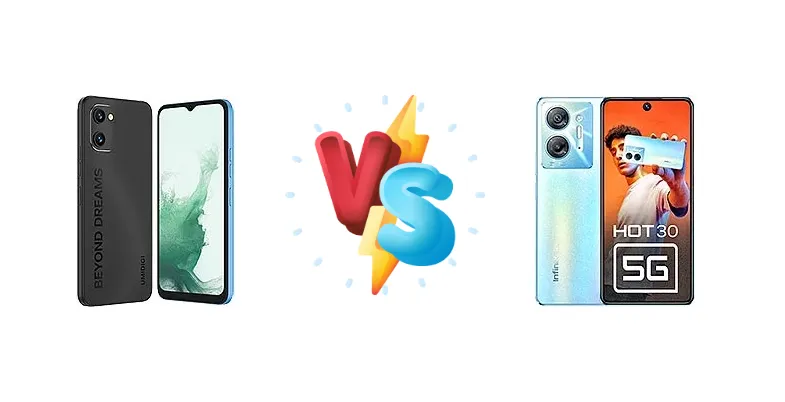
The sub-$200 smartphone market is fiercely competitive. The Umidigi G1 Plus offers a basic, functional experience, while the Infinix Hot 30 5G aims to deliver 5G connectivity and improved performance. This comparison dissects the key differences between these two devices, focusing on where each excels and who will benefit most from their respective strengths.
🏆 Quick Verdict
For the average user prioritizing 5G connectivity and a smoother overall experience, the Infinix Hot 30 5G is the clear winner. Its Dimensity 6020 chipset provides a significant performance uplift over the Umidigi G1 Plus’s MT8766, justifying the price difference. However, the G1 Plus remains a viable option for those on an extremely tight budget.
| Network |
|---|
| 2G bands | GSM 850 / 900 / 1800 / 1900 | GSM 850 / 900 / 1800 / 1900 |
| 3G bands | HSDPA 850 / 900 / 1700(AWS) / 1900 / 2100 | HSDPA 850 / 900 / 1700(AWS) / 1900 / 2100 |
| 4G bands | 1, 2, 3, 4, 5, 7, 8, 12, 17, 20, 28, 38, 40, 41 | LTE |
| 5G bands | - | 1, 3, 5, 8, 28, 38, 40, 41, 77, 78 SA/NSA |
| Speed | HSPA, LTE | HSPA, LTE, 5G |
| Technology | GSM / HSPA / LTE | GSM / HSPA / LTE / 5G |
| Launch |
|---|
| Announced | 2023 | 2023, July 14 |
| Status | Available. Released 2023 | Available. Released 2023, July 18 |
| Body |
|---|
| Build | - | Glass front, plastic frame, plastic back |
| Dimensions | 163.9 x 75.7 x 8.8 mm (6.45 x 2.98 x 0.35 in) | 168.5 x 76.5 x 9.2 mm (6.63 x 3.01 x 0.36 in) |
| SIM | Nano-SIM + Nano-SIM | Nano-SIM + Nano-SIM |
| Weight | 195 g (6.88 oz) | 215 g (7.58 oz) |
| Display |
|---|
| Resolution | 720 x 1600 pixels, 20:9 ratio (~269 ppi density) | 1080 x 2460 pixels (~396 ppi density) |
| Size | 6.52 inches, 102.6 cm2 (~82.7% screen-to-body ratio) | 6.78 inches, 109.2 cm2 (~84.7% screen-to-body ratio) |
| Type | IPS LCD | IPS LCD, 120Hz, 580 nits (peak) |
| Platform |
|---|
| CPU | Quad-core 1.5 GHz Cortex-A53 | Octa-core (2x2.2 GHz Cortex-A76 & 6x2.0 GHz Cortex-A55) |
| Chipset | Mediatek MT8766 | Mediatek Dimensity 6020 (7 nm) |
| GPU | PowerVR GE8300 | Mali-G57 MC2 |
| OS | Android 13 | Android 13, XOS 13 |
| Memory |
|---|
| Card slot | microSDXC (uses shared SIM slot) | microSDXC (dedicated slot) |
| Internal | 32GB 3GB RAM | 128GB 4GB RAM, 128GB 8GB RAM |
| Main Camera |
|---|
| Dual | 13 MP, f/2.2, (wide), AF
Auxiliary lens | - |
| Features | Dual-LED flash | Quad-LED flash, HDR, panorama |
| Single | - | 50 MP, f/1.6, (wide), 1/2.55", AF
Auxiliary lens |
| Video | 1080p@30fps | 1440p@30fps, 1080p@30fps |
| Selfie camera |
|---|
| Features | - | Dual-LED flash |
| Single | 5 MP, f/2.2, (wide) | 8 MP, f/2.0, (wide) |
| Video | 720p@30fps | 1080p@30fps |
| Sound |
|---|
| 35mm jack | Yes | Yes |
| Loudspeaker | Yes | Yes, with stereo speakers |
| Comms |
|---|
| Bluetooth | 4.2, A2DP | 5.1, A2DP, LE |
| NFC | No | No |
| Positioning | GPS, GLONASS, GALILEO, BDS | GPS, GLONASS, GALILEO, BDS |
| Radio | No | FM radio |
| USB | USB Type-C, OTG | USB Type-C 2.0 |
| WLAN | Wi-Fi 802.11 b/g/n/ac, dual-band, Wi-Fi Direct | Wi-Fi 802.11 a/b/g/n/ac, dual-band |
| Features |
|---|
| Sensors | Fingerprint (side-mounted), accelerometer, proximity, compass | Fingerprint (side-mounted), accelerometer, proximity, compass |
| Battery |
|---|
| Charging | 10W wired | 18W wired |
| Type | 5150 mAh | 5000 mAh |
| Misc |
|---|
| Colors | Starry Black, Galaxy Blue | Knight Black, Aurora Blue |
| Models | - | X6832 |
| Price | - | About 140 EUR |
Umidigi G1 Plus
- Lowest possible price point
- Functional for basic tasks
- Simple and straightforward software experience
- Outdated processor
- Slow charging speed
- Limited performance for demanding apps
Infinix Hot 30 5G
- 5G connectivity for faster data speeds
- Significantly faster processor
- Faster charging with 18W support
- Higher price than the Umidigi G1 Plus
- May still lack advanced features found in higher-end phones
- Software experience may include bloatware
Display Comparison
Neither device boasts a standout display. While specific display specs (resolution, panel type) are missing for the Umidigi G1 Plus, its price point suggests a basic LCD panel. The Infinix Hot 30 5G, similarly, likely features a standard LCD. The key difference lies in processing power impacting UI smoothness. The G1 Plus’s older chipset will struggle to drive even a basic display at a consistently high refresh rate, while the Dimensity 6020 in the Hot 30 5G will provide a more fluid experience.
Camera Comparison
Without detailed camera specifications, a direct comparison is difficult. However, both phones likely feature basic camera setups geared towards casual photography. The Umidigi G1 Plus likely relies on software processing to enhance image quality, while the Infinix Hot 30 5G benefits from the Dimensity 6020’s improved image signal processor (ISP). This ISP allows for faster image processing and potentially better low-light performance. The presence of a 5G modem in the Hot 30 5G also suggests a more modern overall platform, potentially extending to camera capabilities.
Performance
The performance gap is the most significant differentiator. The Umidigi G1 Plus’s Mediatek MT8766, with its quad-core Cortex-A53 CPU, is a dated chipset designed for entry-level tasks. The Infinix Hot 30 5G’s Mediatek Dimensity 6020, built on a more efficient 7nm process, features an octa-core configuration with two high-performance Cortex-A76 cores and six efficiency-focused Cortex-A55 cores. This translates to a substantial improvement in CPU and GPU performance, making the Hot 30 5G far better suited for gaming, multitasking, and demanding applications. The 7nm process also contributes to better thermal management, reducing the likelihood of throttling under sustained load.
Battery Life
The Infinix Hot 30 5G’s 18W wired charging is a clear advantage over the Umidigi G1 Plus’s 10W charging. While battery capacity isn’t specified for either device, the faster charging speed will significantly reduce the time spent tethered to a wall outlet. The Dimensity 6020’s 7nm efficiency also contributes to better battery life, allowing the Hot 30 5G to potentially last longer on a single charge despite potentially having a similar capacity battery.
Buying Guide
Buy the Umidigi G1 Plus if you need a functional smartphone for basic tasks like calls, texts, and light social media, and your budget is extremely limited. You're willing to accept slower performance and lack of 5G. Buy the Infinix Hot 30 5G if you prioritize 5G connectivity for faster data speeds, smoother multitasking, and a more responsive user experience, and are willing to spend a bit more for a noticeable performance boost.
Frequently Asked Questions
❓ Will the Dimensity 6020 in the Infinix Hot 30 5G overheat during extended gaming sessions?
The Dimensity 6020’s 7nm process and improved thermal management capabilities make overheating less likely than with the Umidigi G1 Plus’s older MT8766. While it won’t match the cooling performance of flagship phones, it should handle moderate gaming sessions without significant throttling.
❓ Is the 5G connectivity on the Infinix Hot 30 5G actually useful, or is it just a marketing gimmick?
5G connectivity is genuinely useful if you live in an area with 5G coverage. It provides significantly faster download and upload speeds compared to 4G, making streaming, browsing, and downloading large files much quicker. However, 5G coverage varies greatly, so check your local network availability.
❓ Can the Umidigi G1 Plus handle popular social media apps like TikTok and Instagram without significant lag?
The Umidigi G1 Plus can *run* these apps, but expect a less fluid experience. The MT8766’s limited processing power will result in noticeable lag when scrolling through feeds or recording videos. The Infinix Hot 30 5G will provide a much smoother and more responsive experience with these apps.
❓ What kind of storage options are available on each device, and can it be expanded with a microSD card?
Specific storage details are missing, but both devices likely offer limited internal storage (32GB or 64GB) and support microSD card expansion. This is crucial for budget phones, as it allows users to store more photos, videos, and apps.