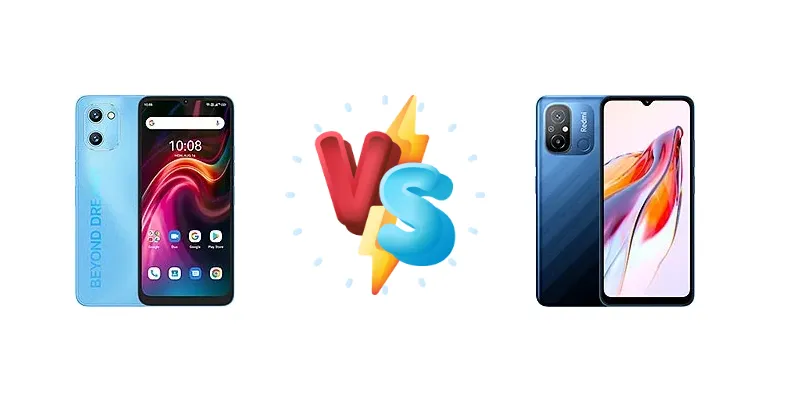
The sub-$150 smartphone market is fiercely competitive. Both the Umidigi G1 Max and the Xiaomi Redmi 12C aim to deliver essential smartphone functionality at an incredibly accessible price point. However, they take different approaches to achieving this, primarily through their chipset choices. This comparison will dissect the key differences to determine which device offers the best value for your money.
🏆 Quick Verdict
For most users, the Xiaomi Redmi 12C emerges as the slightly better choice. While both phones share a 10W charging rate, the Redmi 12C’s Helio G85 chipset provides a noticeable performance edge in everyday tasks and light gaming, making it more responsive and future-proof.
| Network |
|---|
| 2G bands | GSM 850 / 900 / 1800 / 1900 | GSM 850 / 900 / 1800 / 1900 |
| 3G bands | HSDPA 850 / 900 / 1700(AWS) / 1900 / 2100 | HSDPA 850 / 900 / 2100 |
| 4G bands | 1, 2, 3, 4, 5, 7, 8, 12, 17, 20, 28, 38, 40, 41 | 1, 3, 5, 7, 8, 20, 28, 38, 40, 41 - International |
| Speed | HSPA, LTE | HSPA, LTE |
| Technology | GSM / HSPA / LTE | GSM / CDMA / HSPA / EVDO / LTE |
| | - | CDMA2000 1xEV-DO |
| Launch |
|---|
| Announced | 2022 | 2022, December 31 |
| Status | Available. Released 2022 | Available. Released 2023, January 01 |
| Body |
|---|
| Dimensions | 163.9 x 75.7 x 8.8 mm (6.45 x 2.98 x 0.35 in) | 168.8 x 76.4 x 8.8 mm (6.65 x 3.01 x 0.35 in) |
| SIM | Nano-SIM + Nano-SIM | Nano-SIM + Nano-SIM |
| Weight | 192 g (6.77 oz) | 192 g (6.77 oz) |
| Display |
|---|
| Resolution | 720 x 1600 pixels, 20:9 ratio (~269 ppi density) | 720 x 1650 pixels (~268 ppi density) |
| Size | 6.52 inches, 102.6 cm2 (~82.7% screen-to-body ratio) | 6.71 inches, 106.5 cm2 (~82.6% screen-to-body ratio) |
| Type | IPS LCD | IPS LCD, 500 nits (typ) |
| Platform |
|---|
| CPU | Octa-core (2x1.8 GHz Cortex-A75 & 6x1.8 GHz Cortex-A55) | Octa-core (2x2.0 GHz Cortex-A75 & 6x1.8 GHz Cortex-A55) |
| Chipset | Unisoc T610 (12 nm) | Mediatek MT6769Z Helio G85 (12 nm) |
| GPU | Mali-G52 MP2 | Mali-G52 MC2 |
| OS | Android 12 | Android 12, MIUI 13 |
| Memory |
|---|
| Card slot | microSDXC (uses shared SIM slot) | microSDXC (dedicated slot) |
| Internal | 128GB 6GB RAM | 32GB 2GB RAM, 32GB 3GB RAM, 32GB 4GB RAM, 64GB 3GB RAM, 64GB 4GB RAM, 128GB 3GB RAM, 128GB 4GB RAM, 128GB 6GB RAM |
| | - | eMMC 5.1 |
| Main Camera |
|---|
| Dual | 50 MP, f/1.8, (wide), AF
Auxiliary lens | 50 MP, (wide), PDAF
0.08 MP (depth) |
| Features | Dual-LED flash, HDR, panorama | LED flash, HDR |
| Single | - | 50 MP, f/1.8, (wide), 1/2.76", PDAF
Auxiliary lens |
| Video | 1080p@30fps | 1080p@30fps |
| Selfie camera |
|---|
| Single | 8 MP, f/2.2, (wide) | 5 MP, f/2.2, (wide) |
| Video | 720p@30fps | 1080p@30fps |
| Sound |
|---|
| 3.5mm jack | - | Yes |
| 35mm jack | Yes | Yes |
| Loudspeaker | Yes | Yes |
| Comms |
|---|
| Bluetooth | 5.0, A2DP, LE | 5.1, A2DP, LE |
| NFC | No | Yes (market/region dependent) |
| Positioning | GPS, GALILEO, GLONASS, BDS | GPS, GLONASS, BDS, GALILEO |
| Radio | No | FM radio |
| USB | USB Type-C, OTG | microUSB 2.0 |
| WLAN | Wi-Fi 802.11 a/b/g/n/ac, dual-band, Wi-Fi Direct | Wi-Fi 802.11 a/b/g/n/ac, dual-band, Wi-Fi Direct |
| Features |
|---|
| Sensors | Fingerprint (side-mounted), accelerometer, proximity | Fingerprint (rear-mounted), accelerometer |
| | - | Virtual proximity sensing |
| Battery |
|---|
| Charging | 10W wired | 10W wired |
| Type | 5150 mAh | Li-Po 5000 mAh |
| Misc |
|---|
| Colors | Starry Black, Galaxy Blue | Graphite Gray, Ocean Blue, Mint Green, Lavender Purple |
| Models | - | 22120RN86G, 22120RN86I, 22126RN91Y, 2212ARNC4L |
| Price | - | £ 132.99 / € 107.41 |
| SAR | - | 1.08 W/kg (head) 0.64 W/kg (body) |
| SAR EU | - | 0.98 W/kg (head) 0.99 W/kg (body) |
Umidigi G1 Max
- Potentially lower price point
- Unisoc chipset offers decent efficiency for basic tasks
- Likely similar battery life to Redmi 12C
- Less powerful chipset than the Redmi 12C
- Unisoc chipset may have limited software support
- Potentially slower app loading times
Xiaomi Redmi 12C
- More powerful Helio G85 chipset
- Better GPU performance for gaming
- Xiaomi’s established software ecosystem
- May be slightly more expensive than the Umidigi G1 Max
- 10W charging is slow
- Software can include bloatware
Display Comparison
Neither device boasts a standout display. Both are likely utilizing LCD panels, common in this price bracket. The critical difference lies under the hood: display driver efficiency. While neither spec sheet details refresh rates or peak brightness, the Redmi 12C’s slightly more powerful GPU suggests it *could* handle a smoother visual experience if Xiaomi chose to implement it. However, given the focus on cost, expect similar viewing experiences in typical conditions.
Camera Comparison
Both phones likely feature a primary camera paired with depth and macro sensors. However, the specifications don't reveal sensor sizes or apertures. Given the price point, image quality will be heavily reliant on software processing. The Helio G85’s image signal processor (ISP) *may* offer slightly better noise reduction and dynamic range, but this is speculative. The inclusion of a 2MP macro camera on both devices is largely a marketing tactic; image quality will be limited. Focus should be on real-world samples to assess the primary camera's performance.
Performance
The core distinction between these phones is the chipset. The Xiaomi Redmi 12C’s MediaTek Helio G85 (12nm) has a slight clock speed advantage in its Cortex-A75 cores (2.0 GHz vs 1.8 GHz on the Umidigi’s Unisoc T610). While both use the same Cortex-A55 efficiency cores, the G85’s GPU (Mali-G52 MC2) is generally more capable than the T610’s (Mali-G52 MC1). This translates to smoother app launches, faster multitasking, and a more enjoyable gaming experience on the Redmi 12C. The Unisoc T610 isn’t *bad*, but it’s demonstrably less powerful.
Battery Life
Both devices are equipped with 10W wired charging, indicating similar charging speeds – expect around 2.5-3 hours for a full charge. Battery capacity isn't specified, but given the target market, both are likely in the 5000mAh range. The slightly more efficient Helio G85 in the Redmi 12C *could* translate to marginally better battery life, but usage patterns will be the dominant factor. Neither phone is designed for all-day heavy use.
Buying Guide
Buy the Umidigi G1 Max if you prioritize a potentially lower price and are primarily focused on basic smartphone functions like calling, texting, and light social media use. Buy the Xiaomi Redmi 12C if you want a more responsive experience, slightly better gaming performance, and a brand with a more established software ecosystem, even if it means spending a little more.
Frequently Asked Questions
❓ Will the Redmi 12C handle popular games like PUBG Mobile or Call of Duty Mobile?
The Helio G85 in the Redmi 12C can run PUBG Mobile and Call of Duty Mobile, but you’ll likely need to stick to lower graphics settings (Medium or Low) and frame rates to maintain a smooth experience. The Umidigi G1 Max will struggle more with these titles.
❓ How does the software experience differ between Umidigi and Xiaomi?
Xiaomi’s MIUI is a heavily customized Android skin with a large user base and frequent updates (though often with bloatware). Umidigi typically uses a near-stock Android experience, which some users prefer for its simplicity, but it may receive fewer software updates and security patches.
❓ Is the 10W charging speed a significant drawback on either phone?
Yes, 10W charging is quite slow by modern standards. Expect over 2.5 hours to fully charge either device. Neither phone prioritizes fast charging to keep costs down. Consider this a trade-off for the low price point.