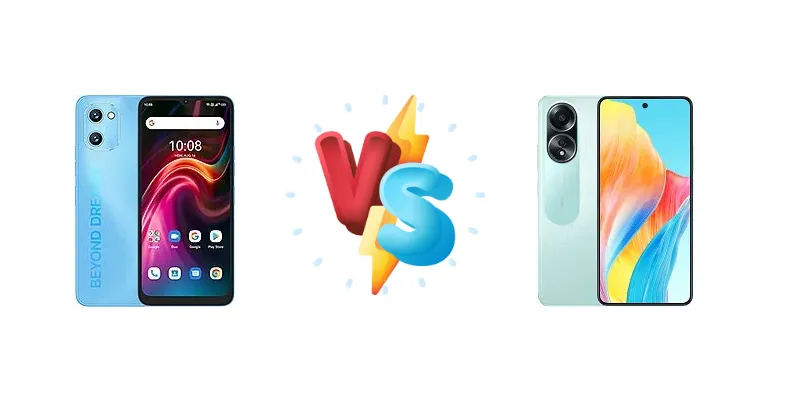
The sub-$200 smartphone market is fiercely competitive. The Umidigi G1 Max and Oppo A58 4G both aim to deliver a solid experience without breaking the bank, but they take different approaches. The G1 Max focuses on a larger display and potentially lower price, while the A58 4G prioritizes faster charging and a more established brand reputation. This comparison dives deep into the key differences to help you choose the right device.
🏆 Quick Verdict
For the average user prioritizing quick top-ups and a more refined software experience, the Oppo A58 4G is the better choice. Its 33W charging significantly outperforms the Umidigi G1 Max’s 10W, and the Helio G85 chipset offers a slight performance edge. However, the G1 Max may appeal to those on a tighter budget.
| Network |
|---|
| 2G bands | GSM 850 / 900 / 1800 / 1900 | GSM 900 / 1800 |
| 3G bands | HSDPA 850 / 900 / 1700(AWS) / 1900 / 2100 | HSDPA 900 / 2100 |
| 4G bands | 1, 2, 3, 4, 5, 7, 8, 12, 17, 20, 28, 38, 40, 41 | 1, 3, 5, 8, 40 |
| Speed | HSPA, LTE | HSPA, LTE |
| Technology | GSM / HSPA / LTE | GSM / HSPA / LTE |
| Launch |
|---|
| Announced | 2022 | 2023, July 26 |
| Status | Available. Released 2022 | Available. Released 2023, July 28 |
| Body |
|---|
| Build | - | Glass front, plastic frame, plastic back |
| Dimensions | 163.9 x 75.7 x 8.8 mm (6.45 x 2.98 x 0.35 in) | 165.7 x 76 x 8 mm (6.52 x 2.99 x 0.31 in) |
| SIM | Nano-SIM + Nano-SIM | Nano-SIM + Nano-SIM |
| Weight | 192 g (6.77 oz) | 192 g (6.77 oz) |
| Display |
|---|
| Resolution | 720 x 1600 pixels, 20:9 ratio (~269 ppi density) | 1080 x 2400 pixels, 20:9 ratio (~392 ppi density) |
| Size | 6.52 inches, 102.6 cm2 (~82.7% screen-to-body ratio) | 6.72 inches, 109.0 cm2 (~86.6% screen-to-body ratio) |
| Type | IPS LCD | IPS LCD, 550 nits (typ), 680 nits (HBM) |
| Platform |
|---|
| CPU | Octa-core (2x1.8 GHz Cortex-A75 & 6x1.8 GHz Cortex-A55) | Octa-core (2x2.0 GHz Cortex-A75 & 6x1.8 GHz Cortex-A55) |
| Chipset | Unisoc T610 (12 nm) | Mediatek MT6769 Helio G85 (12 nm) |
| GPU | Mali-G52 MP2 | Mali-G52 MC2 |
| OS | Android 12 | Android 13, upgradable to Android 15, ColorOS 15 |
| Memory |
|---|
| Card slot | microSDXC (uses shared SIM slot) | microSDXC |
| Internal | 128GB 6GB RAM | 128GB 6GB RAM, 128GB 8GB RAM, 256GB 8GB RAM |
| Main Camera |
|---|
| Dual | 50 MP, f/1.8, (wide), AF
Auxiliary lens | 50 MP, f/1.8, (wide), AF
Auxiliary lens |
| Features | Dual-LED flash, HDR, panorama | LED flash, HDR, panorama |
| Video | 1080p@30fps | 1080p@30fps |
| Selfie camera |
|---|
| Features | - | Panorama |
| Single | 8 MP, f/2.2, (wide) | 8 MP, f/2.0, (wide) |
| Video | 720p@30fps | 1080p@30fps |
| Sound |
|---|
| 35mm jack | Yes | Yes |
| Loudspeaker | Yes | Yes, with stereo speakers |
| Comms |
|---|
| Bluetooth | 5.0, A2DP, LE | 5.3, A2DP, LE, aptX HD |
| Infrared port | - | Yes |
| NFC | No | Yes |
| Positioning | GPS, GALILEO, GLONASS, BDS | GPS, GALILEO, GLONASS, BDS, QZSS |
| Radio | No | No |
| USB | USB Type-C, OTG | USB Type-C 2.0, OTG |
| WLAN | Wi-Fi 802.11 a/b/g/n/ac, dual-band, Wi-Fi Direct | Wi-Fi 802.11 a/b/g/n/ac, dual-band |
| Features |
|---|
| Sensors | Fingerprint (side-mounted), accelerometer, proximity | Fingerprint (side-mounted), accelerometer, proximity, compass |
| Battery |
|---|
| Charging | 10W wired | 33W wired, 56% in 30 min |
| Type | 5150 mAh | Li-Po 5000 mAh |
| Misc |
|---|
| Colors | Starry Black, Galaxy Blue | Glowing Black, Dazzling Green |
| Models | - | CPH2577 |
| Price | - | About 150 EUR |
Umidigi G1 Max
- Potentially lower price point
- Larger display size (assumed)
- May offer more storage for the price
- Significantly slower 10W charging
- Less powerful Unisoc T610 chipset
- Less established brand reputation
Oppo A58 4G
- Faster 33W wired charging (56% in 30 min)
- More powerful Mediatek Helio G85 chipset
- Established brand with better software support
- May be slightly more expensive
- Potentially smaller display size
- Software bloatware (typical of Oppo)
Display Comparison
Neither device boasts a standout display. Both utilize 12nm chipsets, suggesting a focus on cost optimization over premium display features. While specific display specs (resolution, panel type) are missing, the focus here is on performance. The larger size of the G1 Max may be preferable for media consumption, but without knowing the panel technology, it's difficult to assess color accuracy or brightness. Bezels are likely comparable given the price point.
Camera Comparison
Without detailed camera specifications, a direct comparison is challenging. Both phones likely feature a multi-camera setup, but the quality will heavily depend on sensor size and image processing. It's reasonable to assume both will include a primary sensor, a depth sensor, and potentially a macro lens. Given the market segment, image processing will likely prioritize scene recognition and software enhancements over raw image quality. The absence of OIS on either device suggests reliance on software stabilization.
Performance
The Oppo A58 4G holds a clear advantage in processing power. Both phones employ an octa-core CPU configuration with 2x Cortex-A75 and 6x Cortex-A55 cores, but the A58 4G’s Helio G85 operates at a higher clock speed of 2.0 GHz compared to the G1 Max’s Unisoc T610’s 1.8 GHz. This translates to snappier app launches and smoother multitasking. While both chipsets are 12nm, the Helio G85 generally exhibits better GPU performance, making it more suitable for casual gaming. The G1 Max will handle everyday tasks, but the A58 4G offers a more responsive experience.
Battery Life
The Oppo A58 4G’s 33W wired charging is a game-changer in this price bracket. The ability to reach 56% charge in just 30 minutes is a significant convenience. The Umidigi G1 Max, limited to 10W charging, will take considerably longer to fully charge. While battery capacity isn’t specified, the faster charging of the A58 4G effectively mitigates any potential capacity disadvantage. Users who frequently top up their phones will greatly benefit from the A58 4G’s charging speed.
Buying Guide
Buy the Umidigi G1 Max if you need a large screen on the absolute lowest budget and aren't concerned about fast charging or brand recognition. Buy the Oppo A58 4G if you prefer a more polished user experience, faster charging speeds to minimize downtime, and the reliability of a well-known brand like Oppo. The A58 4G is ideal for users who frequently find themselves needing to quickly replenish their battery.
Frequently Asked Questions
❓ Is the Helio G85 in the Oppo A58 4G capable of handling demanding games like PUBG Mobile?
The Helio G85 is a capable chipset for casual gaming. PUBG Mobile should be playable at medium settings with reasonable frame rates. However, don't expect a flagship-level gaming experience. The G85 prioritizes efficiency over raw power.
❓ How long will it realistically take to fully charge the Umidigi G1 Max with its 10W charger?
With a 10W charger, a full charge for the Umidigi G1 Max will likely take between 3 to 4 hours, depending on the battery capacity. This is a significant drawback compared to the Oppo A58 4G's 33W fast charging.
❓ Does the Oppo A58 4G have a noticeable amount of pre-installed bloatware?
Oppo phones are known to include some pre-installed apps (bloatware). While the amount varies, users can typically uninstall or disable most of these apps to free up storage and improve performance.
❓ Which phone is likely to receive more software updates and security patches?
Oppo, as a larger and more established brand, is more likely to provide consistent software updates and security patches for the A58 4G compared to Umidigi. This is an important consideration for long-term security and functionality.