
Umidigi F3S vs Xiaomi Redmi Note 11R: A Deep Dive into Budget 5G
| Phones Images | |||||
|---|---|---|---|---|---|
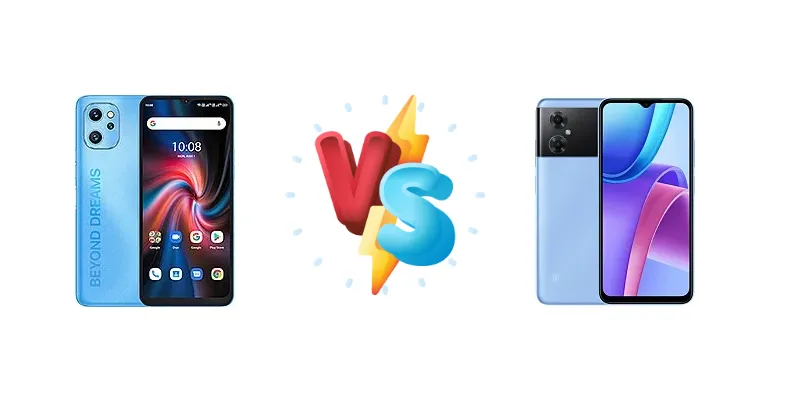
|
🏆 Quick Verdict
For most users, the Xiaomi Redmi Note 11R is the superior choice. Its Mediatek Dimensity 700 chipset, built on a more efficient 7nm process, provides a noticeable performance advantage over the Umidigi F3S’s Unisoc T610. While the F3S offers a slightly lower entry price, the 11R’s faster charging and superior processing power justify the small premium.
| PHONES | ||
|---|---|---|
| Phone Names | Umidigi F3S | Xiaomi Redmi Note 11R |
| Network | ||
|---|---|---|
| 2G bands | GSM 850 / 900 / 1800 / 1900 | GSM 850 / 900 / 1800 / 1900 |
| 3G bands | HSDPA 800 / 850 / 900 / 1700(AWS) / 1900 / 2100 | HSDPA 850 / 900 / 1900 / 2100 |
| 4G bands | 1, 2, 3, 4, 5, 7, 8, 12, 13, 17, 18, 19, 20, 25, 26, 28, 34, 38, 39, 40, 41, 66 | 1, 3, 5, 7, 8, 34, 38, 39, 40, 41 |
| 5G bands | - | 1, 5, 8, 28, 41, 78 |
| Speed | HSPA, LTE | HSPA, LTE, 5G |
| Technology | GSM / HSPA / LTE | GSM / CDMA / HSPA / LTE / 5G |
| - | CDMA 800 | |
| Launch | ||
|---|---|---|
| Announced | 2022 | 2022, September 30 |
| Status | Available. Released 2022 | Available. Released 2022, September 30 |
| Body | ||
|---|---|---|
| Build | - | Glass front, plastic frame, plastic back |
| Dimensions | 168.3 x 76.6 x 8.8 mm (6.63 x 3.02 x 0.35 in) | 164 x 76.1 x 8.9 mm (6.46 x 3.00 x 0.35 in) |
| SIM | Nano-SIM + Nano-SIM | Nano-SIM + Nano-SIM |
| Weight | 195 g (6.88 oz) | 201 g (7.09 oz) |
| Display | ||
|---|---|---|
| Resolution | 720 x 1650 pixels (~269 ppi density) | 1080 x 2408 pixels, 20:9 ratio (~401 ppi density) |
| Size | 6.7 inches, 106.2 cm2 (~82.3% screen-to-body ratio) | 6.58 inches, 104.3 cm2 (~83.6% screen-to-body ratio) |
| Type | IPS LCD | IPS LCD, 90Hz, 400 nits (typ) |
| Platform | ||
|---|---|---|
| CPU | Octa-core (2x1.8 GHz Cortex-A75 & 6x1.8 GHz Cortex-A55) | Octa-core (2x2.2 GHz Cortex-A76 & 6x2.0 GHz Cortex-A55) |
| Chipset | Unisoc T610 (12 nm) | Mediatek Dimensity 700 (7 nm) |
| GPU | Mali-G52 MP2 | Mali-G57 MC2 |
| OS | Android 11 | Android 12, MIUI 13 |
| Memory | ||
|---|---|---|
| Card slot | microSDXC (uses shared SIM slot) | microSDXC (dedicated slot) |
| Internal | 128GB 6GB RAM | 128GB 4GB RAM, 128GB 6GB RAM, 128GB 8GB RAM |
| - | UFS 2.2 | |
| Main Camera | ||
|---|---|---|
| Dual | - | 13 MP, f/2.2, (wide), PDAF Auxiliary lens |
| Features | Dual-LED flash, HDR, panorama | LED flash, HDR, panorama |
| Triple | 48 MP, f/1.8, (wide), 1/2.0", AF 8 MP, f/2.2, 120˚ (ultrawide) 5 MP (macro) | - |
| Video | 1080p@30fps | 1080p@30fps |
| Selfie camera | ||
|---|---|---|
| Features | - | HDR |
| Single | 16 MP, f/2.2, (wide) | 5 MP, f/2.2, (wide) |
| Video | 1080p@30fps | 1080p@30fps |
| Sound | ||
|---|---|---|
| 3.5mm jack | - | Yes |
| 35mm jack | Yes | Yes |
| Loudspeaker | Yes | Yes |
| - | 24-bit/192kHz audio | |
| Comms | ||
|---|---|---|
| Bluetooth | 5.0, A2DP, LE | 5.1, A2DP, LE |
| Infrared port | - | Yes |
| NFC | Yes | No |
| Positioning | GPS, GALILEO, GLONASS, BDS | GPS, GLONASS, GALILEO, BDS |
| Radio | Wireless FM radio | No |
| USB | USB Type-C, OTG | USB Type-C 2.0, OTG |
| WLAN | Wi-Fi 802.11 b/g/n/ac, dual-band, Wi-Fi Direct | Wi-Fi 802.11 a/b/g/n/ac, dual-band, Wi-Fi Direct |
| Features | ||
|---|---|---|
| Sensors | Fingerprint (side-mounted), accelerometer, proximity, compass | Fingerprint (side-mounted), accelerometer, proximity, compass |
| Battery | ||
|---|---|---|
| Charging | 10W wired | 18W wired |
| Type | 5150 mAh | Li-Po 5000 mAh |
| Misc | ||
|---|---|---|
| Colors | Hawaii Blue, Matte Silver, Starry Black, Sunglow Gold, Galaxy Blue | Black, Blue, Gray |
| Models | - | 22095RA98C |
| Price | - | About 160 EUR |
Umidigi F3S
- Lowest possible price point
- Functional for basic tasks
- Acceptable battery life (assuming 5000mAh)
- Slow Unisoc T610 processor
- Slow 10W charging
- Limited multitasking capabilities
Xiaomi Redmi Note 11R
- Faster Mediatek Dimensity 700 processor
- Faster 18W charging
- Smoother user experience
- 5G connectivity
- Slightly higher price
- Display quality likely similar to F3S
Display Comparison
Neither device boasts a standout display. Given the price point, details like panel type (likely IPS LCD for both) and resolution are not specified. However, the focus should be on the processing power needed to drive the display. The Redmi Note 11R’s more powerful GPU will likely handle scrolling and animations more smoothly, even if the raw resolution is similar. Bezels are expected to be comparable on both devices, reflecting their budget nature.
Camera Comparison
Without detailed sensor information, a direct camera comparison is difficult. However, it’s safe to assume both phones feature a primary camera and potentially a depth or macro sensor. The Redmi Note 11R’s image signal processor (ISP), integrated within the Dimensity 700, is likely more advanced than the one in the Unisoc T610, resulting in better image processing, particularly in low-light conditions. The aperture of the main lens will be a key factor, but without that data, we can only infer that the Redmi Note 11R has a processing edge.
Performance
The core difference lies in the chipsets. The Xiaomi Redmi Note 11R’s Mediatek Dimensity 700, fabricated on a 7nm process, is a significant upgrade over the Umidigi F3S’s Unisoc T610 (12nm). The Dimensity 700 utilizes Cortex-A76 cores clocked at 2.2 GHz, offering substantially better single-core performance than the F3S’s Cortex-A75 cores at 1.8 GHz. This translates to faster app launches, smoother multitasking, and a more responsive overall experience. The 7nm process also contributes to better thermal efficiency, reducing the likelihood of throttling during sustained workloads. While both have octa-core CPUs, the architectural advantage of the Dimensity 700 is undeniable.
Battery Life
Battery capacity isn’t specified for either device, but both likely fall in the 5000mAh range, typical for this price bracket. The critical difference is charging speed. The Redmi Note 11R supports 18W wired charging, significantly faster than the Umidigi F3S’s 10W charging. This means the 11R can replenish its battery much quicker, minimizing downtime. While a larger battery capacity is always desirable, the faster charging of the Redmi Note 11R effectively mitigates any potential capacity disadvantage.
Buying Guide
Buy the Umidigi F3S if you prioritize absolute lowest cost and are primarily focused on basic smartphone tasks like calling, texting, and light social media browsing. You’ll need to be patient with charging times and accept limited multitasking capabilities. Buy the Xiaomi Redmi Note 11R if you value smoother performance, faster app loading, and quicker charging, even if it means spending a bit more. This phone is better suited for users who enjoy occasional gaming or demand a more responsive user experience.