
Umidigi F3S vs vivo Y76s: A Detailed Comparison of Budget 5G Smartphones
| Phones Images | |||||
|---|---|---|---|---|---|
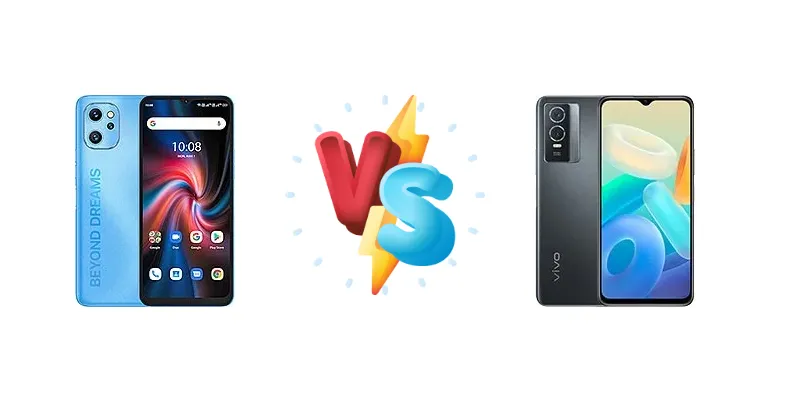
|
🏆 Quick Verdict
For most users, the vivo Y76s is the superior choice. Its Dimensity 810 chipset offers significantly faster performance, and the 44W charging is a game-changer compared to the F3S's 10W trickle-charge. While the F3S is cheaper, the Y76s' improved experience justifies the price difference.
| PHONES | ||
|---|---|---|
| Phone Names | Umidigi F3S | vivo Y76s |
| Network | ||
|---|---|---|
| 2G bands | GSM 850 / 900 / 1800 / 1900 | GSM 850 / 900 / 1800 / 1900 |
| 3G bands | HSDPA 800 / 850 / 900 / 1700(AWS) / 1900 / 2100 | HSDPA 850 / 900 / 1700(AWS) / 2100 |
| 4G bands | 1, 2, 3, 4, 5, 7, 8, 12, 13, 17, 18, 19, 20, 25, 26, 28, 34, 38, 39, 40, 41, 66 | 1, 3, 4, 5, 8, 28, 34, 38, 39, 40, 41 |
| 5G bands | - | 1, 5, 8, 28, 41, 77, 78 SA/NSA |
| Speed | HSPA, LTE | HSPA, LTE, 5G |
| Technology | GSM / HSPA / LTE | GSM / CDMA / HSPA / CDMA2000 / LTE / 5G |
| - | CDMA2000 1x | |
| Launch | ||
|---|---|---|
| Announced | 2022 | 2021, November 10 |
| Status | Available. Released 2022 | Available. Released 2021, November 20 |
| Body | ||
|---|---|---|
| Build | - | Glass front, plastic frame, plastic back |
| Dimensions | 168.3 x 76.6 x 8.8 mm (6.63 x 3.02 x 0.35 in) | 163.8 x 75 x 7.8 mm (6.45 x 2.95 x 0.31 in) |
| SIM | Nano-SIM + Nano-SIM | Nano-SIM + Nano-SIM |
| Weight | 195 g (6.88 oz) | 175 g (6.17 oz) |
| Display | ||
|---|---|---|
| Resolution | 720 x 1650 pixels (~269 ppi density) | 1080 x 2408 pixels, 20:9 ratio (~401 ppi density) |
| Size | 6.7 inches, 106.2 cm2 (~82.3% screen-to-body ratio) | 6.58 inches, 104.3 cm2 (~84.9% screen-to-body ratio) |
| Type | IPS LCD | IPS LCD |
| Platform | ||
|---|---|---|
| CPU | Octa-core (2x1.8 GHz Cortex-A75 & 6x1.8 GHz Cortex-A55) | Octa-core (2x2.4 GHz Cortex-A76 & 6x2.0 GHz Cortex-A55) |
| Chipset | Unisoc T610 (12 nm) | Mediatek Dimensity 810 (6 nm) |
| GPU | Mali-G52 MP2 | Mali-G57 MC2 |
| OS | Android 11 | Android 11, OriginOS |
| Memory | ||
|---|---|---|
| Card slot | microSDXC (uses shared SIM slot) | microSDXC |
| Internal | 128GB 6GB RAM | 128GB 8GB RAM, 256GB 8GB RAM, 256GB 12GB RAM |
| Main Camera | ||
|---|---|---|
| Dual | - | 50 MP, f/1.8, 26mm (wide), PDAF 2 MP (macro) |
| Features | Dual-LED flash, HDR, panorama | LED flash, HDR, panorama |
| Single | - | 8 MP, f/2.0, (wide) |
| Triple | 48 MP, f/1.8, (wide), 1/2.0", AF 8 MP, f/2.2, 120˚ (ultrawide) 5 MP (macro) | - |
| Video | 1080p@30fps | 1080p@30fps |
| Selfie camera | ||
|---|---|---|
| Single | 16 MP, f/2.2, (wide) | 8 MP, f/2.0, (wide) |
| Video | 1080p@30fps | 1080p@30fps |
| Sound | ||
|---|---|---|
| 3.5mm jack | - | Yes |
| 35mm jack | Yes | Yes |
| Loudspeaker | Yes | Yes |
| Comms | ||
|---|---|---|
| Bluetooth | 5.0, A2DP, LE | 5.1, A2DP, LE, aptX HD |
| NFC | Yes | No |
| Positioning | GPS, GALILEO, GLONASS, BDS | GPS, GLONASS, GALILEO, BDS, QZSS |
| Radio | Wireless FM radio | No |
| USB | USB Type-C, OTG | USB Type-C, OTG |
| WLAN | Wi-Fi 802.11 b/g/n/ac, dual-band, Wi-Fi Direct | Wi-Fi 802.11 a/b/g/n/ac, dual-band, Wi-Fi Direct |
| Features | ||
|---|---|---|
| Sensors | Fingerprint (side-mounted), accelerometer, proximity, compass | Fingerprint (side-mounted), accelerometer, gyro, proximity, compass |
| Battery | ||
|---|---|---|
| Charging | 10W wired | 44W wired, 70% in 34 min |
| Type | 5150 mAh | 4100 mAh |
| Misc | ||
|---|---|---|
| Colors | Hawaii Blue, Matte Silver, Starry Black, Sunglow Gold, Galaxy Blue | Black, Aurora, Silver |
| Models | - | V2156A |
| Price | - | About 240 EUR |
Umidigi F3S
- Extremely affordable price point
- 5G connectivity for future-proofing
- Acceptable for basic smartphone tasks
- Slow 10W charging
- Unisoc T610 chipset offers limited performance
- Likely to struggle with demanding apps and games
vivo Y76s
- Significantly faster Dimensity 810 chipset
- 44W fast charging (70% in 34 minutes)
- Smoother user experience and better multitasking
- Higher price compared to the Umidigi F3S
- May not have a dramatically superior camera system
- Still a budget device with potential compromises in build quality
Display Comparison
Neither device boasts a standout display. While specific panel details (like OLED vs. LCD) are missing, the focus here is on performance. The lack of high refresh rates on either phone suggests a focus on power efficiency. Bezels are likely comparable given the price points, and color accuracy will likely be standard for this segment. The real differentiator will be brightness, which is not specified, but the Y76s' more powerful chipset *could* allow for a brighter panel.
Camera Comparison
Without detailed camera specs, it's difficult to make a definitive judgment. However, the chipset difference indirectly impacts camera performance. The Dimensity 810's more powerful ISP (Image Signal Processor) will enable faster image processing and potentially better low-light performance. It's likely both phones feature a primary camera and depth/macro sensors, but the Y76s' ISP will likely extract more detail and dynamic range from its sensor. We can assume both phones will struggle with complex scenes or challenging lighting conditions.
Performance
The performance gap is substantial. The vivo Y76s' Mediatek Dimensity 810 (6nm) is a clear upgrade over the Umidigi F3S's Unisoc T610 (12nm). The Dimensity 810 utilizes more efficient Cortex-A76 cores clocked at 2.4 GHz, compared to the F3S's Cortex-A75 cores at 1.8 GHz. This translates to a noticeable difference in app launch speeds, multitasking, and gaming performance. The 6nm process node also means the Dimensity 810 will generate less heat under load, reducing throttling. The F3S will be adequate for basic tasks, but the Y76s offers a far more responsive experience.
Battery Life
The battery capacity isn't specified for either device, but the charging speeds tell a crucial story. The vivo Y76s' 44W wired charging, capable of reaching 70% in 34 minutes, is a massive advantage over the Umidigi F3S's slow 10W charging. Even if the F3S has a slightly larger battery, the Y76s' faster charging will minimize downtime. This is a significant benefit for users who frequently use their phones throughout the day.
Buying Guide
Buy the Umidigi F3S if your primary need is an extremely affordable 5G phone for basic tasks like calls, messaging, and light social media. You're willing to compromise on performance and charging speed to stay within a tight budget. Buy the vivo Y76s if you prioritize a smoother user experience, faster app loading times, and significantly quicker charging, even if it means spending a bit more. This phone is better suited for casual gaming and multitasking.