
Umidigi F3S vs Samsung Galaxy A23 5G: A Detailed Comparison of Budget 5G Contenders
| Phones Images | |||||
|---|---|---|---|---|---|
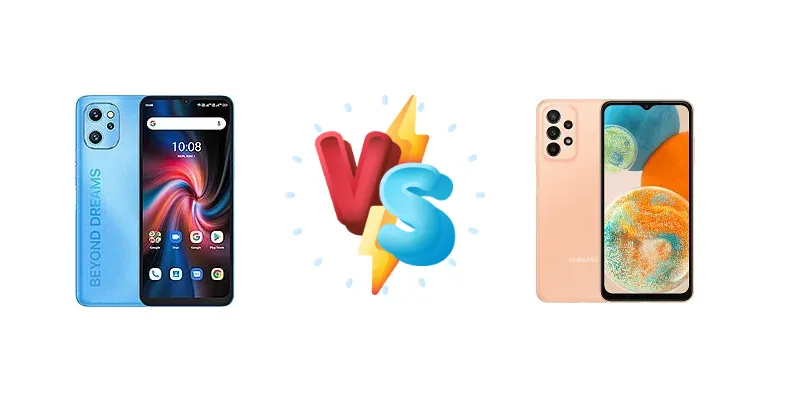
|
🏆 Quick Verdict
For the average user prioritizing consistent performance and faster charging, the Samsung Galaxy A23 5G is the better choice. Its Snapdragon 695 chipset, built on a more efficient 6nm process, provides a noticeable performance edge over the Umidigi F3S’s Unisoc T610, despite the slower RAM. However, the F3S remains a viable option for those on a very tight budget.
| PHONES | ||
|---|---|---|
| Phone Names | Umidigi F3S | Samsung Galaxy A23 5G |
| Network | ||
|---|---|---|
| 2G bands | GSM 850 / 900 / 1800 / 1900 | GSM 850 / 900 / 1800 / 1900 |
| 3G bands | HSDPA 800 / 850 / 900 / 1700(AWS) / 1900 / 2100 | HSDPA 850 / 900 / 1700(AWS) / 1900 / 2100 |
| 4G bands | 1, 2, 3, 4, 5, 7, 8, 12, 13, 17, 18, 19, 20, 25, 26, 28, 34, 38, 39, 40, 41, 66 | 1, 2, 3, 4, 5, 7, 8, 12, 17, 20, 26, 28, 32, 38, 40, 41, 66 - International |
| 5G bands | - | 1, 3, 7, 8, 20, 28, 38, 40, 41, 77, 78 SA/NSA/Sub6 - International |
| Speed | HSPA, LTE | HSPA, LTE, 5G |
| Technology | GSM / HSPA / LTE | GSM / HSPA / LTE / 5G |
| - | 2, 5, 30, 66, 77 SA/NSA/Sub6/mmWave - USA | |
| Launch | ||
|---|---|---|
| Announced | 2022 | 2022, August 05 |
| Status | Available. Released 2022 | Available. Released 2022, September 02 |
| Body | ||
|---|---|---|
| Build | - | Glass front (Gorilla Glass 5), plastic frame, plastic back |
| Dimensions | 168.3 x 76.6 x 8.8 mm (6.63 x 3.02 x 0.35 in) | 165.4 x 76.9 x 8.4 mm (6.51 x 3.03 x 0.33 in) |
| SIM | Nano-SIM + Nano-SIM | · Nano-SIM· Nano-SIM + Nano-SIM |
| Weight | 195 g (6.88 oz) | 197 g (6.95 oz) |
| Display | ||
|---|---|---|
| Protection | - | Corning Gorilla Glass 5 |
| Resolution | 720 x 1650 pixels (~269 ppi density) | 1080 x 2408 pixels, 20:9 ratio (~400 ppi density) |
| Size | 6.7 inches, 106.2 cm2 (~82.3% screen-to-body ratio) | 6.6 inches, 104.9 cm2 (~82.5% screen-to-body ratio) |
| Type | IPS LCD | PLS LCD, 120Hz |
| Platform | ||
|---|---|---|
| CPU | Octa-core (2x1.8 GHz Cortex-A75 & 6x1.8 GHz Cortex-A55) | Octa-core (2x2.2 GHz Kryo 660 Gold & 6x1.7 GHz Kryo 660 Silver) |
| Chipset | Unisoc T610 (12 nm) | Qualcomm SM6375 Snapdragon 695 5G (6 nm) |
| GPU | Mali-G52 MP2 | Adreno 619 |
| OS | Android 11 | Android 12, upgradable to Android 14, One UI 6 |
| Memory | ||
|---|---|---|
| Card slot | microSDXC (uses shared SIM slot) | microSDXC (dedicated slot) |
| Internal | 128GB 6GB RAM | 64GB 4GB RAM, 64GB 6GB RAM, 128GB 4GB RAM, 128GB 6GB RAM, 128GB 8GB RAM |
| Main Camera | ||
|---|---|---|
| Features | Dual-LED flash, HDR, panorama | LED flash, panorama, HDR |
| Quad | - | 50 MP, f/1.8, 26mm (wide), 1/2.76", 0.64µm, PDAF, OIS 5 MP, f/2.2, 13mm, 123˚ (ultrawide), 1/5.0", 1.12µm 2 MP (macro) Auxiliary lens |
| Triple | 48 MP, f/1.8, (wide), 1/2.0", AF 8 MP, f/2.2, 120˚ (ultrawide) 5 MP (macro) | - |
| Video | 1080p@30fps | 1080p@30fps |
| Selfie camera | ||
|---|---|---|
| Single | 16 MP, f/2.2, (wide) | 8 MP, f/2.0, 25mm (wide), 1/4.0", 1.12µm - USA 8 MP, f/2.2, 25mm (wide), 1/4.0", 1.12µm - International |
| Video | 1080p@30fps | 1080p@30fps |
| Sound | ||
|---|---|---|
| 3.5mm jack | - | Yes |
| 35mm jack | Yes | Yes |
| Loudspeaker | Yes | Yes |
| Comms | ||
|---|---|---|
| Bluetooth | 5.0, A2DP, LE | 5.1, A2DP, LE |
| NFC | Yes | Yes |
| Positioning | GPS, GALILEO, GLONASS, BDS | GPS, GLONASS, GALILEO, BDS |
| Radio | Wireless FM radio | FM radio (market/region dependent) |
| USB | USB Type-C, OTG | USB Type-C 2.0 |
| WLAN | Wi-Fi 802.11 b/g/n/ac, dual-band, Wi-Fi Direct | Wi-Fi 802.11 a/b/g/n/ac, dual-band, Wi-Fi Direct |
| Features | ||
|---|---|---|
| Sensors | Fingerprint (side-mounted), accelerometer, proximity, compass | Fingerprint (side-mounted), accelerometer, gyro, compass, barometer (USA only) |
| - | Virtual proximity sensing | |
| Battery | ||
|---|---|---|
| Charging | 10W wired | 25W wired |
| Type | 5150 mAh | Li-Po 5000 mAh |
| Misc | ||
|---|---|---|
| Colors | Hawaii Blue, Matte Silver, Starry Black, Sunglow Gold, Galaxy Blue | Black, White, Peach, Blue |
| Models | - | SM-A236U, SM-A236U1, SM-A236B, SM-A236B/DS, SM-A236B/DSN, SM-A236E, SM-S236DL |
| Price | - | $ 84.44 / £ 129.00 / € 125.28 / ₹ 21,000 |
| SAR | - | 0.68 W/kg (head) 0.57 W/kg (body) |
| SAR EU | - | 1.49 W/kg (head) 1.25 W/kg (body) |
| Tests | ||
|---|---|---|
| Battery life | - | Endurance rating 138h |
| Camera | - | Photo / Video |
| Display | - | Contrast ratio: 1328:1 (nominal) |
| Loudspeaker | - | -25.9 LUFS (Very good) |
| Performance | - | AnTuTu: 318821 (v9) GeekBench: 1940 (v5.1) GFXBench: 16fps (ES 3.1 onscreen) |
Umidigi F3S
- Lower price point makes it accessible to budget-conscious buyers.
- 5G connectivity offers future-proofed data speeds.
- Functional smartphone experience for basic tasks.
- Unisoc T610 chipset is less powerful and efficient than the Snapdragon 695.
- Slow 10W charging is a significant drawback.
- Likely inferior camera performance compared to the A23 5G.
Samsung Galaxy A23 5G
- Snapdragon 695 chipset delivers superior performance and efficiency.
- 25W fast charging significantly reduces charging times.
- Brighter display enhances outdoor visibility.
- Samsung’s software support and brand reputation.
- Higher price compared to the Umidigi F3S.
- May still exhibit some performance limitations in demanding games.
- LCD panel lacks the vibrancy of AMOLED displays.
Display Comparison
Both devices feature displays with a 1328:1 contrast ratio, suggesting similar visual characteristics in terms of black levels and color pop. However, the Samsung Galaxy A23 5G boasts a measured peak brightness of 508 nits, significantly outshining the Umidigi F3S (brightness data unavailable). This higher brightness translates to better outdoor visibility, a crucial advantage for users frequently exposed to sunlight. While both likely utilize LCD panels given the price point, the A23’s brightness gives it a clear edge.
Camera Comparison
Both phones offer photo and video capabilities, but detailed camera specifications are limited. Without sensor size or aperture information, a direct comparison is difficult. However, Samsung’s image processing algorithms are generally more refined, potentially leading to better image quality in various lighting conditions. The inclusion of OIS (Optical Image Stabilization) on the A23 5G (assumed based on Samsung’s typical implementation in this price range) would further enhance image stability and low-light performance. The F3S likely relies solely on digital image stabilization.
Performance
The core difference lies in the chipsets. The Samsung Galaxy A23 5G’s Qualcomm Snapdragon 695 5G, fabricated on a 6nm process, offers a substantial advantage in power efficiency and performance compared to the Umidigi F3S’s Unisoc T610 (12nm). The Snapdragon 695’s CPU configuration – 2x2.2 GHz Kryo 660 Gold & 6x1.7 GHz Kryo 660 Silver – provides a higher clock speed and more modern architecture than the F3S’s 2x1.8 GHz Cortex-A75 & 6x1.8 GHz Cortex-A55. This translates to snappier app launches, smoother multitasking, and improved gaming performance on the A23 5G. The 6nm process also means less heat generation under load, potentially reducing throttling.
Battery Life
Both devices share an endurance rating of 138 hours, indicating comparable battery life under typical usage. However, the Samsung Galaxy A23 5G’s 25W wired charging significantly outperforms the Umidigi F3S’s 10W charging. This means the A23 5G can replenish its battery much faster, minimizing downtime. While battery capacity isn’t specified, the faster charging speed is a significant convenience factor for users who frequently need to top up their devices.
Buying Guide
Buy the Umidigi F3S if you need a functional 5G smartphone on an extremely limited budget and are willing to accept compromises in performance and charging speed. Buy the Samsung Galaxy A23 5G if you prefer a smoother user experience, faster charging with its 25W support, and the brand recognition and software support associated with Samsung.