
Umidigi F3S vs Realme 9i 5G: A Deep Dive into Budget 5G Performance
| Phones Images | |||||
|---|---|---|---|---|---|
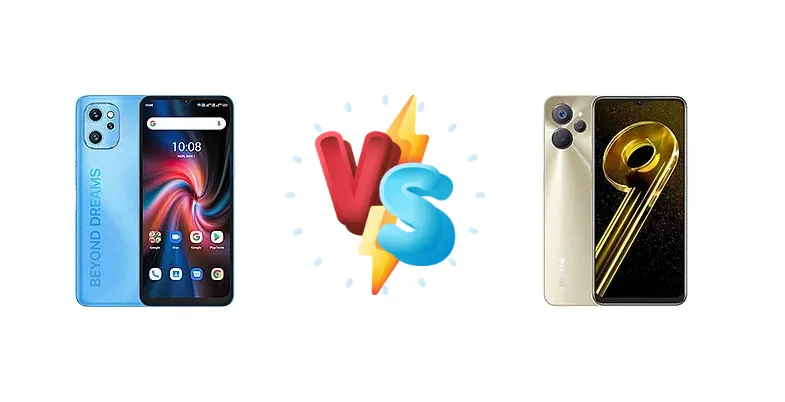
|
🏆 Quick Verdict
For the average user prioritizing responsiveness and future-proofing, the Realme 9i 5G is the clear winner. Its Mediatek Dimensity 810 chipset, built on a more efficient 6nm process, provides a substantial performance advantage over the Umidigi F3S’s Unisoc T610, making it better suited for multitasking and demanding applications. While the F3S offers a lower entry price, the 9i 5G’s faster charging and superior processing power justify the price difference.
| PHONES | ||
|---|---|---|
| Phone Names | Umidigi F3S | Realme 9i 5G |
| Network | ||
|---|---|---|
| 2G bands | GSM 850 / 900 / 1800 / 1900 | GSM 850 / 900 / 1800 / 1900 |
| 3G bands | HSDPA 800 / 850 / 900 / 1700(AWS) / 1900 / 2100 | HSDPA 850 / 900 / 1700(AWS) / 1900 / 2100 |
| 4G bands | 1, 2, 3, 4, 5, 7, 8, 12, 13, 17, 18, 19, 20, 25, 26, 28, 34, 38, 39, 40, 41, 66 | 1, 2, 3, 4, 5, 7, 8, 19, 20, 28, 34, 38, 39, 40, 41 |
| 5G bands | - | 1, 5, 7, 8, 28, 41, 77, 78 SA/NSA |
| Speed | HSPA, LTE | HSPA, LTE, 5G |
| Technology | GSM / HSPA / LTE | GSM / HSPA / LTE / 5G |
| Launch | ||
|---|---|---|
| Announced | 2022 | 2022, August 18 |
| Status | Available. Released 2022 | Available. Released 2022, August 24 |
| Body | ||
|---|---|---|
| Dimensions | 168.3 x 76.6 x 8.8 mm (6.63 x 3.02 x 0.35 in) | 164.4 x 75.1 x 8.1 mm (6.47 x 2.96 x 0.32 in) |
| SIM | Nano-SIM + Nano-SIM | Nano-SIM + Nano-SIM |
| Weight | 195 g (6.88 oz) | 187 g (6.60 oz) |
| Display | ||
|---|---|---|
| Protection | - | Panda Glass |
| Resolution | 720 x 1650 pixels (~269 ppi density) | 1080 x 2408 pixels, 20:9 ratio (~400 ppi density) |
| Size | 6.7 inches, 106.2 cm2 (~82.3% screen-to-body ratio) | 6.6 inches, 104.9 cm2 (~85.0% screen-to-body ratio) |
| Type | IPS LCD | IPS LCD, 90Hz, 400 nits (typ) |
| Platform | ||
|---|---|---|
| CPU | Octa-core (2x1.8 GHz Cortex-A75 & 6x1.8 GHz Cortex-A55) | Octa-core (2x2.4 GHz Cortex-A76 & 6x2.0 GHz Cortex-A55) |
| Chipset | Unisoc T610 (12 nm) | Mediatek Dimensity 810 (6 nm) |
| GPU | Mali-G52 MP2 | Mali-G57 MC2 |
| OS | Android 11 | Android 12, upgradable to Android 13, Realme UI 4.0 |
| Memory | ||
|---|---|---|
| Card slot | microSDXC (uses shared SIM slot) | microSDXC (dedicated slot) |
| Internal | 128GB 6GB RAM | 64GB 4GB RAM, 128GB 4GB RAM, 128GB 6GB RAM |
| - | UFS 2.2 | |
| Main Camera | ||
|---|---|---|
| Features | Dual-LED flash, HDR, panorama | LED flash, HDR, panorama |
| Single | - | 8 MP, f/2.0, 27mm (wide) |
| Triple | 48 MP, f/1.8, (wide), 1/2.0", AF 8 MP, f/2.2, 120˚ (ultrawide) 5 MP (macro) | 50 MP, f/1.8, 26mm (wide), 1/2.76", 0.64µm, PDAF Unspecified MP, 46mm (telephoto) 2 MP (macro) |
| Video | 1080p@30fps | 1080p@30fps |
| Selfie camera | ||
|---|---|---|
| Features | - | HDR, panorama |
| Single | 16 MP, f/2.2, (wide) | 8 MP, f/2.0, 27mm (wide) |
| Video | 1080p@30fps | 1080p@30fps |
| Sound | ||
|---|---|---|
| 3.5mm jack | - | Yes |
| 35mm jack | Yes | Yes |
| Loudspeaker | Yes | Yes |
| Comms | ||
|---|---|---|
| Bluetooth | 5.0, A2DP, LE | 5.2, A2DP, LE |
| NFC | Yes | No |
| Positioning | GPS, GALILEO, GLONASS, BDS | GPS, GLONASS, GALILEO, BDS |
| Radio | Wireless FM radio | No |
| USB | USB Type-C, OTG | USB Type-C 2.0, OTG |
| WLAN | Wi-Fi 802.11 b/g/n/ac, dual-band, Wi-Fi Direct | Wi-Fi 802.11 a/b/g/n/ac, dual-band |
| Features | ||
|---|---|---|
| Sensors | Fingerprint (side-mounted), accelerometer, proximity, compass | Fingerprint (side-mounted), accelerometer, proximity, compass |
| Battery | ||
|---|---|---|
| Charging | 10W wired | 18W wired |
| Type | 5150 mAh | 5000 mAh |
| Misc | ||
|---|---|---|
| Colors | Hawaii Blue, Matte Silver, Starry Black, Sunglow Gold, Galaxy Blue | Soulful Blue, Rocking Black, Gold |
| Models | - | RMX3612 |
| Price | - | About 180 EUR |
Umidigi F3S
- Lower price point makes it accessible to budget-conscious buyers.
- Functional for basic smartphone tasks.
- Acceptable performance for light usage.
- Significantly slower performance compared to the Realme 9i 5G.
- Slow 10W charging.
- Less future-proof due to the older chipset.
Realme 9i 5G
- Faster and more efficient Mediatek Dimensity 810 chipset.
- Faster 18W wired charging.
- Better performance for gaming and multitasking.
- Slightly higher price point.
- May still lack advanced features found in higher-end phones.
- Camera performance, while better, is still limited by the budget sensor.
Display Comparison
Neither device boasts a standout display. While specific panel details (like peak brightness or color gamut coverage) are unavailable, the core difference lies in the processing power driving the display. The Realme 9i 5G’s Dimensity 810 will likely handle display rendering more efficiently, resulting in smoother animations and transitions. Bezels are expected to be comparable given the price point, and both likely utilize IPS LCD panels, meaning viewing angles and color accuracy won't be exceptional.
Camera Comparison
Without detailed camera specs, a direct comparison is difficult. However, given the price bracket, both phones likely feature a primary sensor paired with basic auxiliary lenses. The Realme 9i 5G’s more powerful ISP (Image Signal Processor) within the Dimensity 810 chipset will likely result in better image processing, particularly in low-light conditions. Expect improved noise reduction and dynamic range. The Umidigi F3S will likely struggle with complex scenes and low-light photography.
Performance
The performance gap is the most significant differentiator. The Realme 9i 5G’s Mediatek Dimensity 810 (6nm) is a substantial upgrade over the Umidigi F3S’s Unisoc T610 (12nm). The 6nm process node translates to improved power efficiency and reduced heat generation, allowing the Dimensity 810 to sustain higher clock speeds for longer periods. The CPU architecture also favors the Realme: Cortex-A76 cores (2x2.4 GHz) in the 9i 5G are significantly more powerful than the Cortex-A75 cores (2x1.8 GHz) in the F3S. This difference will be noticeable in app launch times, multitasking, and gaming performance. The 9i 5G is better equipped for demanding games and applications.
Battery Life
While battery capacity isn't specified, the Realme 9i 5G’s 18W wired charging is a clear advantage over the Umidigi F3S’s 10W charging. This translates to significantly faster charging times, reducing downtime. Even with a similar battery capacity, the 9i 5G will spend less time tethered to a charger. The Dimensity 810’s 6nm efficiency also contributes to better battery life during usage, offsetting any potential capacity differences.
Buying Guide
Buy the Umidigi F3S if you need a functional smartphone for basic tasks like calls, texts, and light social media browsing, and your budget is extremely limited. You're willing to accept slower performance and longer charging times. Buy the Realme 9i 5G if you prioritize a smoother user experience, faster app loading times, and the ability to handle more demanding applications, and you want a phone that will remain usable for longer. The 9i 5G is the better choice for gamers and those who frequently multitask.