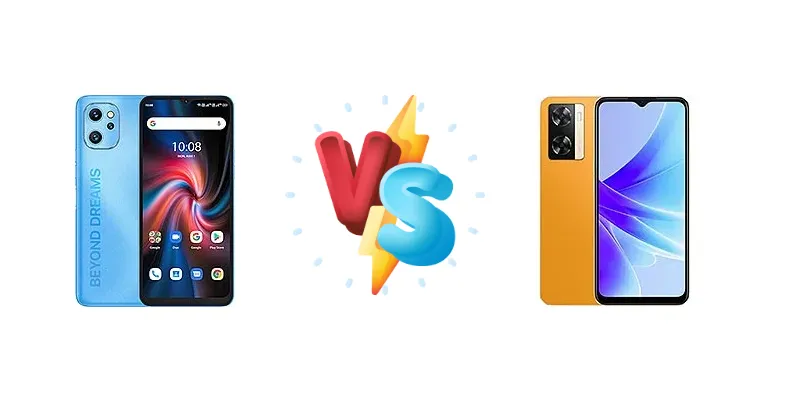
The sub-$200 smartphone market is fiercely competitive. The Umidigi F3S, powered by a Unisoc T610, aims to deliver value through affordability. However, the Oppo A77s, featuring Qualcomm’s Snapdragon 680, enters the fray with a more established brand reputation and a focus on faster charging. This comparison will dissect the core differences between these two devices to determine which offers the best experience for budget-conscious consumers.
🏆 Quick Verdict
For the average user prioritizing consistent performance and significantly faster charging, the Oppo A77s is the better choice. While the Umidigi F3S offers a compelling price point, the Snapdragon 680’s superior efficiency and 33W charging outweigh the F3S’s cost savings.
| Network |
|---|
| 2G bands | GSM 850 / 900 / 1800 / 1900 | GSM 850 / 900 / 1800 / 1900 |
| 3G bands | HSDPA 800 / 850 / 900 / 1700(AWS) / 1900 / 2100 | HSDPA 850 / 900 / 2100 |
| 4G bands | 1, 2, 3, 4, 5, 7, 8, 12, 13, 17, 18, 19, 20, 25, 26, 28, 34, 38, 39, 40, 41, 66 | 1, 3, 5, 7, 8, 28, 38, 40, 41 |
| Speed | HSPA, LTE | HSPA, LTE |
| Technology | GSM / HSPA / LTE | GSM / HSPA / LTE |
| Launch |
|---|
| Announced | 2022 | 2022, October 05 |
| Status | Available. Released 2022 | Available. Released 2022, October 07 |
| Body |
|---|
| Build | - | Glass front, plastic frame, plastic back or eco leather back |
| Dimensions | 168.3 x 76.6 x 8.8 mm (6.63 x 3.02 x 0.35 in) | 163.8 x 75 x 8 mm (6.45 x 2.95 x 0.31 in) |
| SIM | Nano-SIM + Nano-SIM | Nano-SIM + Nano-SIM |
| Weight | 195 g (6.88 oz) | 187 g / 190 g (6.60 oz) |
| | - | IP54, dust and water resistant |
| Display |
|---|
| Resolution | 720 x 1650 pixels (~269 ppi density) | 720 x 1612 pixels, 20:9 ratio (~269 ppi density) |
| Size | 6.7 inches, 106.2 cm2 (~82.3% screen-to-body ratio) | 6.56 inches, 103.4 cm2 (~84.2% screen-to-body ratio) |
| Type | IPS LCD | IPS LCD, 90Hz, 480 nits (typ), 600 nits (HBM) |
| Platform |
|---|
| CPU | Octa-core (2x1.8 GHz Cortex-A75 & 6x1.8 GHz Cortex-A55) | Octa-core (4x2.4 GHz Kryo 265 Gold & 4x1.9 GHz Kryo 265 Silver) |
| Chipset | Unisoc T610 (12 nm) | Qualcomm SM6225 Snapdragon 680 4G (6 nm) |
| GPU | Mali-G52 MP2 | Adreno 610 |
| OS | Android 11 | Android 12, upgradable to Android 14, ColorOS 14 |
| Memory |
|---|
| Card slot | microSDXC (uses shared SIM slot) | microSDXC |
| Internal | 128GB 6GB RAM | 128GB 8GB RAM |
| | - | UFS 2.2 |
| Main Camera |
|---|
| Dual | - | 50 MP, f/1.8, 27mm (wide), PDAF
Auxiliary lens |
| Features | Dual-LED flash, HDR, panorama | LED flash, HDR, panorama |
| Single | - | 8 MP, f/2.0, 26mm (wide) |
| Triple | 48 MP, f/1.8, (wide), 1/2.0", AF
8 MP, f/2.2, 120˚ (ultrawide)
5 MP (macro) | - |
| Video | 1080p@30fps | 1080p@30fps |
| Selfie camera |
|---|
| Features | - | Panorama |
| Single | 16 MP, f/2.2, (wide) | 8 MP, f/2.0, 26mm (wide) |
| Video | 1080p@30fps | 1080p@30fps |
| Sound |
|---|
| 3.5mm jack | - | Yes |
| 35mm jack | Yes | Yes |
| Loudspeaker | Yes | Yes, with stereo speakers |
| Comms |
|---|
| Bluetooth | 5.0, A2DP, LE | 5.0, A2DP, LE, aptX HD |
| NFC | Yes | Yes |
| Positioning | GPS, GALILEO, GLONASS, BDS | GPS, GLONASS, BDS, GALILEO, QZSS |
| Radio | Wireless FM radio | FM radio |
| USB | USB Type-C, OTG | USB Type-C 2.0, OTG |
| WLAN | Wi-Fi 802.11 b/g/n/ac, dual-band, Wi-Fi Direct | Wi-Fi 802.11 a/b/g/n/ac, dual-band, Wi-Fi Direct |
| Features |
|---|
| Sensors | Fingerprint (side-mounted), accelerometer, proximity, compass | Fingerprint (side-mounted), accelerometer, proximity, compass |
| Battery |
|---|
| Charging | 10W wired | 33W wired, 100% in 69 min |
| Type | 5150 mAh | Li-Po 5000 mAh |
| Misc |
|---|
| Colors | Hawaii Blue, Matte Silver, Starry Black, Sunglow Gold, Galaxy Blue | Sunset Orange, Starry Black |
| Models | - | CPH2473 |
| Price | - | About 220 EUR |
Umidigi F3S
- Lower price point makes it accessible to budget-conscious buyers.
- Functional for basic smartphone tasks.
- Unisoc T610 is adequate for light usage.
- Significantly slower charging speed (10W).
- Less powerful chipset compared to the Snapdragon 680.
- Likely inferior camera performance.
Oppo A77s
- Faster and more efficient Snapdragon 680 chipset.
- Significantly faster 33W charging.
- Better overall performance for multitasking and gaming.
- Higher price compared to the Umidigi F3S.
- May still lack features found in higher-end smartphones.
- Brand recognition may not be as strong as some competitors.
Display Comparison
Neither device boasts a standout display. Given the lack of display specifications in the provided data, we can infer both likely utilize LCD panels common in this price bracket. The focus here will be on performance, not visual fidelity. Bezels are likely comparable, and color accuracy will be standard for budget phones. The absence of high refresh rates or advanced panel technologies like LTPO suggests neither phone is geared towards media consumption.
Camera Comparison
Without detailed camera specifications, a direct comparison is difficult. However, the chipset difference indirectly impacts camera performance. The Snapdragon 680’s image signal processor (ISP) is more advanced, enabling better noise reduction, dynamic range, and overall image quality. While both phones likely feature a multi-camera setup, the Oppo A77s will likely deliver more consistent and detailed photos, particularly in challenging lighting conditions. We anticipate both phones will include lower-resolution auxiliary cameras (e.g., 2MP macro) that offer limited practical benefit.
Performance
The core difference lies in the chipsets. The Oppo A77s’ Snapdragon 680 (6nm) is built on a smaller fabrication process than the Umidigi F3S’s Unisoc T610 (12nm). This 6nm process translates to significantly improved power efficiency and thermal performance. While both are octa-core CPUs, the Snapdragon 680’s Kryo 265 Gold cores, clocked at 2.4 GHz, offer a substantial performance advantage over the Unisoc T610’s Cortex-A75 cores at 1.8 GHz. This means faster app loading times, smoother multitasking, and a more responsive user interface on the Oppo A77s. The Snapdragon 680’s Adreno GPU will also provide a better gaming experience, even if limited to lighter titles.
Battery Life
The Oppo A77s’ 33W wired charging is a game-changer in this segment. A full charge in 69 minutes is significantly faster than the Umidigi F3S’s 10W charging, which will likely take several hours. While battery capacity isn’t specified, the Snapdragon 680’s superior power efficiency means the Oppo A77s will likely offer comparable or even better real-world battery life despite potentially having a smaller battery. The convenience of rapid charging is a major advantage for users who rely heavily on their smartphones throughout the day.
Buying Guide
Buy the Umidigi F3S if you need a functional smartphone for basic tasks like calls, messaging, and light social media, and are willing to accept slower performance and charging speeds to minimize upfront cost. Buy the Oppo A77s if you prefer a smoother, more responsive experience, especially when multitasking or playing casual games, and value the convenience of rapid 33W charging for minimizing downtime.
Frequently Asked Questions
❓ Will the Snapdragon 680 in the Oppo A77s handle popular apps like TikTok and Instagram smoothly?
Yes, the Snapdragon 680 is more than capable of handling social media apps like TikTok and Instagram without significant lag. Its higher clock speeds and improved architecture provide a smoother experience compared to the Unisoc T610, especially when multitasking between apps.
❓ How much of a difference will the 33W charging make in daily use with the Oppo A77s?
The 33W charging on the Oppo A77s is a substantial improvement. Going from 0% to 100% in approximately 69 minutes means you can quickly top up your battery during short breaks, minimizing downtime. The Umidigi F3S’s 10W charging will require significantly longer, potentially overnight, for a full charge.
❓ Is the Unisoc T610 in the Umidigi F3S sufficient for playing mobile games?
The Unisoc T610 can handle some mobile games, but it will likely struggle with graphically demanding titles. Expect lower frame rates and potentially noticeable lag, even on medium settings. The Oppo A77s’ Snapdragon 680 will provide a better gaming experience, though still limited to casual or less intensive games.
❓ Does the Oppo A77s support software updates and security patches?
Oppo generally provides regular software updates and security patches for its devices, though the longevity of support can vary. While not guaranteed to receive the same level of long-term support as flagship models, the A77s is likely to receive updates for at least a year or two after its release.